My Crittercam
My Crittercam › American bison

Wood bison herd found after being written off

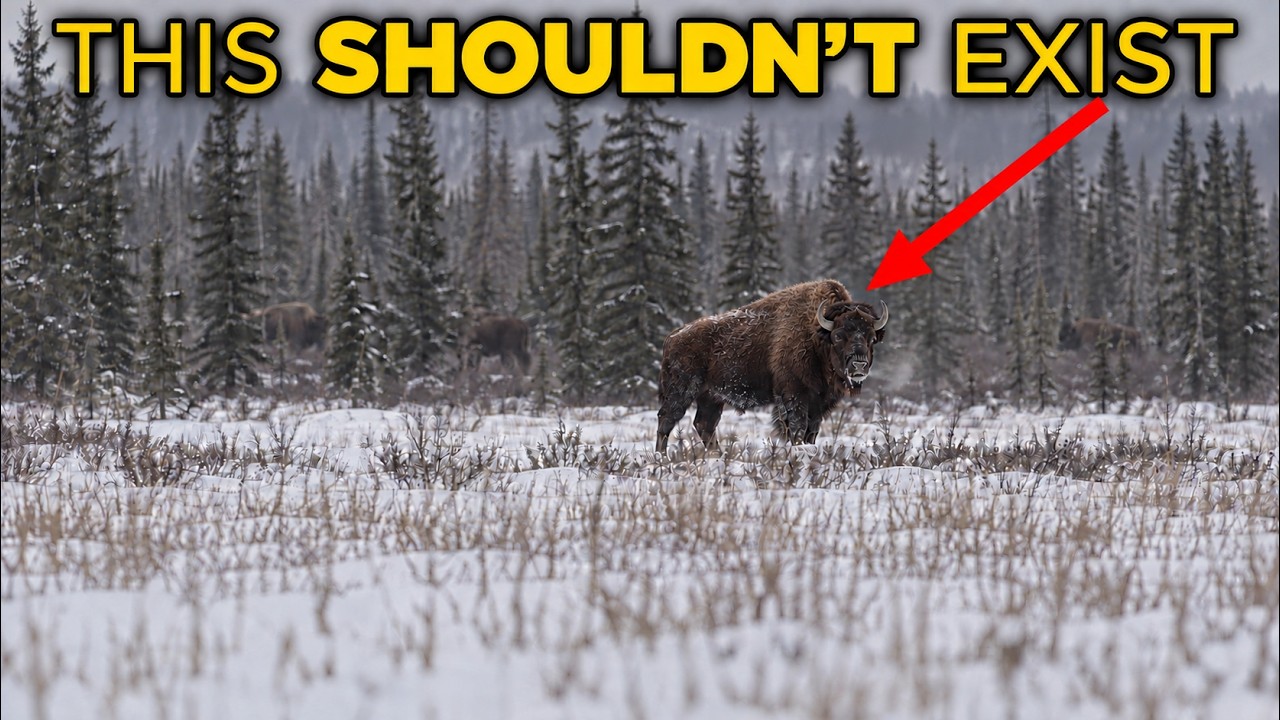
A shaggy brown bison with curved horns stands in snow among dry shrubs at a conifer forest edge, facing the camera, under cut-off large yellow text and a red arrow pointing at its head.

Footage: The Frozen Record · 12:10 · uploaded October 11, 2026
Written by My Crittercam · published November 6, 2026

The Story

A patrol plane crosses the far northwest corner of Wood Buffalo National Park in 1957, and along the Nyarling River below stand about two hundred bison. Scientists had already written off the wood bison, the bigger bison of the northern forest, as gone in its pure form.

The park, straddling Alberta and the Northwest Territories, was created in 1922 to save them. Three years later Ottawa began shipping 6,673 plains bison north from Wainwright, over biologists' protests. The two kinds bred, and cattle diseases spread.

They are two subspecies of one species. Wood bison average about 15 percent heavier, with a taller hump peaking forward of the front legs and woolly hair along the ribs. With no test that could read ancestry, biologists Nicolas Novakowski and A. W. F. Banfield measured Nyarling bison against museum specimens from before 1925.

The measurements overlapped. The herd was declared pure, guarded by country nothing else could cross, and the rescue began. In 1963 eighteen tested animals were trucked north across the Mackenzie River; in 1965 about two dozen more went to Elk Island National Park. Nearly every herd that brought the wood bison back, as far as Alaska and Russia, descends from those few dozen.

Then the two words holding it up, pure and isolated, began to slip. A 1986 skull study suggested about five percent of the herd's genes came from Wainwright. In 1989 Jack Van Camp argued nothing showed the herd had ever been cut off. In August 2026 a study in Science read 160 bison genomes and settled half the quarrel: wood and plains bison are genetically distinct, yet every living wood bison herd carries seven to sixty-four percent plains ancestry from the 1920s shipments.

The animals kept going regardless. In 2015, 130 wood bison were released along the Innoko River in Southwest Alaska, and Canada's wildlife assessment committee, COSEWIC, rates them Special Concern. What nearly pure is worth is still debated, a question the bison have never once raised.
Field Guide

A 1957 patrol flight finds about two hundred bison along the Nyarling River, the herd later measured as pure wood bison and used to seed nearly every recovered herd. Full field guide for the American bison

Common nameAmerican bison
Scientific nameBison bison
FamilyBovidae (cattle, bison, antelope and goats)
SizeMature bulls can reach 5.5 to 6.5 ft (1.9 m) at the hump and 9 to 12.5 ft (2.7 to 3.8 m) long; cows are normally 5 ft (1.5 m) high and 7 to 10 ft (2.2 to 3.2 m) long.Smithsonian's National Zoo and Conservation Biology Institute
WeightBulls up to 2,000 pounds; cows up to 1,000 pounds (Yellowstone).National Park Service (Yellowstone National Park)
RangeOnce Alaska to northern Mexico; now found on private and protected lands in areas of the western United States and Canada.Animal Diversity Web, University of Michigan
Conservation statusIUCN Red List: Near Threatened; NatureServe Global Rank G4. COSEWIC (Canada): Plains Bison Threatened, Wood Bison Special Concern.NatureServe Explorer
DietYellowstone bison: more than 90% grasses, sedges and other grass-like plants; forbs and browse usually under 5%.National Park Service (Yellowstone National Park)
Active whenPrimarily diurnal, especially early morning and late afternoon, with grazing periods between loafing and ruminating.NatureServe Explorer
Lifespan15 to 20 years in the wild; up to 40 years recorded in captivity.Animal Diversity Web, University of Michigan
Cam notes · Time of dayday
Cam notes · Seasonwinter, snow on the ground
Cam notes · PlaceWood Buffalo National Park, on the border of Alberta and the Northwest Territories

Habitat

Behavior

Questions

What is the difference between wood bison and plains bison?

They are two subspecies of the same species. Wood bison average about 15% heavier, with a taller, more forward hump and woolly hair along the ribs.Smithsonian's National Zoo and Conservation Biology Institute · Alaska Department of Fish and Game

Are wood bison the same bison that once roamed farther south?

Wood bison once ranged across northwestern Canada and much of Interior and Southcentral Alaska. The species as a whole once ranged from Alaska to northern Mexico.Alaska Department of Fish and Game · Animal Diversity Web, University of Michigan

Are wood bison still at risk?

In Canada, COSEWIC lists wood bison as Special Concern and plains bison as Threatened. The IUCN Red List rates the American bison as Near Threatened.NatureServe Explorer

Latest clips