The Story
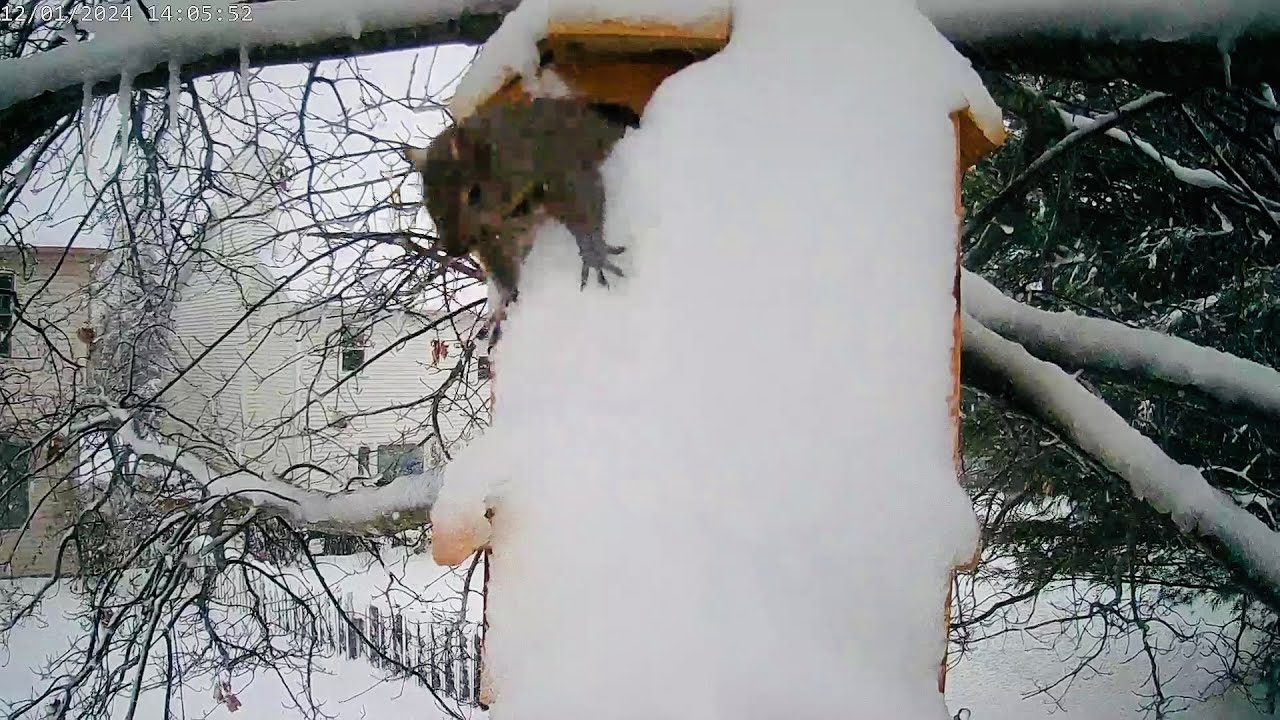
Snow has caked the nest box so thickly it looks cut from a drift, and inside, two eastern gray squirrels are riding out a severe Midwest snowstorm in one bed.
A camera inside the box shows the pair curled up together. Then the calm breaks into a tussle, the two grappling in close quarters, and what sets it off is anyone's guess. When it ends, one squirrel is ready to leave. The other seems in no hurry to let it. Outside, a gray squirrel clings head-down at the top of the snow-heaped box by daylight.
Sharing is in character. Gray squirrels are more social than fox squirrels and red squirrels, and several may share one shelter nest. Their preferred homes, especially in winter, are tree cavities, and large ones are commonly filled with leaves in fall and again in spring, insulation against the winter cold. A nest box answers the same need.
The other option is a drey, a nest of leaves and twigs set in a tree crotch 30 to 45 feet up. Winter-built ones, bare twigs with leaves interlaced, are usually very substantial. Even so, a drey sits out in the weather.
The squirrel that leaves is breaking no rule. Sciurus carolinensis stays active all year and can feed through rain or snowstorms, arching its broad tail over its back to keep dry and warm. Winter does narrow the day: Animal Diversity Web puts the single winter activity peak 2 to 4 hours before sunset, while Mass Audubon says gray squirrels come out only at midday.
Out there, the pantry is scattered. Gray squirrels scatter-hoard, burying nuts in many separate caches to eat in winter, and find them again by memory and by smell; in one experiment they remembered up to 24 cache locations for up to two months. The fall that came before matters too. In Ohio, winter survival and spring breeding are closely tied to the previous fall's mast crop.