The Story
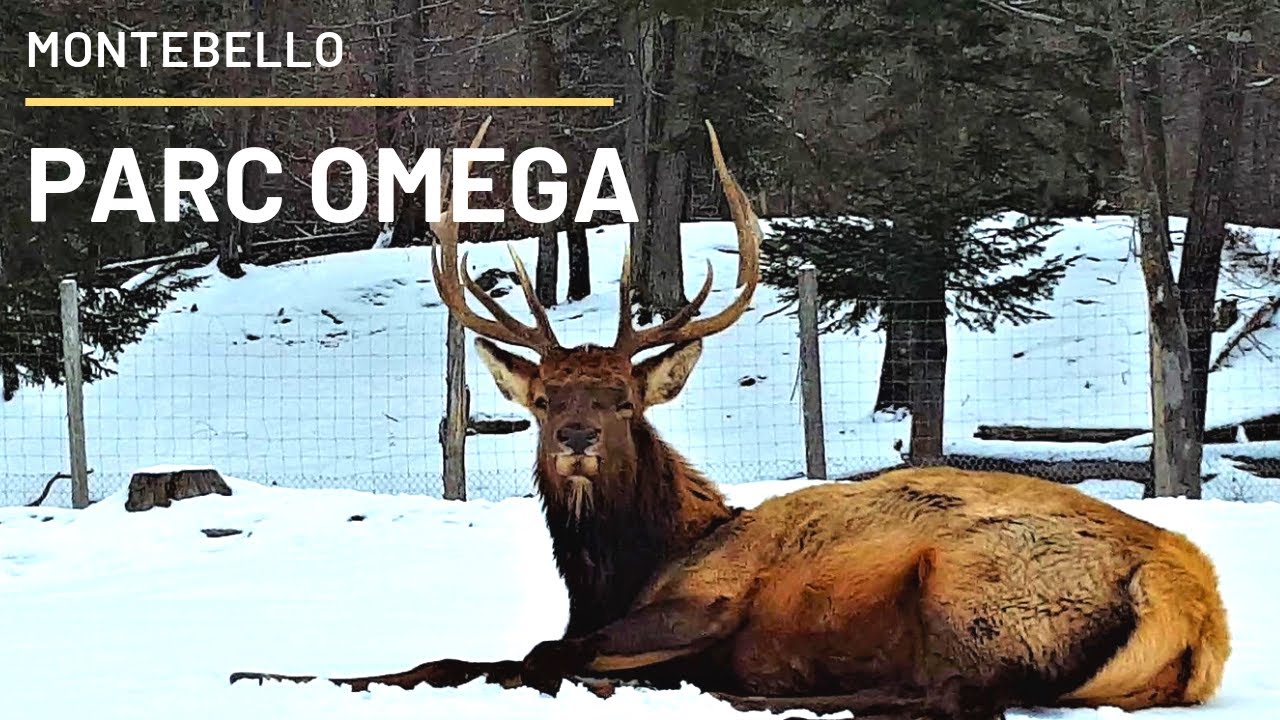
The bull elk does not bother to stand. He lies folded in the snow at Parc Omega, a fenced drive-through wildlife park in Montebello, Quebec, and stares back at the lens over a tall rack of antlers.
This is a captive animal, living behind wire in a park that visitors tour from their own vehicles. Deer-family animals walk up to the car, some of them antlered, and stand at the roadside or square in the middle of it; a crowd of wild boar feeds on something on the ground, a pack of wolves gathers, and a bison comes right to the window. This bull stays down in the snow, head up, and watches the car instead.
The field marks name him. A dark brown mane hangs shaggy from neck to chest, as it does on both sexes in winter, though it runs longer on bulls than on cows. His head and legs are darker than the body, which wears the light brown of an elk's winter coat. That coat is built of hollow hairs that trap air for insulation. The antlers climb in long curved beams set with tines; a mature bull's generally carry five off the main branch, six points in all. His are still on. The largest bulls begin dropping theirs in late February, younger ones as late as April or early May.
Lying down by day is ordinary elk behavior. They feed in the early morning and late evening, then rest and chew cud through the day and the middle of the night. In winter wild elk browse shrubs, aspen bark and conifers and can plow through deep snow, and many herds move down from high summer range to lower ground, though some populations stay put. Their wild range is western North America, from the Rocky Mountains to the Pacific coast and western Canada, with reintroduced herds in the East such as Great Smoky Mountains National Park. This bull sees the season out in Quebec, inside a fence.