My Crittercam
My Crittercam › American black bear

Wilford the black bear digs a bed, then naps

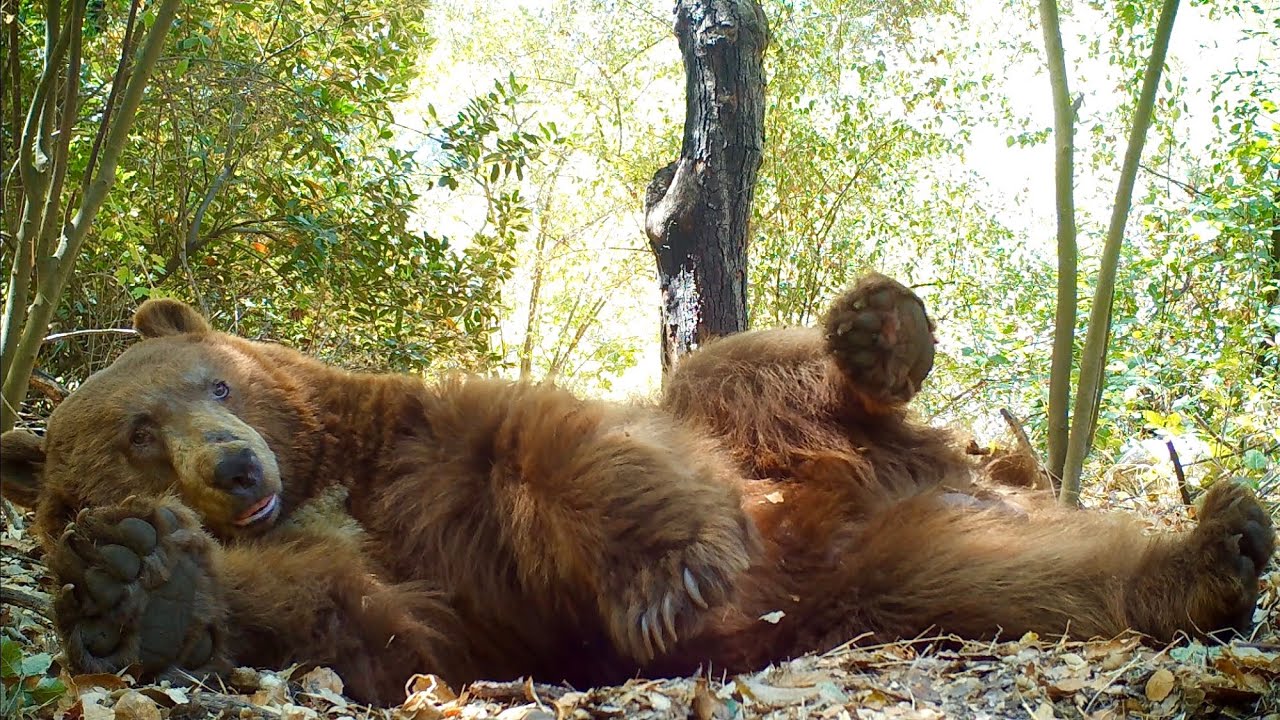
A cinnamon-brown black bear lies on his side in dry leaves close to the camera, pale muzzle resting near one raised front paw that shows its dark pads, with green shrubs and sunlit foliage behind him.

Footage: Parliament Of Owls · 15:45 · uploaded July 11, 2022
Written by My Crittercam · published November 6, 2026

The Story

Wilford is digging a bed, and he has picked a spot right in front of the camera. On the morning of July 6, 2022, in the Angeles National Forest, this cinnamon-brown American black bear is about to lie down for a long time.

The result is not much to look at, which is normal. Black bears bed in forest, usually in a simple shallow depression in the leaf litter, and Wilford's bed is exactly that: a bear-sized hollow in dry leaves. He settles into it, rolls onto his back and stays.

He stays four hours. A front paw hangs in the air with no job to do. A hind leg goes up against a slim trunk. There are yawns and long stretches, and at one point the whole animal rolls to one side and settles again, an arm's length from the lens by the look of it, with the soles of his feet on full display. Few subjects have ever been this easy to photograph.

All that time at ground level makes a fine study in field marks. The muzzle is pale against the darker body, the usual pattern for this species. The ears stand tall and rounded, the face lacks a grizzly's concave profile, and no heavy hump rises behind the neck. A healed scar marks the bridge of his nose. The coat proves nothing either way, because black bears come in black, cinnamon, blonde, blue-gray and even white, and western populations are more often brown, cinnamon or blonde.

None of this was pure luck. The filmer expected him at this spot. A year earlier the same filmer found one of Wilford's beds the day after he had used it, and began hoping to catch him bedding down on camera.

That first bed was empty. This one has its owner in it, and he is in no hurry to leave.
Field Guide

Wilford digs himself a bed in the Angeles National Forest on a July morning and naps in it for four hours. Full field guide for the American black bear

Common nameAmerican black bear
Scientific nameUrsus americanus
FamilyUrsidae (bears)
SizeAbout 3 ft at the shoulder; 5-7 ft standing upright. Total length 1400-2000 mm (males), 1200-1600 mm (females).National Park Service · Animal Diversity Web, University of Michigan
Weight100 to 600 pounds depending on age, sex, and season; males 47-409 kg, females 39-236 kg.National Park Service · Animal Diversity Web, University of Michigan
DietOmnivore: grasses and forbs in spring, fruits in summer, nuts and acorns in fall, plus insects and carrion.Animal Diversity Web, University of Michigan · National Park Service
Active whenGenerally crepuscular (dawn and dusk); breeding and feeding can shift this seasonally.Animal Diversity Web, University of Michigan
RangeNorthern Alaska east across Canada to Labrador and Newfoundland, and south through most of the U.S. into central Mexico.Animal Diversity Web, University of Michigan
LifespanCan live to 30 years in the wild but most often about 10; NPS gives an average of 15-25 years.Animal Diversity Web, University of Michigan · National Park Service
Conservation statusNatureServe: G5 (Globally Secure), reviewed 2016-04-05. IUCN Red List page could not be fetched.NatureServe Explorer
Cam notes · Cameracamera set at a spot the bear was expected to visit
Cam notes · Time of daymorning
Cam notes · SeasonJuly 6, 2022, summer
Cam notes · PlaceAngeles National Forest

Habitat

Behavior

Questions

Why is this black bear brown?

Colour is not a reliable mark: black bears can be black, cinnamon, blonde, blue/gray or even white, and western populations are usually lighter, more often brown, cinnamon or blonde. What separates them from grizzlies is longer ears, smaller shoulder humps and a convex rather than concave face profile.National Park Service · Animal Diversity Web, University of Michigan

How big is a black bear?

About 3 feet at the shoulder and 5-7 feet standing upright. Weight runs from 100 to 600 pounds depending on age, sex and season.National Park Service

Are black bears dangerous to people?

They are by nature wary of people and not normally aggressive, but are large, powerful and surprisingly fast-moving. Bear attacks are rare; most bears are only interested in protecting food, cubs or their space.Minnesota Department of Natural Resources · National Park Service

Latest clips