The Story
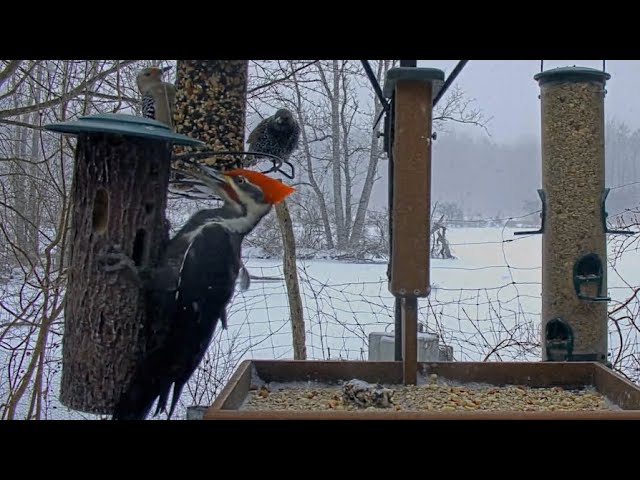
Bark butter, then more bark butter: a male pileated woodpecker has braced himself against a log feeder in Ithaca, New York, and the snow is not moving him. Flurries sift past his red crest, and he stays put.
This is the feeding garden of the Cornell Lab of Ornithology, on the edge of Sapsucker Woods and its 10-acre pond, on the morning of January 6, 2025. The scale of him is the first thing to register. Two smaller birds perch just above his head and look like a different size class altogether. A pileated runs 16 to 19 inches, about the size of a crow, and it is the largest woodpecker found in most of North America.
The marks are all on show: black body, white stripe down the neck, that flaming crest. A male wears red on the forehead and a red mustache. On a female both are black, and the red cap is slightly smaller.
The main course takes demolition. Carpenter ants may be up to 60% of a pileated's diet, and reaching them means excavating deep into rotten wood, prying off long slivers to expose the ant galleries, then drawing them out with a long tongue armed with barbs and sticky saliva. The big rectangular holes in dead trees are the evidence. Nothing here needs tearing open. The food is already out, and he hangs on and eats.
Nothing on this species' calendar sends him south. Pileateds are permanent residents, and the winter range is the same as the year-round range, though individuals sometimes wander far from breeding areas. Nights go by in a cavity, typically a hollow tree with multiple entrances.
The rest of the garden carries on around him. Northern Cardinals and Tufted Titmice take what else is on offer while he holds his post, and the flurries keep falling. This is a species that sometimes tears apart stumps and big sections of fallen logs. This morning he has found a log he can leave in one piece.