Pileated Woodpecker field guide
Field Guide
| Common name | Pileated Woodpecker |
|---|---|
| Scientific name | Dryocopus pileatus |
| Family | Picidae (Woodpeckers) |
| Size | Length: 16–19 in (40–49 cm); about the size of a crowNational Audubon Society |
| Weight | 8.8–12.3 oz (250–350 g)National Audubon Society |
| Wingspan | 2 ft 2 in–2 ft 5 in (66–75 cm)National Audubon Society |
| Lifespan | Average lifespan (wild): 155 months (Bird Banding Laboratory)Animal Diversity Web, University of Michigan |
| Diet | Mostly ants and other insects, as well as fruits and nuts; carpenter ants may be up to 60% of the dietNational Audubon Society |
| Active when | Sleeps or roosts in a cavity at night; drumming is most frequent in the morningAnimal Diversity Web, University of Michigan |
| Range | Year-round resident from northern British Columbia, across Canada to Nova Scotia, south through central California, Idaho, Montana, eastern Kansas, the Gulf Coast and FloridaWashington Department of Fish & Wildlife |
| Conservation status | IUCN Red List: Least Concern; protected by the U.S. Migratory Bird ActNational Audubon Society · Animal Diversity Web, University of Michigan |
Field Marks
- Very large, mostly black, with a red crest and a white neck stripe.National Audubon Society
- White under the wings flashes in flight.National Audubon Society
- Forehead and mustache red on male, black on female.National Audubon Society
- The female has the same markings as the male except for a slightly smaller red cap and no red moustache.Washington Department of Fish & Wildlife
- The largest woodpecker found in most of North America; only the possibly extirpated Ivory-billed and the Imperial Woodpecker are larger.Animal Diversity Web, University of Michigan
- Broad, rounded wings and a multi-pointed, wedge-shaped tail.National Audubon Society
Habitat
- Favors mature deciduous or mixed deciduous-coniferous forest, as well as coniferous forest, from southern swamps to the old-growth Douglas-fir forest of the northwest.National Audubon Society
- Also uses second-growth and fragmented woodlots, as long as some large trees are present.National Audubon Society
- Where unmolested, it even lives in parks and woodlots around the edges of large cities.National Audubon Society
- In some developing areas of Washington it is an urban and suburban resident, occupying remnant patches of forest, parks, and green-belts.Washington Department of Fish & Wildlife
- Prefers to nest in mesic areas, close to streams, in stands with the greatest basal area, stem density, and highest crown canopy.Animal Diversity Web, University of Michigan
- Uses large snags and large decaying live trees for nesting and roosting, features more abundant in older forests.Washington Department of Fish & Wildlife
Behavior
- Excavates deep into rotten wood to reach carpenter ant nests, leaving characteristic rectangular holes in dead trees.National Audubon Society
- Large rectangular/oval excavations in snags are indicative of pileated woodpecker foraging.Washington Department of Fish & Wildlife
- May gouge deep holes in rotten wood to get at ant nests, sometimes tearing apart stumps and big sections of fallen logs.National Audubon Society
- Pries off long slivers of wood to expose ant galleries, then uses a long, extensible, pointed tongue with barbs and sticky saliva to extract ants.Animal Diversity Web, University of Michigan
- Also eats other ants (rarely digging into anthills on the ground), termites, larvae of wood-boring beetles, and other insects; about one-quarter of the diet may be wild fruits, berries, and nuts.National Audubon Society
- May clamber about acrobatically in small branches to get at berries.National Audubon Society
- Call: a loud, flicker-like cuk-cuk-cuk-cuk-cuk, rising and then falling in pitch and volume.National Audubon Society
- Washington's wildlife agency renders the loud, high-pitched, repetitive call as wuka wuka wuka wuka wuka.Washington Department of Fish & Wildlife
- Drumming usually occurs atop a dead tree that resonates; most frequent in the morning, it increases in early spring as courtship begins and is used to proclaim a territory.Animal Diversity Web, University of Michigan
- Territory is defended with loud drumming and ringing calls.National Audubon Society
- Courtship displays include spreading wings to show the white wing patch, raising the crest, swinging the head back and forth, and a gliding display flight.National Audubon Society
- Nests in a cavity in a dead tree or dead branch of a live tree, sometimes a utility pole, usually 15-80 ft above ground; generally makes a new cavity each year, both sexes excavating.National Audubon Society
- Washington's wildlife agency gives the breeding and nesting period as late March to early July.Washington Department of Fish & Wildlife
- Lays 3-5 white eggs; both sexes incubate about 18 days, and young leave the nest 26-28 days after hatching, may remain with parents 2-3 months.National Audubon Society
- Studies within the Pacific Northwest indicate home range size may vary from 1000 acres to over 2000 acres.Washington Department of Fish & Wildlife
- Known predators include the northern goshawk, Cooper's hawk, red-tailed hawk, great horned owl, American marten, and gray fox.Washington Department of Fish & Wildlife
Winter
- A permanent resident, but individuals sometimes wander far from breeding areas.National Audubon Society
- The winter range is the same as the year-round range.Animal Diversity Web, University of Michigan
- Typically roosts in hollow trees with multiple entrances, and sleeps or roosts in a cavity at night.Animal Diversity Web, University of Michigan
- A large, non-migratory insectivore that may play an important role in controlling insect outbreaks, particularly those of tree beetles.Animal Diversity Web, University of Michigan
Questions
How big is a Pileated Woodpecker?
It is 16–19 in (40–49 cm) long with a wingspan of 2 ft 2 in–2 ft 5 in (66–75 cm). It is about the size of a crow and is the largest extant woodpecker in North America.National Audubon Society
How can I tell a male from a female?
The male has a red forehead and a red mustache. The female's forehead and mustache are black, and her red cap is slightly smaller.National Audubon Society · Washington Department of Fish & Wildlife
What does it eat?
Mostly ants and other insects, as well as fruits and nuts. Carpenter ants may be up to 60% of its diet.National Audubon Society
Why does it make rectangular holes in trees?
It excavates deep into rotten wood to get at the nests of carpenter ants. This leaves characteristic rectangular holes in dead trees.National Audubon Society
What does its call sound like?
A loud, flicker-like cuk-cuk-cuk-cuk-cuk that rises and then falls in pitch and volume. It also defends its territory with loud drumming and ringing calls.National Audubon Society
Does it migrate in winter?
No. It is a permanent resident, and its winter range is the same as its year-round range.National Audubon Society · Animal Diversity Web, University of Michigan
Where does it sleep?
It sleeps or roosts in a cavity at night. It typically roosts in hollow trees with multiple entrances.Animal Diversity Web, University of Michigan
Can it damage houses?
It hollows out nests 8 inches wide and 2 feet deep, and homeowners and utility companies are often concerned about damage. It is illegal to harm or remove the birds without a permit.Animal Diversity Web, University of Michigan
Why is it called a keystone species?
It creates nesting cavities used by other forest wildlife species. Washington's wildlife agency names Barrow's goldeneye and flammulated owl as examples.Washington Department of Fish & Wildlife
Is it endangered?
No; it is rated Least Concern on the IUCN Red List. Eastern U.S. numbers declined sharply in the 18th and 19th centuries, but it has made a gradual comeback since about 1900.National Audubon Society · Animal Diversity Web, University of Michigan
Clips
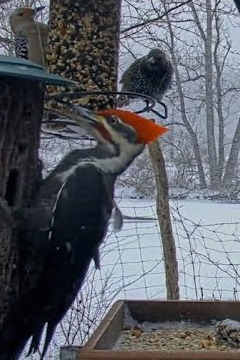 Pileated woodpecker clings to a log feeder in snow
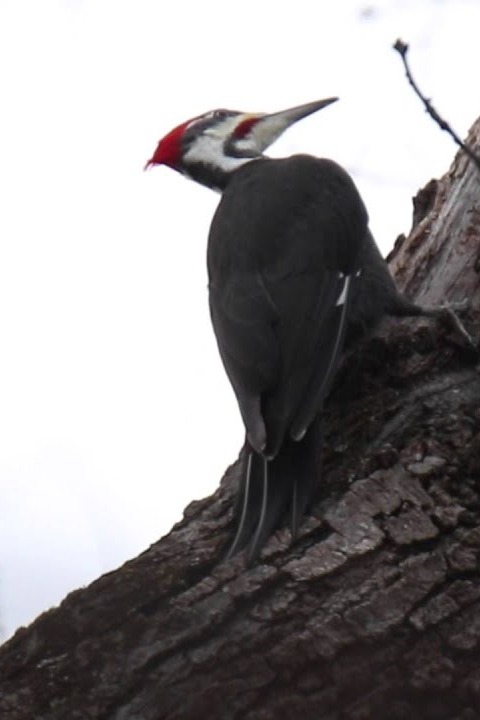 Christmas drumming from a pileated woodpecker
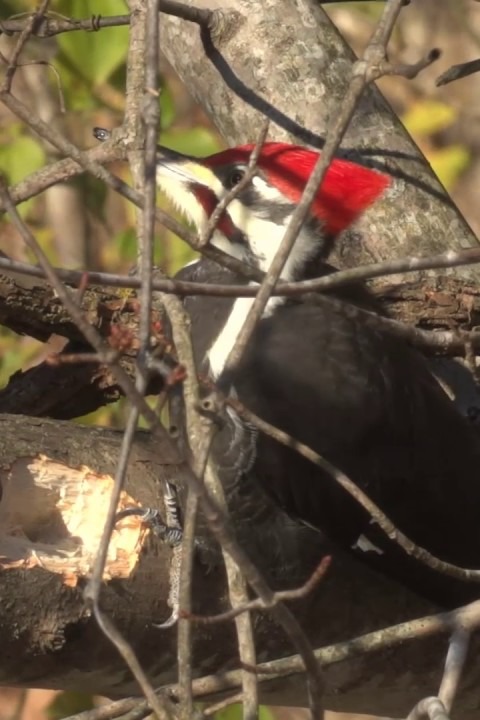 Pileated woodpecker calls beside a torn limb
On a snowy January morning in Ithaca, New York, a male settles in for a long visit at a bark butter feeder while flurries come down around him.
A male pileated woodpecker drums on a broken trunk on Christmas afternoon in Lincoln Woods, Rhode Island, pausing between bursts to look around.
A pileated woodpecker clings beside a freshly torn hole in a limb and lets go a high, clear run of piping notes several seconds long.
Sources
- Pileated Woodpecker | Audubon Field Guide, National Audubon Society
- Dryocopus pileatus (pileated woodpecker), Animal Diversity Web, University of Michigan
- Pileated woodpecker, Washington Department of Fish & Wildlife