The Story
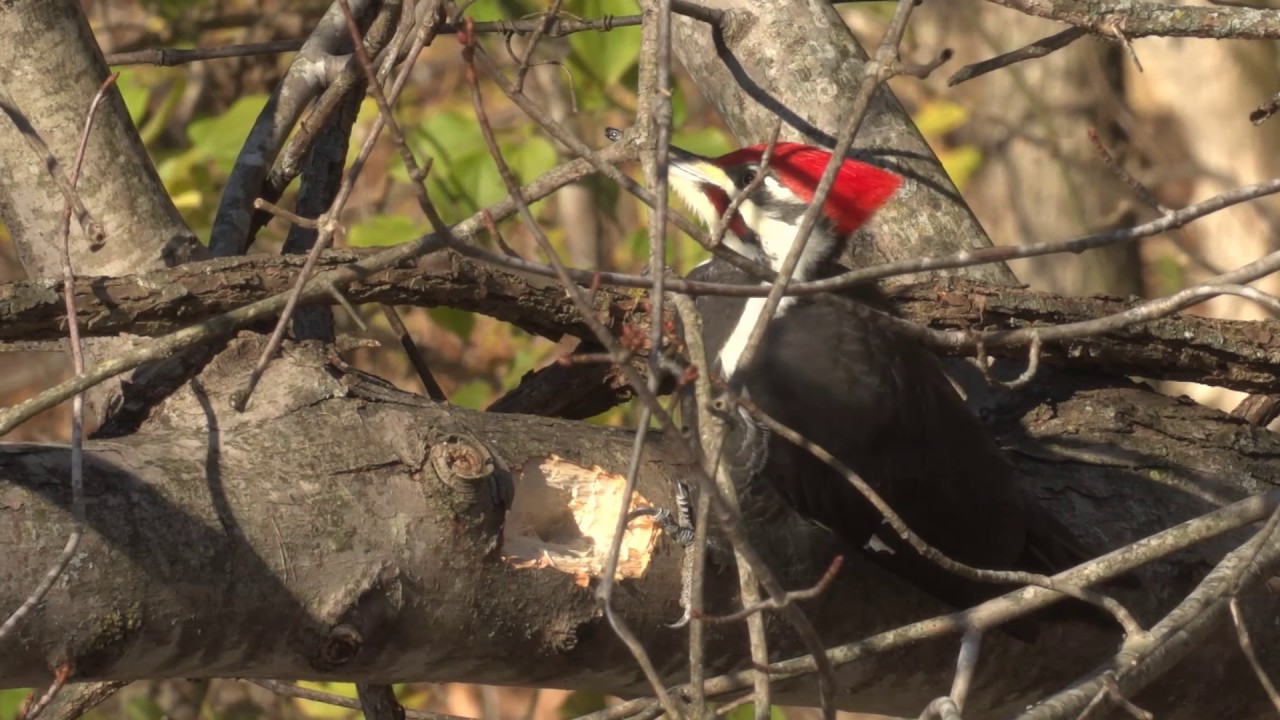
A pileated woodpecker clings to a thick limb behind a lattice of twigs, and just beside its feet the bark has been ripped open to pale, splintered wood. Then the bird calls: a high, clear run of piping notes that carries on for several seconds.
There is no mistaking the caller. The bird is very large and mostly black, with a flaming red crest and a white stripe running down the neck. This is the largest woodpecker found in most of North America, 16 to 19 inches long and about the size of a crow. Only the possibly extirpated ivory-billed and the imperial woodpecker are bigger.
Pileateds are vocal birds, and the call is the giveaway. Audubon writes it as a loud, flicker-like cuk-cuk-cuk-cuk-cuk, rising and then falling in pitch and volume. Washington's wildlife agency hears wuka wuka wuka. Plenty of people link the bird with a certain cartoon woodpecker, and once heard, the laugh is hard to separate from it. Calls have a job, too: a pileated defends its territory with loud drumming and ringing calls.
Ripping into wood is what the species is known for. A pileated excavates deep into rotten wood to reach carpenter ant nests, leaving characteristic rectangular holes in dead trees. It pries off long slivers to expose the ant galleries, then reaches in with a long, extensible, pointed tongue armed with barbs and sticky saliva. Carpenter ants may make up as much as 60 percent of the diet. Nobody else is sitting next to this hole, and the likeliest suspect is not saying.
It needs room to work. The bird favors mature forest but will use second-growth woodlots as long as some large trees remain, and where it is left alone it even settles into parks at the edges of big cities. Pacific Northwest studies put a home range at 1,000 to over 2,000 acres. That is a lot of woods for one voice to cover.