My Crittercam
My Crittercam › American bison

Bison walks out of a whiteout in the Tetons

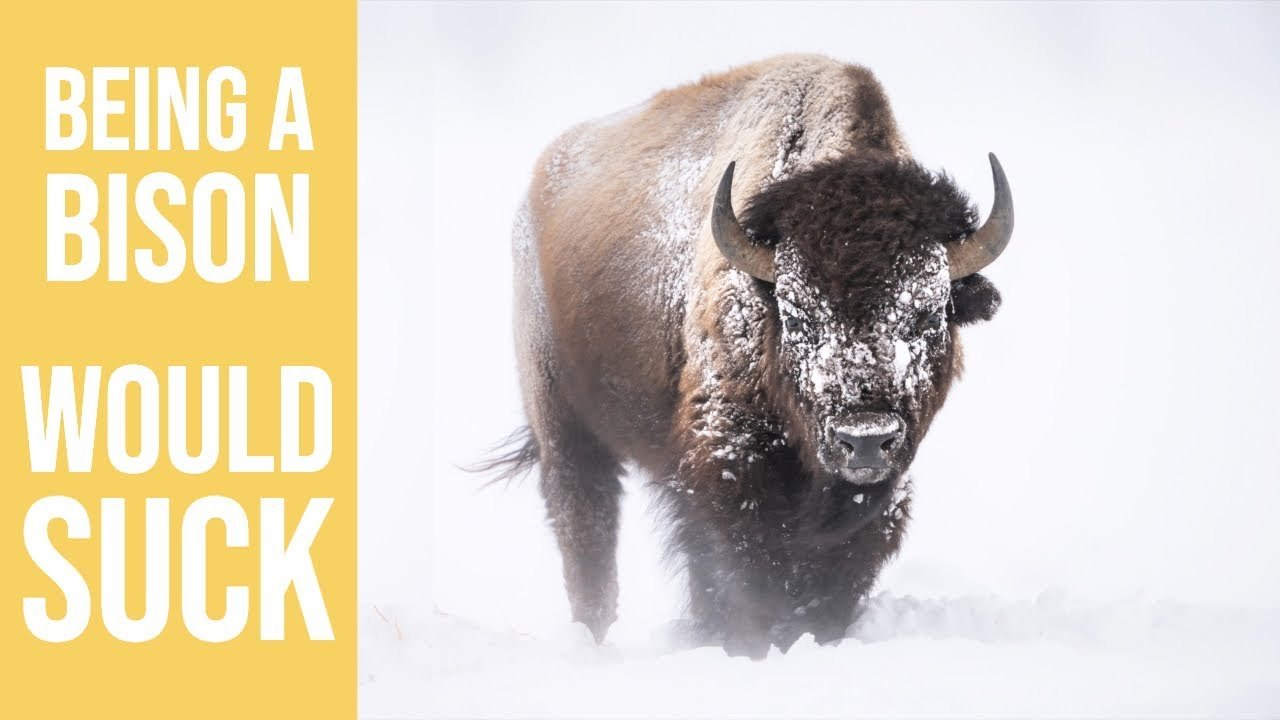
An American bison with snow caked over its face walks toward the camera through deep snow, its curved horns dark against a white background.

Footage: Steve Mattheis · 16:29 · uploaded February 20, 2019
Written by My Crittercam · published November 6, 2026

The Story

Wind is tearing loose snow across a flat in the Tetons, and out in it, dark smudges at first, a band of five or six American bison is walking toward the road.

They start about 200 yards off, far enough that the gusts keep swallowing them whole and the lens cannot hold focus. The wind runs near 30 miles an hour. The snow on the flat is a few feet deep, and earlier on the same drive a coyote hunting grouse out here could barely move. The bison plod on, in no hurry.

With about an hour of daylight left, the gap closes. One animal comes on head-first until it fills the frame: horns hooked out and up, a dark muzzle, the whole face crusted white.

The snow maps the coat. Bison carry thick, long, dark hair on the head and front of the body and shorter hair on the rear, and that shaggy forequarter is where the white piles deepest. Under it lie thick skin and underfur, long guard hairs and layers of fat, the insulation that gets a bison through winter.
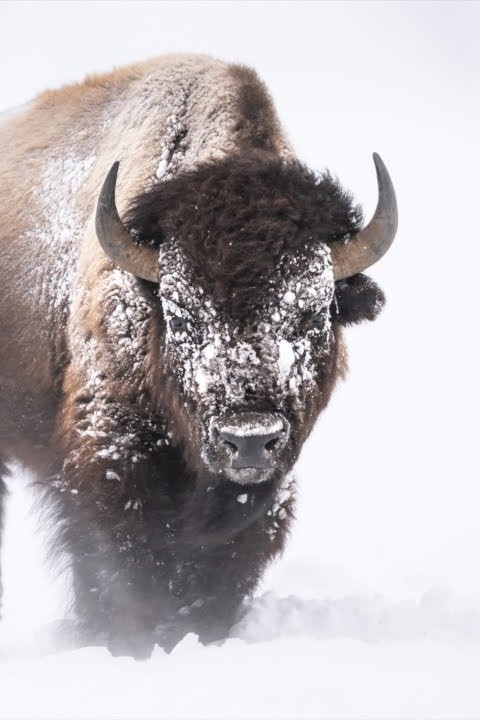
One American bison faces the camera head-on in deep snow, its face and shoulders caked white, curved dark horns, against a plain white background. A headline runs in white letters across the lower third.Save
Snow-caked bison comes head-on through deep snow

The timing fits the animal. Bison are mainly active by day, especially early morning and late afternoon, grazing between spells of loafing and chewing cud, and this band is on the move as the afternoon runs out.

Five or six is a small band. In Yellowstone, winter groups average about 20 bison. The season still takes its cut there: on average 9 of every 100 adult Yellowstone bison die over the winter, and 20 to 40 of every 100 first-year animals may die.

By dusk it is 12 degrees and the wind has not let up. One of the bison lies down in the snow. At an open car window, the photographer's hands are freezing, and he is ready to call it a night too.
Field Guide

On a wind-scoured flat in the Tetons, a band of five or six bison walks slowly in from about 200 yards to full-frame range in the last hour of light, and one lies down in the snow at dusk. Full field guide for the American bison

Common nameAmerican bison
Scientific nameBison bison
FamilyBovidae (cattle, bison, antelope and goats)
SizeMature bulls can reach 5.5 to 6.5 ft (1.9 m) at the hump and 9 to 12.5 ft (2.7 to 3.8 m) long; cows are normally 5 ft (1.5 m) high and 7 to 10 ft (2.2 to 3.2 m) long.Smithsonian's National Zoo and Conservation Biology Institute
WeightBulls up to 2,000 pounds; cows up to 1,000 pounds (Yellowstone).National Park Service (Yellowstone National Park)
DietYellowstone bison: more than 90% grasses, sedges and other grass-like plants; forbs and browse usually under 5%.National Park Service (Yellowstone National Park)
Active whenPrimarily diurnal, especially early morning and late afternoon, with grazing periods between loafing and ruminating.NatureServe Explorer
RangeOnce Alaska to northern Mexico; now found on private and protected lands in areas of the western United States and Canada.Animal Diversity Web, University of Michigan
Lifespan15 to 20 years in the wild; up to 40 years recorded in captivity.Animal Diversity Web, University of Michigan
Conservation statusIUCN Red List: Near Threatened; NatureServe Global Rank G4. COSEWIC (Canada): Plains Bison Threatened, Wood Bison Special Concern.NatureServe Explorer
Cam notes · Camerashot from an open car window
Cam notes · Time of daylate afternoon into dusk
Cam notes · Seasonwinter, blowing and drifting snow
Cam notes · Placethe Tetons

Habitat

Behavior

Questions

How do bison find food when the snow is this deep?

They swing their heads side to side to sweep snow off the grass. Large shoulder and neck muscles, the hump, power the motion.National Park Service (Yellowstone National Park) · U.S. Department of the Interior

Are bison cold standing out in a storm like this?

Their winter insulation is thick skin and underfur, long guard hairs and layers of fat. Winter is still hard on them, and on average 9 of every 100 adult Yellowstone bison die over the winter.National Park Service (Yellowstone National Park)

How close is it safe to get to a bison for photos?

Bison have injured more people in Yellowstone than any other animal. Yellowstone says to stay at least 25 yards (23 meters) away and never approach one for a photo.National Park Service (Yellowstone National Park)

Latest clips