The Story
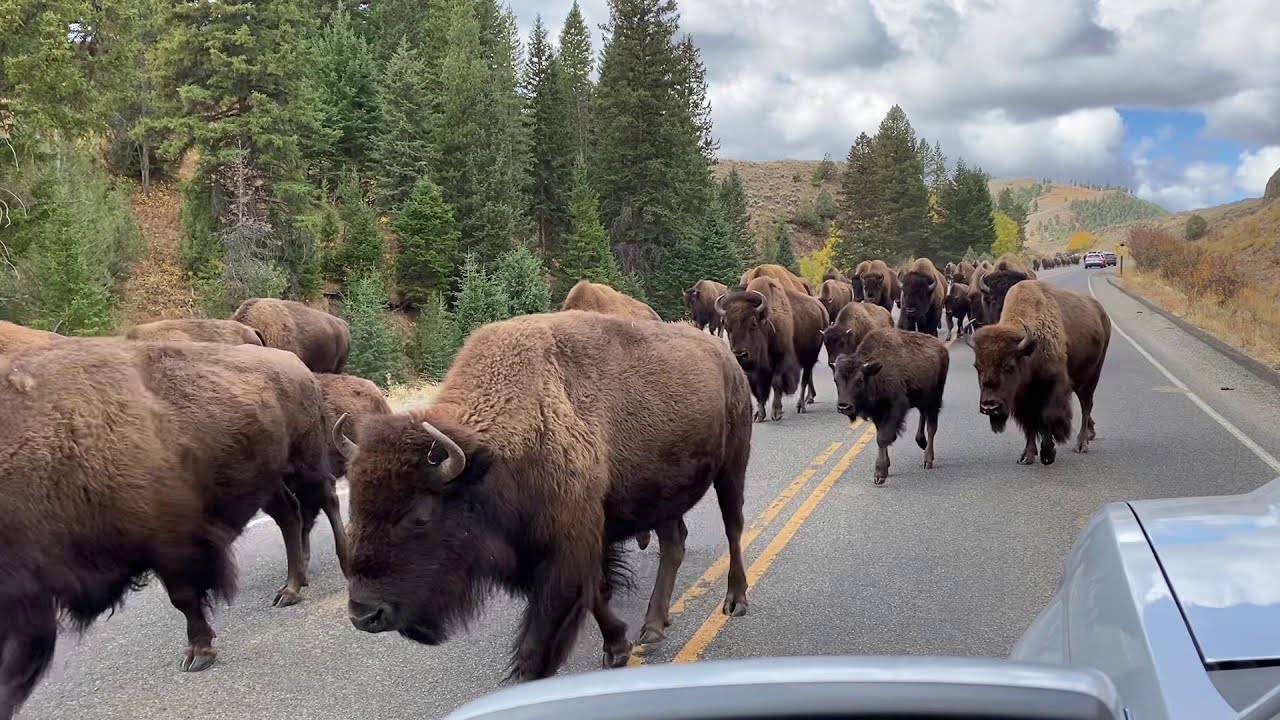
For as long as this clip runs, the road through this corner of Yellowstone belongs to American bison. They come down both lanes in a dense brown column, and the car holding the camera turns into a rock in a river.
The animal nearest the glass fills the frame. It carries a heavy hump over the shoulders, a dark shag on the head and forequarters, shorter hair toward the rear, and short horns that hook outward and up. Behind it the herd stretches back along the yellow center line toward a far bend, where more bison are still coming and a couple of cars sit on the road beyond them. Conifers crowd the slope on the left.
The herd moves briskly, some animals at a trot, and holds together as it streams past the car. The filmer called it a stampede, a word that fits the numbers better than the mood. Bison can run up to 35 miles per hour, spin quickly and jump high fences, and nothing on this road comes close to that gear.
Bison herds keep linear dominance hierarchies, and a traveling herd strings out in a line led by an adult cow, the same long file this one forms on the asphalt. Yellowstone groups average about 20 animals in winter and about 200 in summer, and the park's bison migrate up to 70 miles between summer and winter ranges.
Mature bulls can reach 5.5 to 6.5 feet at the hump and weigh up to 2,000 pounds; cows weigh up to 1,000. From the driver's seat the nearest backs ride higher than the hood. Bison have an excellent sense of smell and sharp hearing, and they talk among themselves in grunts and snorts.
Yellowstone asks people to keep at least 25 yards from bison, and here the bison close the gap themselves. Near the car the column thins to three walkers and a smaller animal following them, but far down the road, beside a few waiting cars, the dark line is still coming.