The Story
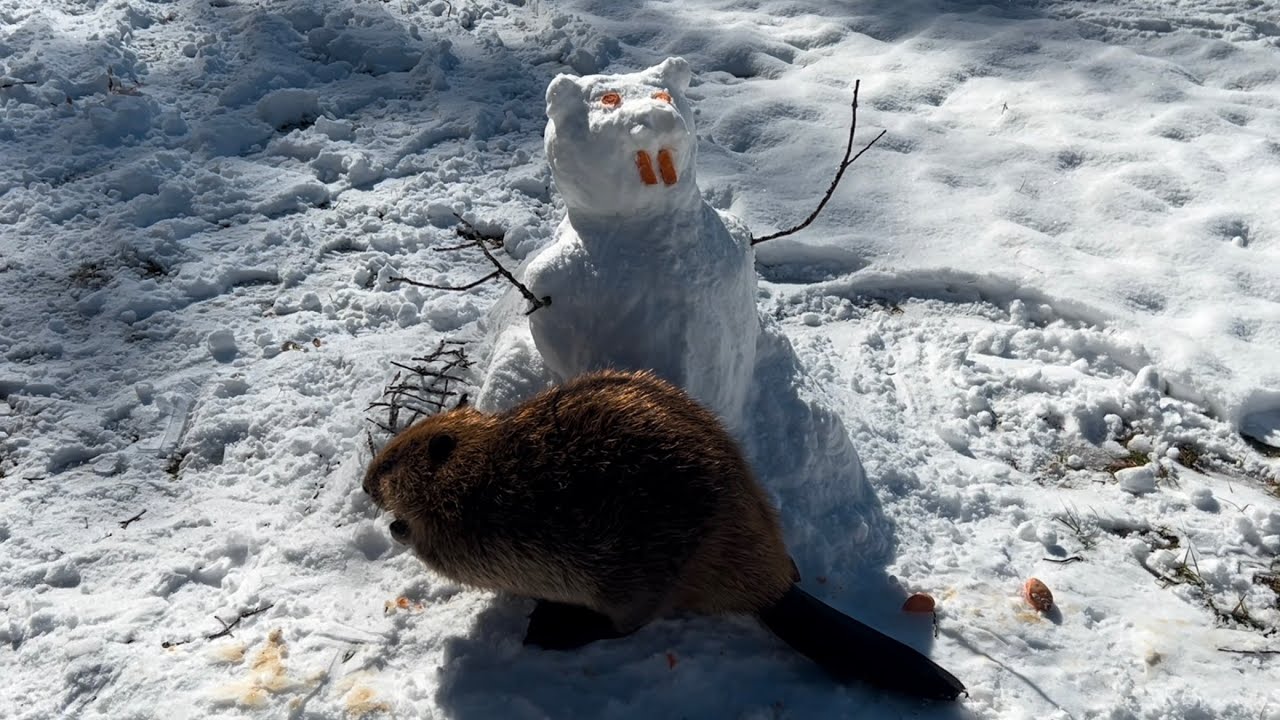
A North American beaver pushes its nose through sunlit snow at the feet of its own likeness, a packed-snow beaver with twig arms and two orange front teeth. On this part of the Gulf Coast, the snow is the stranger of the two.
It is day two of a blizzard, on a coast where a snow like this comes once in a generation. Last night the thermometer fell to 15 degrees, a record low, and today it has climbed just above freezing. Much of the snow is melting, and it will refreeze tonight.
The beavers here live in rehab care, and the people looking after them built the sculpture. Tulip treats it as a snack bar. The orange parts are food, and those are what she goes for.
The sculptors got the teeth right, which is why the joke lands. A real beaver carries large orange incisors, tinted dark by a high amount of iron in the enamel. They grow for as long as the animal lives, and the hard orange face wears more slowly than the softer back, so the edge keeps itself sharp. A snow beaver's teeth do not last long.
Stormy Rose, a second beaver in care, has taken on a bigger project. She has built herself a den. In the wild, a beaver's house is a lodge: a mound of branches and logs plastered with mud, with underwater openings leading to a single central chamber.
Cold on its own does not stop the species. Beavers never hibernate. They slow down instead, and spend most of the winter inside the lodge or den. The tail does double duty: beavers store fat in it, and because it is nearly hairless it also sheds body heat. On a frozen pond, a wild beaver lives off branches anchored in the mud of its home pond, eaten under the ice, where the water acts as a refrigerator and keeps the stems cold.
Tonight the slush freezes again. The snow beaver will freeze with it, a few bites lighter.