My Crittercam
My Crittercam › North American beaver

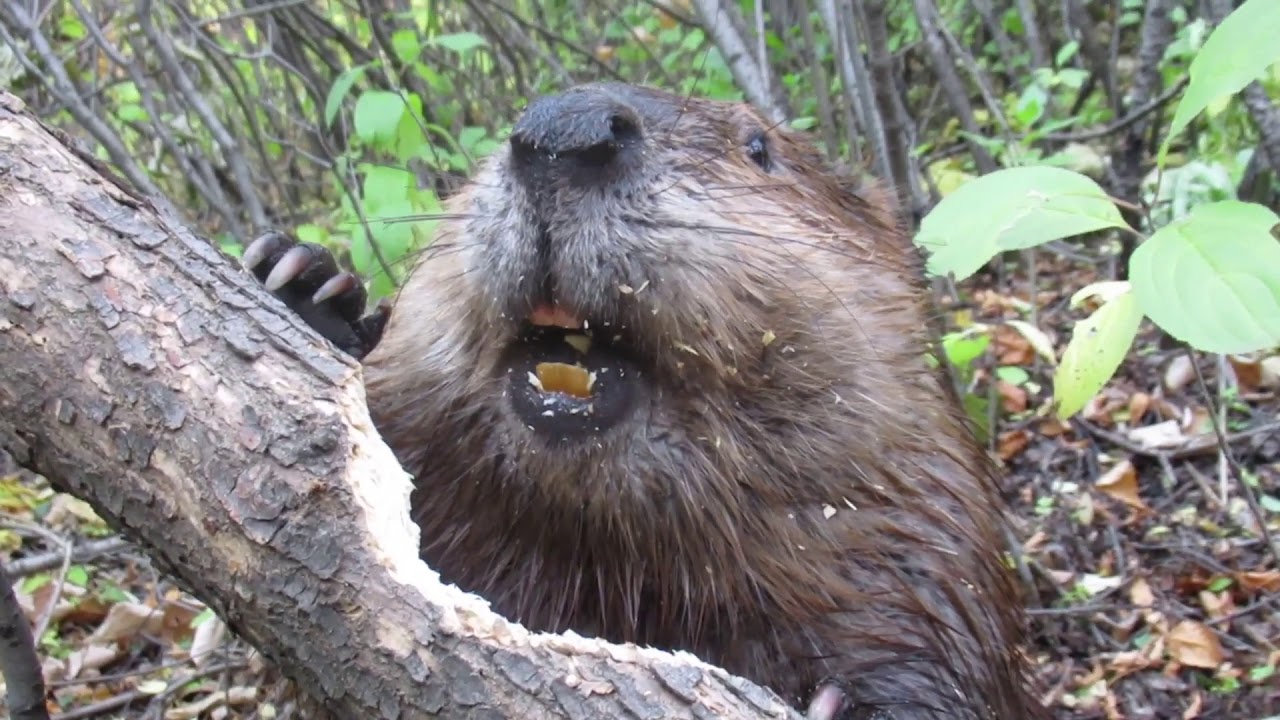
Beaver gnaws through a fallen limb, up close

Close-up of a beaver's face, mouth open to show orange incisors, with pale wood chips stuck in its whiskers and fur, green leaves behind and the freshly gnawed edge of a log below.

Footage: Mike’s Videos of Beavers · 3:17 · uploaded January 23, 2021
Written by My Crittercam · published November 6, 2026

The Story

Wood chips cling to the whiskers of a North American beaver as it leans over a fallen trunk and bites in again. The lens sits so close that each pale flake is easy to follow.

The filmer happened on this beaver at work and moved in tight on purpose. The beaver keeps working anyway. It is daytime, green leaves all round, a thicket of saplings behind. The head tilts, the incisors set, and a chunk of the limb comes away a mouthful at a time. Every so often it stops, lifts its head and stares straight down the lens, mouth full, before spitting the chips and going back in. It has the air of a tradesman checking that the apprentice is paying attention.

Those front teeth are the whole tool kit. Beaver incisors grow throughout life. The front enamel is hard and dark orange, colored by a high amount of iron, while the back is softer and wears away faster. So the edge stays sharp instead of dulling, bite after bite. Fresh beaver work carries their signature: twin grooves, each groove an eighth of an inch or more.

Daylight is less of a surprise than it looks. Beavers spend most of the daylight hours sleeping or resting in their living chambers and come out toward dusk, but they are often active during the day too.

On a standing tree the method is bolder. A beaver braces its forefeet on the trunk, props itself on its tail and gouges chips in an hourglass pattern. It starts with trees under 6 inches across, and one can gnaw through a five-inch tree in five minutes. Bringing a tree down puts the newer, more succulent growth from the canopy within reach.

This trunk is already on its side, so none of that is needed here. The job is sectioning, and by the end the limb is in two.
Field Guide

A wild beaver chews a chunk off a fallen tree trunk in daylight, filmed close enough to see the chips fly from its orange incisors. Full field guide for the North American beaver

Common nameNorth American beaver
Scientific nameCastor canadensis
FamilyCastoridae (beavers)
Size3 to 4 ft (1 to 1.2 m) long, 1 to 1.5 ft (0.3 to 0.5 m) tall; ADW gives 900 to 1170 mmSmithsonian's National Zoo & Conservation Biology Institute · Animal Diversity Web, University of Michigan
Weight35 to 65 lb (16 to 30 kg); heaviest on record 110 lb (50 kg)Smithsonian's National Zoo & Conservation Biology Institute
DietHerbivore: bark, cambium, leaves, twigs and aquatic plants; aspen, poplar, willow, birch and maple favoredAnimal Diversity Web, University of Michigan · Smithsonian's National Zoo & Conservation Biology Institute · Maine Department of Inland Fisheries and Wildlife
Active whenMainly nocturnal, though often active during the day; most often seen around dawn or dusk; does not hibernate, but less active in winterSmithsonian's National Zoo & Conservation Biology Institute · Maine Department of Inland Fisheries and Wildlife · National Park Service
Lifespan10 to 12 years in the wild; oldest on record 30 years in human careSmithsonian's National Zoo & Conservation Biology Institute · Pennsylvania Game Commission
RangeThroughout North America except arctic tundra, peninsular Florida and much of the desert SouthwestNatureServe Explorer · Montana Fish, Wildlife & Parks
Conservation statusIUCN Red List: Least Concern; NatureServe global rank G5NatureServe Explorer · Animal Diversity Web, University of Michigan
Cam notes · Camerafilmed in person, up close
Cam notes · Time of dayday
Cam notes · Seasongreen leaves (spring or summer)

Habitat

Behavior

Questions

How does a beaver chew through a tree so fast?

It braces its forefeet on the trunk, props itself on its tail and gouges chips in an hourglass pattern. One can gnaw through a five-inch tree in five minutes.SUNY ESF Adirondack Ecological Center · National Park Service

Why are beaver teeth orange, and how do they stay sharp?

The enamel holds a high amount of iron, which makes it dark orange. The incisors grow throughout life and stay sharp because the hard front enamel wears slower than the softer back.Smithsonian's National Zoo & Conservation Biology Institute · National Park Service · Montana Fish, Wildlife & Parks

What part of a tree does a beaver eat?

Beavers are herbivores that eat bark, cambium, leaves, twigs and aquatic plants. Aspen, poplar, willow, birch and maple are favored.Animal Diversity Web, University of Michigan · Smithsonian's National Zoo & Conservation Biology Institute · Maine Department of Inland Fisheries and Wildlife

Latest clips