My Crittercam
My Crittercam › American bison

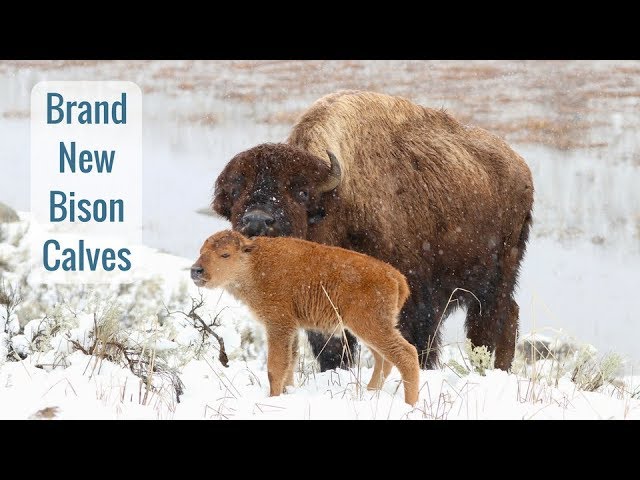
A newborn bison calf in late spring snow

A reddish-brown bison calf faces left in falling snow in front of its mother's dark, snow-flecked head and humped back, with cut-off overlay text at the left edge.

Footage: Fy Nyth · 3:14 · uploaded May 13, 2018
Written by My Crittercam · published November 6, 2026

The Story

Snow is coming down on open ground in Yellowstone, and a reddish-brown American bison calf stands in it on legs that still look borrowed. Its mother stands at its back, broad and dark against the white.

It is one of two very new calves here, among the first born that spring. One of the pair may have arrived earlier that same day, and it is the quieter of the two. Both wobble when they move, and both nurse. The ground had been green before the storm; spring had been declared a little early.

The timing is normal for bison. A cow carries a single calf for 9 to 9½ months and gives birth in late April or May. The newborn's red coat is a phase: it begins turning brown at about two and a half months and is gone by four. A calf can keep up with the herd two to three hours after birth, then nurses for seven to eight months.

The mothers have the harder job. Milk has to come from somewhere, and the grass is now buried, so they stay close to the calves while working for food under the fresh snow. In Yellowstone, more than 90 percent of a bison's diet is grasses, sedges and grass-like plants. Large shoulder and neck muscles let bison swing their heads side to side to clear a patch.

Later the footage turns to a bigger herd crossing an open field. These animals paw through the snow and graze as they go, keeping together, with a few sandhill cranes nearby. No new calves show among them. Bison herds keep a linear pecking order, and when they travel they string out in a line led by an adult cow.

The stakes for the two newborns are real. Wolves and mountain lions take calves, and in Yellowstone 20 to 40 of every 100 first-year bison may die in winter. These two have a summer to grow first. For now they have a mother, a meal and a coat the color of rust.
Field Guide

Two newborn bison calves, one perhaps born that same day, nurse beside their mothers in a Yellowstone snowstorm that buried ground already gone green. Full field guide for the American bison

Common nameAmerican bison
Scientific nameBison bison
FamilyBovidae (cattle, bison, antelope and goats)
SizeMature bulls can reach 5.5 to 6.5 ft (1.9 m) at the hump and 9 to 12.5 ft (2.7 to 3.8 m) long; cows are normally 5 ft (1.5 m) high and 7 to 10 ft (2.2 to 3.2 m) long.Smithsonian's National Zoo and Conservation Biology Institute
WeightBulls up to 2,000 pounds; cows up to 1,000 pounds (Yellowstone).National Park Service (Yellowstone National Park)
DietYellowstone bison: more than 90% grasses, sedges and other grass-like plants; forbs and browse usually under 5%.National Park Service (Yellowstone National Park)
Active whenPrimarily diurnal, especially early morning and late afternoon, with grazing periods between loafing and ruminating.NatureServe Explorer
Lifespan15 to 20 years in the wild; up to 40 years recorded in captivity.Animal Diversity Web, University of Michigan
RangeOnce Alaska to northern Mexico; now found on private and protected lands in areas of the western United States and Canada.Animal Diversity Web, University of Michigan
Conservation statusIUCN Red List: Near Threatened; NatureServe Global Rank G4. COSEWIC (Canada): Plains Bison Threatened, Wood Bison Special Concern.NatureServe Explorer
Cam notes · Time of dayday
Cam notes · Seasonlate spring, snowstorm
Cam notes · PlaceYellowstone, Wyoming

Habitat

Behavior

Questions

Are these bison wild, or does someone own them?

Bison have lived in Yellowstone continuously since prehistoric times. About 30,000 bison live in conservation herds and about 500,000 are managed as livestock.National Park Service (Yellowstone National Park) · Smithsonian's National Zoo and Conservation Biology Institute

When are bison calves born?

A cow gives birth to one calf in late April or May after a gestation of 9 to 9½ months. Calves are red to reddish-tan at birth and entirely brown by four months.National Park Service (Yellowstone National Park) · Animal Diversity Web, University of Michigan

Can a newborn bison calf survive the snow?

Calves can keep up with the herd 2 to 3 hours after birth and nurse for seven to eight months. Winter is the real test: in Yellowstone 20 to 40 of every 100 first-year animals may die.National Park Service (Yellowstone National Park) · Animal Diversity Web, University of Michigan

Latest clips