My Crittercam
My Crittercam › White-tailed deer

White-tailed deer on alert, a chase unsolved

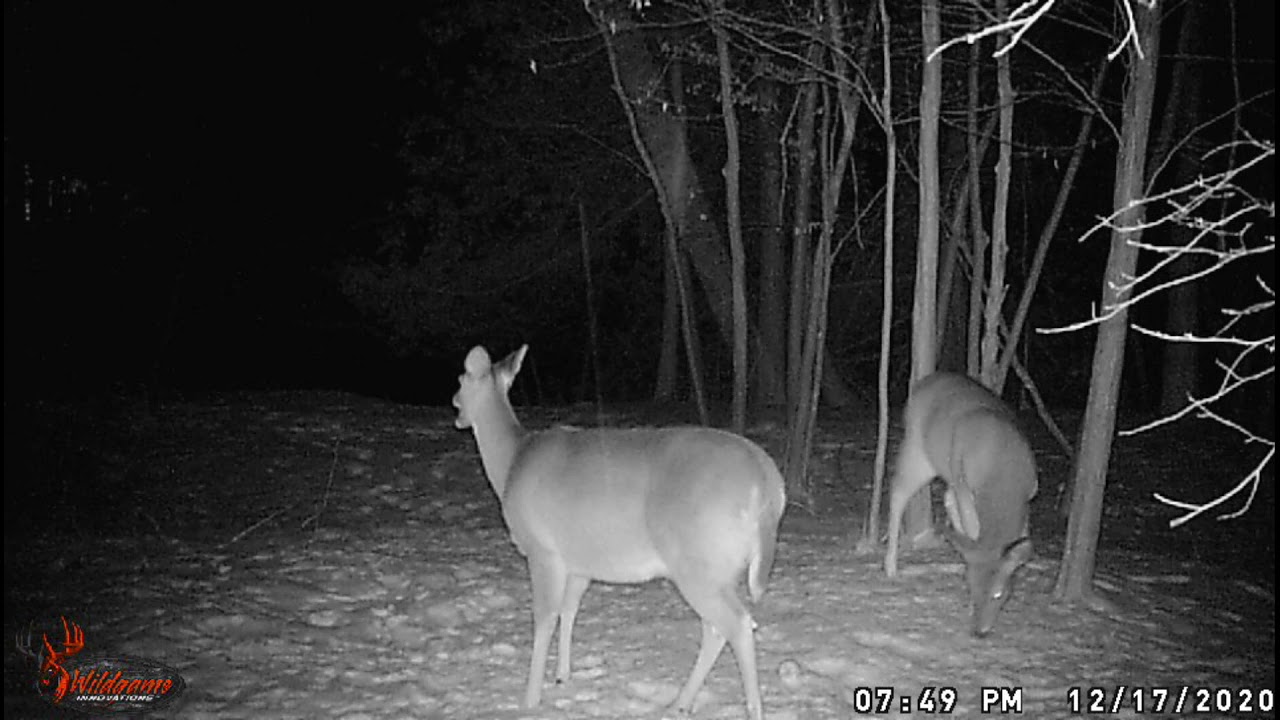
A white-tailed deer in black-and-white night infrared stands side-on facing left on pale, mottled ground, head raised and ears up, its hindquarters cut off by the right edge and bare trunks rising in the dark behind it.

Footage: Central Michigan Bigfoot & Wildlife · 18:24 · uploaded December 23, 2020
Written by My Crittercam · published November 6, 2026

The Story

Something is running behind a white-tailed deer, and the camera gives it no name. The lens sits four feet off the ground, and the filmer cannot tell what it is.

That is the whole case file. A deer goes by with a pursuer behind it, the pursuer cannot be made out, and the rest of the reel settles into about seven days and nights of trail camera footage. Whatever gave chase seems to carry a long tail, and little else can be pinned down. The deer, presumably, got a better look.

A white-tailed deer in flight has options. The species can bound at up to 30 miles per hour through tangled forest. An alarmed deer raises its tail to show the white underside, a flag that flashes danger to other deer nearby, and a fleeing deer waves it side to side. The alarm whistle, a snort or blow forced out through the nostrils, warns all deer nearby of a possible predator. How much of that this deer did is not on the record.

A quieter frame from the same footage carries the stamp 7:49 PM, 12/17/2020. Two white-tailed deer stand under infrared on pale ground in front of bare trees, with nothing to tie them to the chase. One has its head down at the ground. The other has its head up and faces left, ears raised. Deer are sometimes called an edge species, thriving where openings meet cover and feeding in openings close to escape cover, and this pair stands on that kind of seam.

The best witness to any chase is the ground, and a camera does not read the ground. Deer tracks are heart-shaped and pointed, 2 1/2 to 4 inches long and split down the middle, and a running deer may leave dewclaw dots behind each one, especially when bounding on mud or snow. Prints of another shape would point to another animal; a second line of hearts, to a deer. Whether anyone went to look, the filmer's notes do not say.
Field Guide

A trail camera set four feet off the ground catches a white-tailed deer being chased by something its filmer cannot identify. Full field guide for the White-tailed deer

Common nameWhite-tailed deer
Scientific nameOdocoileus virginianus
FamilyCervidae (Deer)
SizeHead and body 150 to 200 cm, tail 10 to 28 cm; 80 to 100 cm at the shoulder.Animal Diversity Web, University of Michigan
Weight57 to 137 kg (125.55 to 301.76 lb). Missouri: females 110-145 lb, males 155-195 lb.Animal Diversity Web, University of Michigan · Missouri Department of Conservation
DietHerbivore: leaves, twigs, fruits and nuts of trees and shrubs, herbaceous plants, grasses, crops, and occasionally fungi, mosses and lichens.Missouri Department of Conservation
Active whenCrepuscular: typically most active around dawn and dusk; activity may increase throughout the day during the breeding season.Maine Department of Inland Fisheries and Wildlife
RangeMost of southern Canada and the United States (except most of California, Nevada and Utah), south through Central America to Bolivia.Animal Diversity Web, University of Michigan · Connecticut Department of Energy & Environmental Protection
LifespanMost live about 2 to 3 years; maximum in the wild 20 years, but few live past 10.Animal Diversity Web, University of Michigan
Conservation statusIUCN Red List: Least Concern (via NatureServe Explorer); NatureServe global rank G5.NatureServe Explorer
Cam notes · Cameratrail camera, four feet off the ground
Cam notes · Time of daynight (infrared) in the thumbnail, stamped 7:49 PM; the reel covers days and nights
Cam notes · Seasonlate fall or winter, thumbnail stamped 12/17/2020; trees bare

Habitat

Behavior

Questions

What would deer tracks look like after a chase?

Deer tracks are heart-shaped and pointed, 2 1/2 to 4 inches long and split down the middle. When a deer is running, dewclaws may leave dots behind each track, especially when bounding on mud or snow.Missouri Department of Conservation

How long is a white-tailed deer's tail?

The tail is 10 to 28 cm long, brown above and white underneath. An alarmed deer raises it high as a white flag and bounds off.Animal Diversity Web, University of Michigan · Connecticut Department of Energy & Environmental Protection

Is December still breeding season for white-tailed deer?

In Connecticut, mating runs from late October through early January, peaking in the last two weeks of November. Rival bucks fight by clashing antlers for access to a doe, and they do not guard harems.Connecticut Department of Energy & Environmental Protection · Animal Diversity Web, University of Michigan

Latest clips