My Crittercam
My Crittercam › Gray wolf

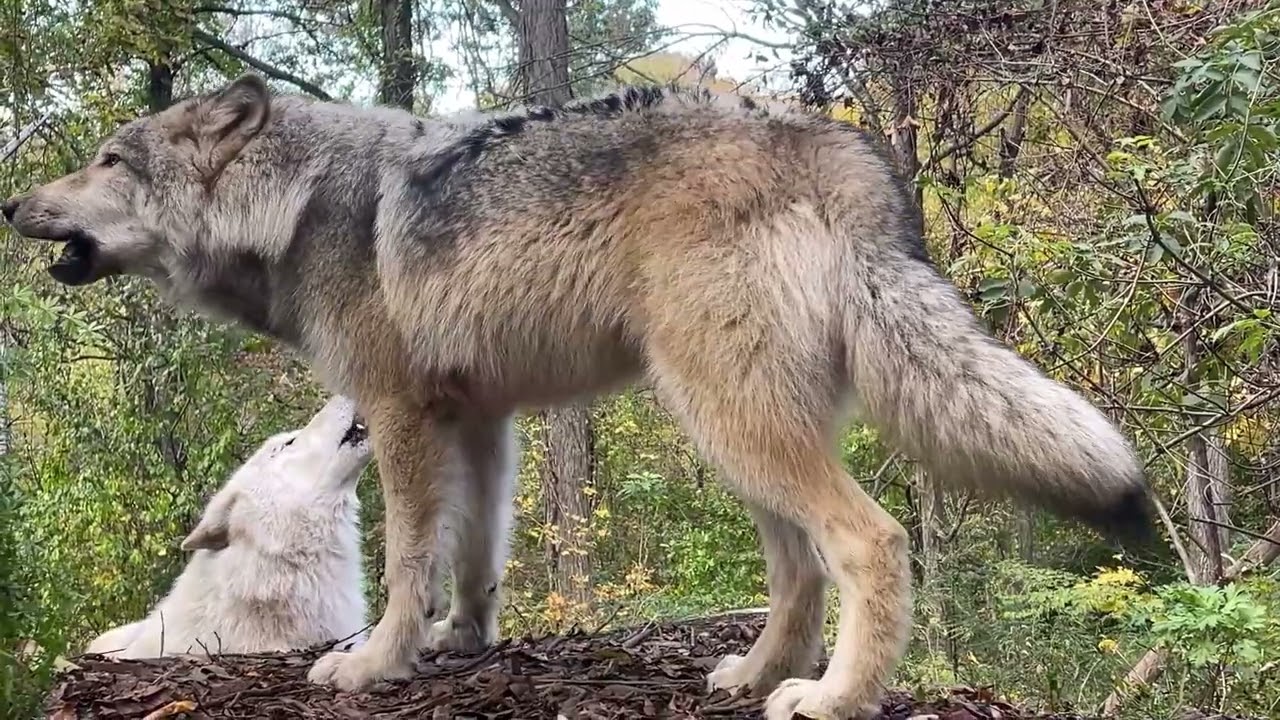
Two gray wolves howl together on an autumn day

A grizzled gray and tan wolf stands in profile howling with its mouth open while a white wolf lies on bark mulch beneath it with its muzzle raised, green and yellow autumn trees behind.

Footage: Wolf Conservation Center · 0:34 · uploaded October 20, 2023
Written by My Crittercam · published November 6, 2026

The Story

Nikai lies on the bark mulch and howls anyway. The white gray wolf tips a long white muzzle skyward, while Silas, grizzled tan and gray, stands above and opens his mouth on a note of his own.

Both are captive-born gray wolves at the Wolf Conservation Center in South Salem, New York, where they work as ambassador wolves, helping teach the public about wolves and their role in the environment. The woods behind them are just turning, green going to yellow on a clear autumn day.

Silas wears the coat the species often shows, buff-tan grizzled with gray and black, with a dark band across his shoulders. Nikai is close to pure white. In Yellowstone, gray and black wolves turn up about half and half, and white is the rare one.

Through forest a wolf's howl can be heard about 11 kilometers away; across open country, about 16. Pack members use it to communicate, to advertise a territory and to coordinate social activities.

The International Wolf Center describes two kinds of howl. A defensive howl keeps the pack together and strangers away, guarding pups and kill sites. A social howl helps wolves find one another and rally, and possibly just have fun. With these two a body length apart, finding each other is hardly the point.

Then Silas swings round to face the trees, and a moment later walks past the lens so close that he fills the frame, head low, amber eyes on the camera. His tail hangs down behind him, black at the tip, the way a wolf carries it: straight out or down, never curled. Nikai stays down on the mulch as he goes.
Field Guide

On a clear autumn day at the Wolf Conservation Center in South Salem, New York, ambassador wolves Silas and Nikai howl together, Nikai lying down and Silas standing over the white wolf. Full field guide for the Gray wolf

Common nameGray wolf
Scientific nameCanis lupus
FamilyCanidae (Dog family)
SizeMales 5 to 6.5 ft long nose to tail tip, females 4.5 to 6 ft; 26 to 32 in at the shoulderU.S. Fish & Wildlife Service (hosted by Montana Fish, Wildlife & Parks)
WeightMales 70 to 115 lb, females 60 to 100 lb; Alaska males occasionally 145 lbU.S. Fish & Wildlife Service (hosted by Montana Fish, Wildlife & Parks)
LifespanUp to 13 years in the wild, 15 in captivity; Yellowstone average 4-5 yearsU.S. Fish & Wildlife Service (hosted by Montana Fish, Wildlife & Parks) · National Park Service, Yellowstone National Park
DietMainly medium and large hoofed mammals. Midwest: mainly white-tailed deer, also moose, beaver and snowshoe hare; Rocky Mountains: elk, deer, moose, bison and beaverU.S. Fish & Wildlife Service (hosted by Montana Fish, Wildlife & Parks) · U.S. Fish & Wildlife Service
RangeLower 48: Minnesota, Wisconsin, Michigan, Montana, Idaho, Wyoming and northern Washington's Cascades; tens of thousands in Canada and AlaskaU.S. Fish & Wildlife Service (hosted by Montana Fish, Wildlife & Parks) · NatureServe Explorer
Active whenMainly nocturnal; movements are usually at night and cover long distancesNatureServe Explorer · Animal Diversity Web, University of Michigan
Conservation statusNatureServe global rank G5. US Endangered Species Act: threatened in Minnesota, endangered in most other lower-48 states; Northern Rocky Mountain population delistedNatureServe Explorer
Cam notes · Time of dayday
Cam notes · Seasonclear autumn day
Cam notes · PlaceWolf Conservation Center, South Salem, New York

Habitat

Behavior

Questions

Why do wolves howl?

Howling has many uses, including communication within the pack, advertising territory and coordinating social activities. Wolves howl to locate and rally pack members and to keep strangers away from territory, pups and kills.National Park Service, Yellowstone National Park · International Wolf Center

Are white wolves and gray wolves the same species?

Yes, white, gray and black are all coats of the gray wolf, which is often buff-tan grizzled with gray and black. In Yellowstone gray and black wolves occur about 50:50, and white ones are rare.U.S. Fish & Wildlife Service (hosted by Montana Fish, Wildlife & Parks) · National Park Service, Yellowstone National Park

How far away can you hear a wolf howl?

A howl is the wolves' long-distance call. It can be heard about 11 km (6.6 mi) away in forest and about 16 km (9.6 mi) in open country.International Wolf Center · National Park Service, Yellowstone National Park

Latest clips