My Crittercam
My Crittercam › Bald eagle

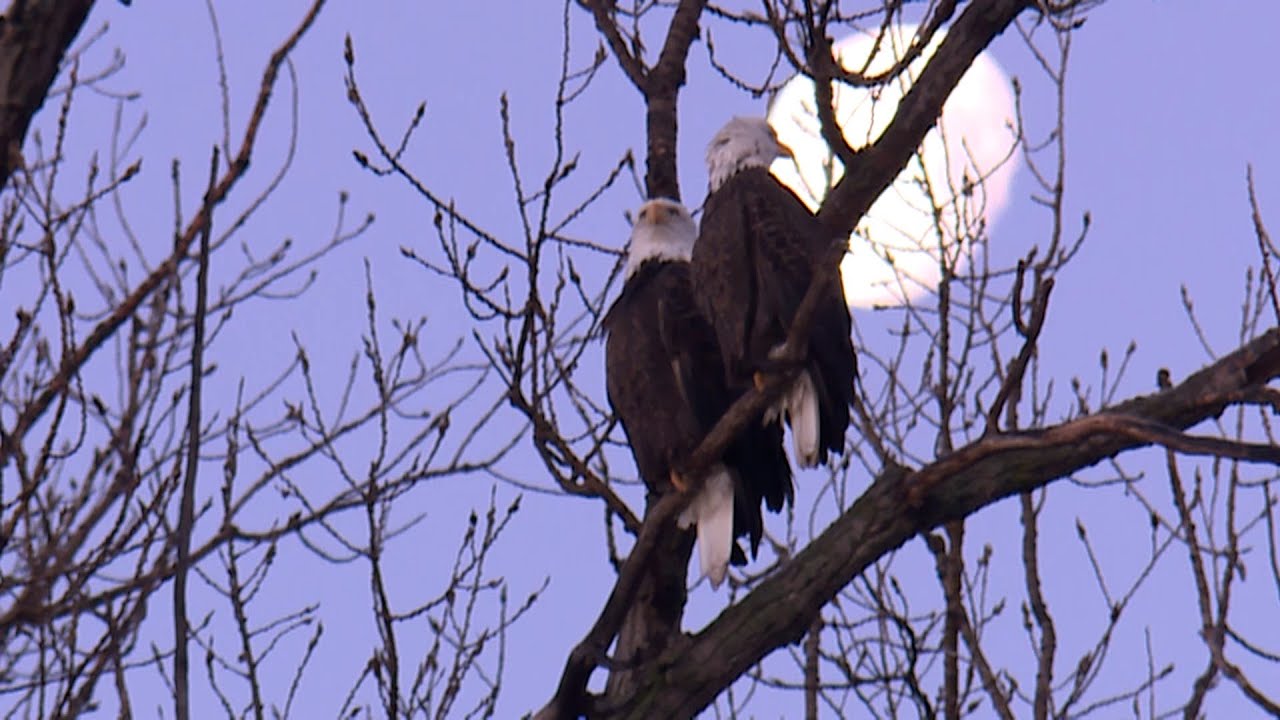
Two adult bald eagles share a bare winter limb

Two adult bald eagles with white heads and white tails perch close together on one bare diagonal branch, the left bird facing the camera and the right one higher and turned in profile, against a pale lavender sky with a pale moon partly hidden by branches at the upper right edge.

Footage: KMBC 9 · 2:24 · uploaded January 7, 2026
Written by My Crittercam · published November 6, 2026

The Story

Bald eagles fill this short clip from Loess Bluffs Wildlife Refuge, just north of Kansas City: birds crossing a dusky purple sky, white-headed adults paired on bare limbs, brown young ones perched around a huge stick nest under hard blue sky. On December 30 the refuge set a new record, with more than 1,000 bald eagles spotted.

A snowy head, neck and tail on a dark brown body mark an adult, and that full white head and tail arrives at about five years. No other adult eagle wears both a white head and a white tail. The young are dark brown with whitish mottling in the wings and tail and a black bill, and the clip has plenty of them: one sits close enough to show pale flecks across its back, and two more share a treetop near a pair of adults.

In one bare tree, three brown young eagles perch around a stick nest far bigger than any of them. Bald eagle nests are generally 4 to 5 feet wide and 2 to 4 feet deep, and they are added to every year until some reach 10 feet across.

In winter bald eagles gather where open water and easy food meet, and the Mississippi River holds the Midwest's highest concentration, with open water at locks, dams and power plants.

Bald eagles roost communally, especially in winter, in groups that can reach 400 birds. More than 200 winter at Blackwater in Maryland, and Reelfoot Lake in Tennessee draws more than 200 at a February peak. Set beside that, a single-day tally past 1,000 is an outsized figure.

By 1963 only 417 nesting pairs were known in the lower 48 states, their eggshells thinned by DDT. Bans on the pesticide and legal protection turned that around, and on June 28, 2007 the bald eagle's removal from the list of threatened and endangered species was announced. Late in the clip two birds wheel together against a flat gray sky, wings wide, one banking under the other.
Field Guide

Two adults share one bare limb at Loess Bluffs Wildlife Refuge north of Kansas City, where a December 30 count topped 1,000 bald eagles. Full field guide for the Bald eagle

Common nameBald eagle
Scientific nameHaliaeetus leucocephalus
FamilyAccipitridae (hawks, eagles and kites)
Size79 to 94 cm long; females generally somewhat larger than males.Animal Diversity Web, University of Michigan · NatureServe · Smithsonian's National Zoo & Conservation Biology Institute
Wingspan178 to 229 cm; up to 8.5 feet (2.6 meters).Animal Diversity Web, University of Michigan · Smithsonian's National Zoo & Conservation Biology Institute
Weight6.5 to 14 pounds (3 to 6.5 kilograms); average 4.3 kg.Smithsonian's National Zoo & Conservation Biology Institute · Animal Diversity Web, University of Michigan
DietMainly fish such as salmon, herring, catfish and carp; also waterfowl, small mammals, turtles, snakes and carrion.National Audubon Society · U.S. Fish & Wildlife Service
Active whenDiurnal (active by day); most populations, especially northern ones, migrate to milder climates each year.Animal Diversity Web, University of Michigan
RangeThroughout North America near large water, concentrated in Florida, Alaska, the Pacific Northwest and near some Midwest rivers and lakes; Alaska estimated at 70,000 (2020).Animal Diversity Web, University of Michigan · Alaska Department of Fish and Game
LifespanTypically 15-20 years in the wild (oldest known wild bird 28); up to about 30 years in the wild per USFWS; one captive bird reportedly lived 47 years.Animal Diversity Web, University of Michigan · U.S. Fish & Wildlife Service
Conservation statusIUCN Red List: Least Concern; NatureServe Global Rank G5 (secure, reviewed 2016-04-08). Removed from the US endangered species list in 2007.NatureServe · Animal Diversity Web, University of Michigan · U.S. Fish & Wildlife Service
Cam notes · Time of daymixed: a dusk sky in some shots, full daylight in most
Cam notes · Seasonwinter, bare trees
Cam notes · PlaceLoess Bluffs Wildlife Refuge, just north of Kansas City

Habitat

Behavior

Questions

Why do some bald eagles have no white head or tail?

Those are young birds, dark brown with whitish mottling in the wings and tail and a black bill instead of yellow. The full white head and tail come in at about five years of age.National Audubon Society · Alaska Department of Fish and Game · U.S. National Park Service

Why do so many bald eagles gather in one place in winter?

They gather where open water and easy food meet. Locks, dams and power plants keep the Mississippi from freezing, and in Alaska thousands feed on spawned-out salmon. They also roost communally in winter, in groups of up to 400 birds.Iowa Department of Natural Resources · Alaska Department of Fish and Game · NatureServe · Animal Diversity Web, University of Michigan

Were bald eagles ever endangered?

DDT thinned their eggshells, and by 1963 only 417 nesting pairs were known in the lower 48 states. After DDT bans and protection they recovered, and their removal from the threatened and endangered list was announced on June 28, 2007.U.S. Fish & Wildlife Service

Latest clips