The Story
A young female snowy owl is out hunting over the winter fields of southwest rural Ottawa. Other owls here skim across the same fields just above the surface.
More often the owls here do far less. Through the winter of 2022-2023 they sat on fence posts, preened, or slept away the hours in a busy neighborhood while snow buntings chirped nearby. People travel from as far as Europe, Africa and Asia to photograph birds that can sleep away the hours on a fence post.
That daytime stillness has a reason. Project SNOWstorm says wintering snowy owls are active primarily at night, and observers find them fairly inactive by day. Its Scott Weidensaul says they stir earlier in the afternoon on gloomy, cloudy days than on sunny ones. A hunt usually starts from a perch. The owl chases prey in swift flight and takes it in its talons, and sometimes it flies low or hovers. It can pinpoint a rodent moving under the snow by hearing.
These birds come down from across the Canadian Arctic. Snowy owls breed on the tundra of Alaska and northern Canada and winter in Canada and the northern United States, choosing open country: prairies, farmland, coastal marshes, even large airports. When a big lemming year on the breeding grounds sends many owls south, most of them are healthy young birds, not starving ones.
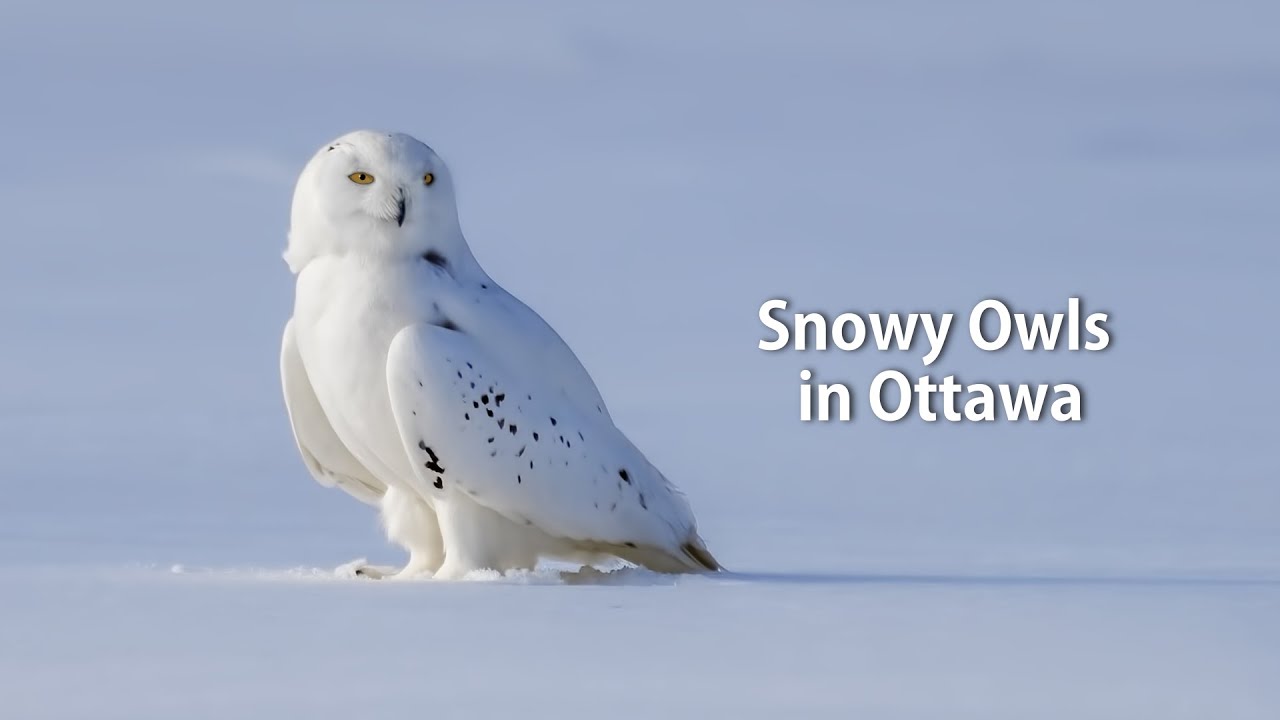
The owl in the still frame stands on bare snow with its round head turned to the camera, yellow eyes open, black beak tucked into white feathers, its very small ear tufts hard to see. Black spots fleck its wing. That spotting is how you read a snowy owl. Young females are heavily marked, adult females retain some darker markings, and old males are almost pure white, a change that takes several years. A male wintered here this year too, and males carry far fewer black spots than females.
Then the winter ends and the fields empty. Too soon for the people who come looking, the owls head back north to the Arctic.