The Story
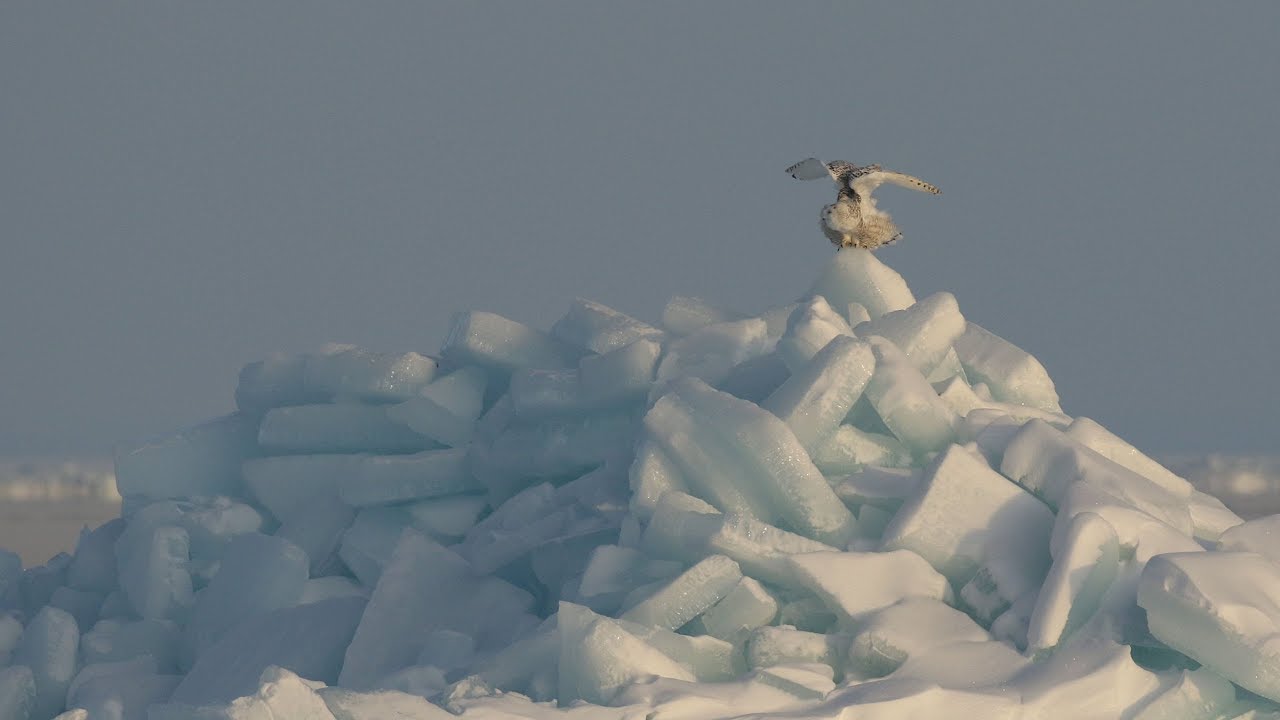
Something small moves on a mountain of broken ice, and through a long lens it resolves into a snowy owl, perched on the very summit. She holds there, a barred white bird with only pale sky behind her.
This is Ontario in March 2019, at one of the filmer's favorite places for snowy owls, on frozen water. The ice has piled itself into a jagged heap of slabs, blue-white and glassy, and the owl sits on the highest block. She is far off. The filmer likes it that way: the bird small, the country empty and frozen.
Snowy owls are large, round-headed white owls with yellow eyes and very small ear tufts that are hard to see. This one is far from pure white. Dark bars cross her back and wings, and barring sorts these birds: juveniles tend to have the most black, adult females retain some darker markings, and males have the least. A bird marked like this is most likely a female or a young owl, which squares with the filmer calling her she.
Mostly she roosts, and that is the expected daytime shape of a wintering snowy owl. In winter they are active primarily at night, Project SNOWstorm says, and fairly inactive by day. When one hunts, it usually works from a perch, then runs prey down in swift flight.
At one point both wings come up, spread wide over the top of the ice, the barred flight feathers lit against the gray.
Snowy owls breed on Arctic tundra and winter in Canada and the northern US, in open country: prairies, farmland, coastal marshes, beaches and large airports. Wintering females set up territories and defend them until spring. A treeless plain of ice suits the pattern.
The filmer whispers at first, though the owl is so far off there is no way to disturb her. Snowy owls show it when a person is too close: they stare, bob the head repeatedly or otherwise respond. The fortress has exactly one tenant, and she has the summit.