My Crittercam
My Crittercam › Gray wolf

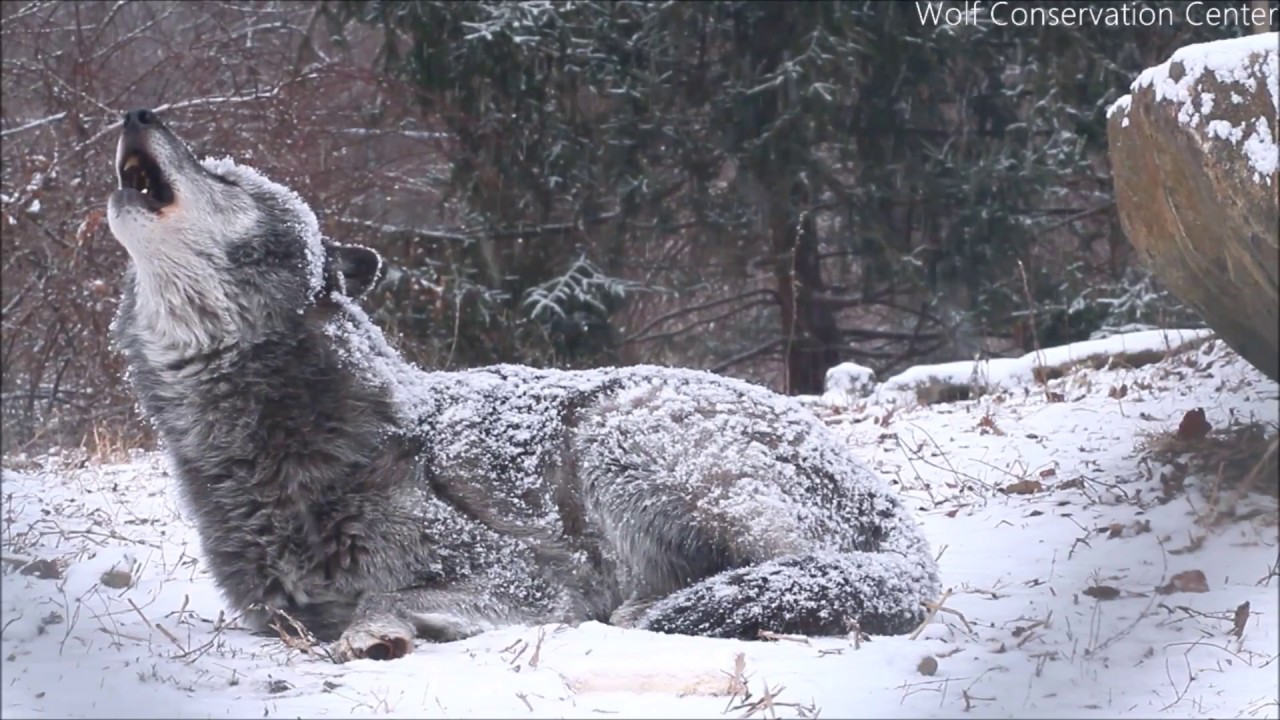
Snow-dusted gray wolf tips his head back to howl

A gray wolf with snow on its head and back lies in the snow, muzzle pointed at the sky and jaws open mid-howl, in front of bare winter brush.

Footage: Wolf Conservation Center · 0:35 · uploaded February 12, 2017
Written by My Crittercam · published November 6, 2026

The Story

Zephyr tips his muzzle to the sky, opens his jaws and howls. He is a gray wolf lying in the snow at the Wolf Conservation Center in South Salem, New York, and the snow has settled on him too.

It powders his head, his shoulders and the long grizzled back. His throat shows pale under the gray. The call runs on, and somewhere off camera a second wolf takes it up. For a few seconds the two voices overlap and blend, one close, one out of sight.

Zephyr was born in captivity and, when this was filmed, was one of the center's four ambassador wolves, so this is no wild pack on patrol. The howl, though, is the genuine article. It is the wolves' long-distance call, and it can be heard about 6.6 miles away in forest and 9.6 miles in open country. Among its uses, a defensive howl keeps the pack together and strangers away, and a social howl helps wolves locate one another and rally.

Which of those Zephyr means cannot be read from this clip alone. What the clip does show is the basic exchange: one wolf calls, another answers from somewhere unseen. In the wild, a pack is a family group, a breeding pair with their pups, perhaps last year's young and sometimes older wolves. Packs defend their territory by howling and by scent-marking with urine.

The winter detail rewards a second look. The snow sits on top of his coat. Beneath the outer guard hairs is a dense undercoat that wolves grow in fall and shed by July. The head carries the marks that set a wolf apart from a coyote: short, rounded ears and a big, blocky muzzle, here aimed straight up.

Wolves are mainly nocturnal, and their movements usually happen at night. This call comes in daylight, from a wolf settled in the snow with flakes collecting on his back. His only chorus is the one wolf who answers out of sight.
Field Guide

Zephyr, a captive-born ambassador wolf in South Salem, New York, howls from the snow while a second wolf answers out of sight. Full field guide for the Gray wolf

Common nameGray wolf
Scientific nameCanis lupus
FamilyCanidae (Dog family)
SizeMales 5 to 6.5 ft long nose to tail tip, females 4.5 to 6 ft; 26 to 32 in at the shoulderU.S. Fish & Wildlife Service (hosted by Montana Fish, Wildlife & Parks)
WeightMales 70 to 115 lb, females 60 to 100 lb; Alaska males occasionally 145 lbU.S. Fish & Wildlife Service (hosted by Montana Fish, Wildlife & Parks)
LifespanUp to 13 years in the wild, 15 in captivity; Yellowstone average 4-5 yearsU.S. Fish & Wildlife Service (hosted by Montana Fish, Wildlife & Parks) · National Park Service, Yellowstone National Park
DietMainly medium and large hoofed mammals. Midwest: mainly white-tailed deer, also moose, beaver and snowshoe hare; Rocky Mountains: elk, deer, moose, bison and beaverU.S. Fish & Wildlife Service (hosted by Montana Fish, Wildlife & Parks) · U.S. Fish & Wildlife Service
Active whenMainly nocturnal; movements are usually at night and cover long distancesNatureServe Explorer · Animal Diversity Web, University of Michigan
RangeLower 48: Minnesota, Wisconsin, Michigan, Montana, Idaho, Wyoming and northern Washington's Cascades; tens of thousands in Canada and AlaskaU.S. Fish & Wildlife Service (hosted by Montana Fish, Wildlife & Parks) · NatureServe Explorer
Conservation statusNatureServe global rank G5. US Endangered Species Act: threatened in Minnesota, endangered in most other lower-48 states; Northern Rocky Mountain population delistedNatureServe Explorer
Cam notes · Time of dayday
Cam notes · Seasonwinter, snow on the ground and on the wolf
Cam notes · PlaceWolf Conservation Center, South Salem, New York

Habitat

Behavior

Questions

Why do wolves howl?

Howling has many uses, including communication within the pack, advertising territory and coordinating social activities. Wolves howl to locate and rally pack members and to keep strangers away from territory, pups and kills.International Wolf Center

How far away can a wolf howl be heard?

Up to about 11 km (6.6 mi) in forest and 16 km (9.6 mi) in open country. Howling is the wolves' long-distance call, used to locate pack members and keep strangers away.International Wolf Center · National Park Service, Yellowstone National Park

How can I tell a wolf from a coyote?

A wolf is about twice a coyote's size, with short rounded ears and a broad, blocky muzzle. Its track is about 4.5 inches long; a coyote's is about 2.5 inches.U.S. Fish & Wildlife Service (hosted by Montana Fish, Wildlife & Parks) · International Wolf Center

Latest clips