My Crittercam
My Crittercam › White-tailed deer

Skater tows white-tailed deer off a frozen lake

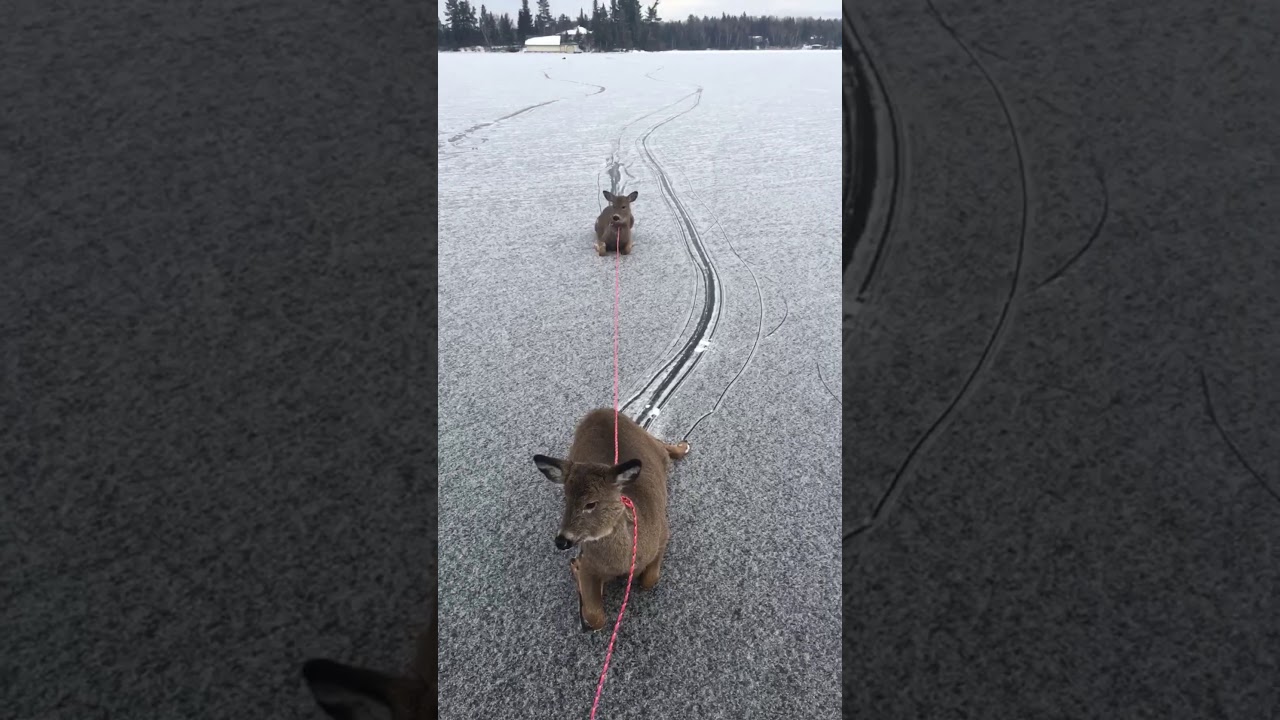
Two white-tailed deer sit on frosted lake ice, joined by a pink rope that runs toward the camera, with curving tracks behind them, a dark treeline and a white building on the far shore, and a blurred strip down the left edge.

Footage: Storyful Viral · 1:59 · uploaded December 13, 2019
Written by My Crittercam · published November 6, 2026

The Story

Two white-tailed deer sit on the frozen skin of an Ontario lake, tied to the same rope. They are going nowhere on their own.

There were three of them. On December 3 a man out skating on his lunch break came across the deer stranded on the ice: a doe and two younger animals, unable to get their footing. He went back to work for rope. The ice was still too thin for any vehicle, so skates were the only way to reach them.

He ties the rope around each deer and pulls. What follows is part rescue, part freight haul. The deer barely resist. They ride it out sitting down, and the last two slide across the lake together on one rope, more cargo than passengers.

White-tailed deer are good swimmers that enter streams and lakes to escape predators or insects, and they can bound at up to 30 miles per hour through tangled forest. Neither skill helps here. On this ice the deer cannot get their footing at all, and they stay down until the rope brings them to the edge.

They are at least dressed for the cold. In September white-tailed deer molt into dense woolly underfur beneath long hollow guard hairs, which can be raised for extra insulation. Through autumn they store fat under the skin, between muscles and even in the leg bones, which by late fall can make up 10 to 25 percent of body weight. The species' basic social unit is a doe and her fawns, though nothing in the footage shows that these two younger deer are hers.

At the edge of the ice the deer find their feet and stand. The two younger ones take off running at once. The doe stays behind, with what looked like an injured hip or leg. The rescuer called Ontario's Natural Resources Ministry, but with the lake not entirely frozen, nobody could safely go out to check on her right away.
Field Guide

On an Ontario lake in December, a skater ropes three stranded white-tailed deer and tows them to the edge of the ice, where they can stand again. Full field guide for the White-tailed deer

Common nameWhite-tailed deer
Scientific nameOdocoileus virginianus
FamilyCervidae (Deer)
Weight57 to 137 kg (125.55 to 301.76 lb). Missouri: females 110-145 lb, males 155-195 lb.Animal Diversity Web, University of Michigan · Missouri Department of Conservation
SizeHead and body 150 to 200 cm, tail 10 to 28 cm; 80 to 100 cm at the shoulder.Animal Diversity Web, University of Michigan
RangeMost of southern Canada and the United States (except most of California, Nevada and Utah), south through Central America to Bolivia.Animal Diversity Web, University of Michigan · Connecticut Department of Energy & Environmental Protection
DietHerbivore: leaves, twigs, fruits and nuts of trees and shrubs, herbaceous plants, grasses, crops, and occasionally fungi, mosses and lichens.Missouri Department of Conservation
Active whenCrepuscular: typically most active around dawn and dusk; activity may increase throughout the day during the breeding season.Maine Department of Inland Fisheries and Wildlife
LifespanMost live about 2 to 3 years; maximum in the wild 20 years, but few live past 10.Animal Diversity Web, University of Michigan
Conservation statusIUCN Red List: Least Concern (via NatureServe Explorer); NatureServe global rank G5.NatureServe Explorer
Cam notes · Camerahandheld, filmed by the rescuer
Cam notes · Time of dayday
Cam notes · Seasonearly winter, December 3
Cam notes · Placea frozen lake in Ontario, Canada

Habitat

Behavior

Questions

How much does a white-tailed deer weigh?

Adults weigh 57 to 137 kg. In Missouri, females run 110 to 145 lb and males 155 to 195 lb.Animal Diversity Web, University of Michigan · Missouri Department of Conservation

Why would deer be out on a lake at all?

White-tailed deer are good swimmers and enter streams and lakes to escape predators or insects. Sometimes called an edge species, they also feed in openings close to escape cover.Animal Diversity Web, University of Michigan · Washington Department of Fish and Wildlife

How do deer keep warm lying on ice?

In September they molt into a coat of dense woolly underfur under long hollow guard hairs, which can be raised for extra insulation. They also store fat in autumn, which by late fall can make up 10 to 25% of body weight.Maine Department of Inland Fisheries and Wildlife

Latest clips