The Story
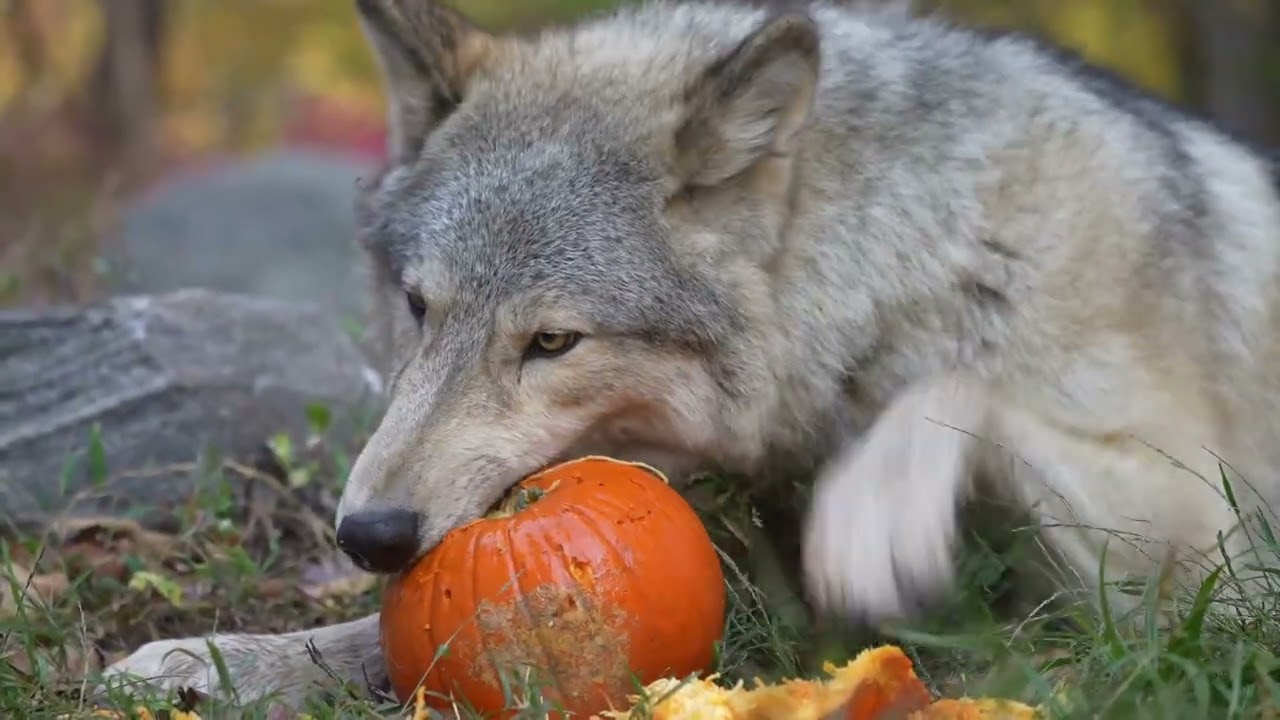
The pumpkin is losing. Silas, an ambassador gray wolf at the Wolf Conservation Center, lies in the grass with his jaws clamped over the top of it and one pale forepaw blurred in motion alongside.
One flank of the rind is already scraped raw, gouged down through the orange skin, and broken pieces lie in the grass in front of him. Behind him, gray rocks and autumn color sit out of focus. His coat runs gray over cream, his near eye shows amber above the fruit, and the large, blocky muzzle, a mark that separates a wolf from a coyote's pointed one, is pressed hard against the rind.
The treat is deliberate. Wolves are classed as carnivores, the center says, yet they may sometimes follow an omnivorous diet, taking meat, eggs and even fruit. In the fall, it adds, pumpkins are a special treat for its ambassador wolves.
The wild staple is another matter. In North America, gray wolves are primarily predators of medium and large hoofed mammals. In the Midwest wolves eat mainly white-tailed deer, with moose, beaver and snowshoe hare besides; in the Rocky Mountains they take elk, deer, moose, bison and beaver. A wolf can eat 20 pounds of meat in a single meal and may not eat for a week or more. A pumpkin is not that meal.
How much of this one actually goes down is harder to judge than how much gets broken. The center calls it eating. The most obvious work here is demolition: a grip held hard, a paw working, pieces coming away.
There is a precedent among the young. Pups stalk and pounce on each other and play with bones, feathers or animal skins, "killing" them and carrying them around as trophies. Silas is no pup, and a pumpkin is not on that list. The footage does not settle whether this is feeding or play. He keeps at it.