My Crittercam
My Crittercam › Coyote

Sideways stare from a coyote on a Maine trail

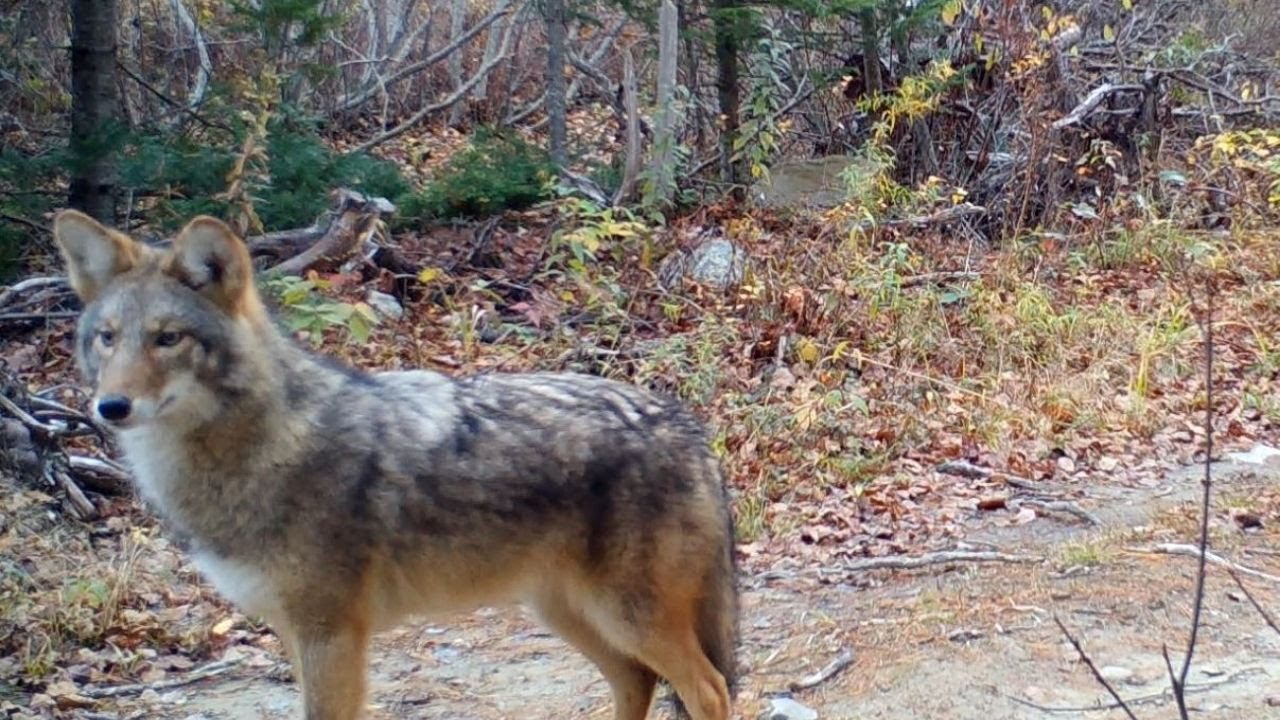
The front half of a coyote with tall pointed ears stands on a leaf-strewn dirt trail with its head turned to the camera, showing rusty cheeks, a white throat and chest and gray-brown fur, with a dark tree trunk, green shrubs and bare branches behind it.

Footage: Maine Wildlife Trail Videos · 11:14 · uploaded October 31, 2020
Written by My Crittercam · published November 6, 2026

The Story

Both ears up, both eyes on the lens. A coyote stands broadside on a leaf-strewn trail in Penobscot County, Maine, and for the moment the camera is the most interesting thing in these woods.

The coat reads easily. Black-washed fur runs along the back and down the flank, broken by a pale patch above the shoulder. Below that the color warms: rust on the legs, the ears and the cheeks, then a white throat and chest. New York's wildlife agency describes the eastern coyote in nearly those words, blonde or reddish blonde to dark tan washed with black, with legs, ears and cheeks usually reddish. Coyotes molt once a year, from May into July, so by late October this coat is long past that change.

One frame cannot put a number on this animal. The type runs large, though: eastern coyotes weigh 35 to 45 pounds and measure 4 to 5 feet from nose to tail. Beyond size, that agency's marks for telling one from a wolf are large pointed ears and a pointed snout, and both show here. At the far end of the frame the tail hangs low and dark, the carriage expected of the species.

Daylight is the less usual part. Coyotes are essentially nocturnal, more active after sunset and at night, though they may be seen by day. This one is out in plain light among yellowing leaves, on a bare dirt track. Coyote trails often follow game trails, road edges and dirt roads.

That is the ground this camera covers. The filmer runs five fixed trail cameras on ATV paths and game trails behind the house, and this coyote shares the week ending October 30, 2020 with a buck in rut, deer, black bear yearlings and bobcats at play. The filmer's usual roll call there includes deer and rabbit, and the coyote diet, about 90 percent mammals, takes in both. Nothing in the frame says it is hunting. For now it is only looking.
Field Guide

On a Penobscot County trail in fall color, a coyote stands broadside in daylight with its face turned to a fixed trail camera. Full field guide for the Coyote

Common nameCoyote
Scientific nameCanis latrans
FamilyCanidae (Dogs, wolves, foxes and jackals)
SizeLength 75 to 100 cm; 16-20 inches high at the shoulder (Yellowstone); eastern coyote 4 to 5 feet nose to tailAnimal Diversity Web, University of Michigan · National Park Service · New York State Department of Environmental Conservation
Weight7 to 21 kg; 25-35 pounds in Yellowstone; eastern coyote 35 to 45 poundsAnimal Diversity Web, University of Michigan · National Park Service · New York State Department of Environmental Conservation
DietAbout 90% mammals: voles, mice, rabbits, squirrels, plus deer, carrion, birds, insects and fruitAnimal Diversity Web, University of Michigan · National Park Service · New York State Department of Environmental Conservation
Active whenEssentially nocturnal; more active after sunset and at night, but may be seen moving about during the dayAnimal Diversity Web, University of Michigan · New York State Department of Environmental Conservation
RangeAlaska and Canada south through the US and Mexico to Central America; expanded into the eastern USAnimal Diversity Web, University of Michigan · NatureServe Explorer
LifespanIn Yellowstone: average life span 6 years, up to 13 yearsNational Park Service
Conservation statusIUCN Red List: Least Concern; NatureServe: G5NatureServe Explorer
Cam notes · Cameraone of 5 fixed trail cameras on ATV paths and game trails
Cam notes · Time of dayday
Cam notes · Seasonfall, week ending October 30, 2020
Cam notes · PlacePenobscot County, Maine

Habitat

Behavior

Questions

Is it a coyote or a wolf?

A coyote is about one-third a wolf's size, with large pointed ears and a pointed snout. Coyotes run with the tail down; wolves hold it straight out.National Park Service · New York State Department of Environmental Conservation · National Park Service

Why are coyotes out in the daytime?

Coyotes are not strictly nocturnal; they are more active after sunset and at night. In Rocky Mountain National Park they can be spotted frequently during the daytime.New York State Department of Environmental Conservation · National Park Service

Do coyotes eat deer?

Yes, deer are part of the diet, which is about 90% mammals along with carrion, birds, insects and fruit. In a Chicago-area study of 1,429 scats, the most common items were small rodents 42%, fruit 23%, deer 22% and rabbit 18%.Animal Diversity Web, University of Michigan · National Park Service · New York State Department of Environmental Conservation · Urban Coyote Research Project (Cook County, Illinois)

Latest clips