My Crittercam
My Crittercam › Black-capped Chickadee

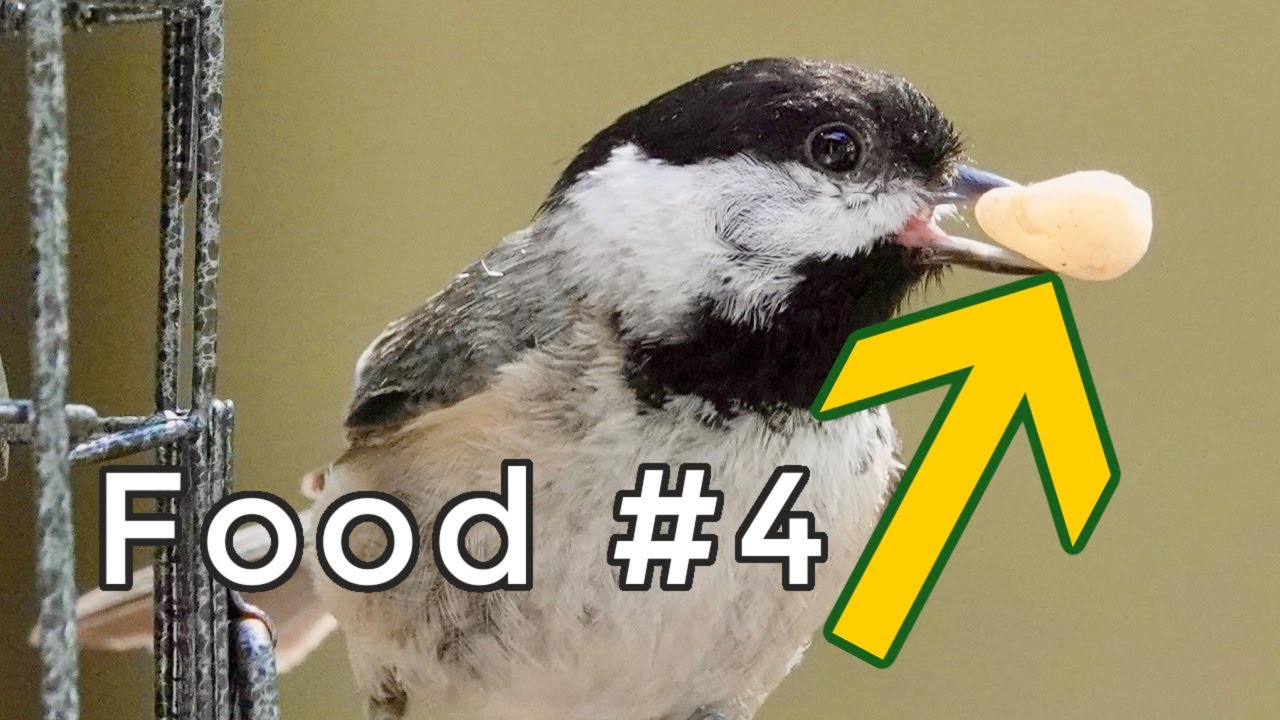
Shelled peanut in a black-capped chickadee's bill

Close-up of a black-capped chickadee's head, black bib and upper breast, its open bill holding a pale shelled peanut cut off by the right edge, with a yellow arrow pointing at the peanut and a white #4 at lower left.

Footage: Bird Watching HQ · 2:59 · uploaded December 13, 2021
Written by My Crittercam · published November 6, 2026

The Story

Food number four is a pale shelled peanut, pinched in the tip of the bill, and the black-capped chickadee holding it opens wide enough to show a pink gape. Black cap, white cheek and black bib fill the frame, and gray wire rises beside its tail, the edge of a backyard feeder.

This is one stop on a numbered menu. A backyard filmer shot chickadees up close in 4K eating eight foods: shelled, black-oil and striped sunflower seeds, shelled peanuts, safflower, suet, mealworms and nyjer.

Sunflower in its three forms fills the first minute after the intro. Peanuts then hold the screen longest of any single food, 33 seconds, while nyjer closes the list in about seven. That is screen time and nothing more. The numbers order the list, and the filmer's notes never call one food the favorite.

The menu reads well against the bird's own year. A chickadee lives mostly on insects, seeds and berries, and seeds and fruit may be no more than 10 percent of its summer diet but up to 50 percent in winter. Summer means mostly caterpillars, other insects and spiders, plus berries. Winter brings insect eggs and pupae, seeds and berries, and the bird will eat fat from dead animals.

At feeders this species tests each sunflower seed for plumpness and throws out empty shells before opening them, chasing the most calories for the least effort. It may also take sunflower seeds one at a time and fly off to stuff them into bark crevices, and in fall it can store up to 1,000 seeds a day. At 0.3 to 0.5 oz, eating more than 35 percent of its weight daily to stay warm, it has little room for waste.

The filmer rates chickadees small but bold, often the first birds to check out new foods and feeders in the yard. This one, at least, is not turning down the peanut.
Field Guide

Number four of eight backyard feeder foods, a shelled peanut pinched in the tip of a black-capped chickadee's bill. Full field guide for the Black-capped Chickadee

Common nameBlack-capped Chickadee
Scientific namePoecile atricapillus
FamilyParidae (Chickadees and Titmice)
DietMostly insects, seeds and berries; seeds and fruit may be no more than 10 percent of the summer diet and up to 50 percent in winter.National Audubon Society (Guide to North American Birds)
Weight0.3–0.5 oz (9–14 g).National Audubon Society (Guide to North American Birds)
SizeLength 5–6 in (12–15 cm); about the size of a sparrow.National Audubon Society (Guide to North American Birds) · National Park Service, Mississippi National River & Recreation Area
Wingspan6–8 in (15–20 cm).National Audubon Society (Guide to North American Birds)
RangeAlaska through the southern half of Canada, south to the upper two-thirds of the United States; mostly a permanent resident.Animal Diversity Web, University of Michigan · National Audubon Society (Guide to North American Birds)
Active whenDiurnal: active by day from first light, sleeping at night in thick branches or tree cavities.Smithsonian's National Zoo and Conservation Biology Institute
LifespanEstimated average about 2.5 years; most live about two to three years. Oldest on record 12.5 years (ADW) or over 11.5 years (Smithsonian).Animal Diversity Web, University of Michigan · Smithsonian's National Zoo and Conservation Biology Institute
Conservation statusIUCN Red List: Least Concern; NatureServe global rank G5. Numbers apparently stable.NatureServe Explorer · National Audubon Society (Guide to North American Birds)
Cam notes · Cameraclose-range 4K video
Cam notes · Time of dayday
Cam notes · Placethe filmer's backyard, at bird feeders

Habitat

Behavior

Questions

Will a chickadee eat out of my hand?

It is among the easiest birds to feed by hand. You must stand very still and let the birds get used to you.National Park Service, Mississippi National River & Recreation Area

Why does a chickadee grab one seed and fly off?

At feeders it may take sunflower seeds one at a time and fly away to stuff them into bark crevices. It often stores food to recover later.National Audubon Society (Guide to North American Birds) · National Park Service, Mississippi National River & Recreation Area

Is the chickadee at my feeder a black-capped or a Carolina?

The two are almost identical and are best told apart by range. In the overlap zone song may not help, as each species can learn the wrong song.National Audubon Society (Guide to North American Birds)

Latest clips