The Story
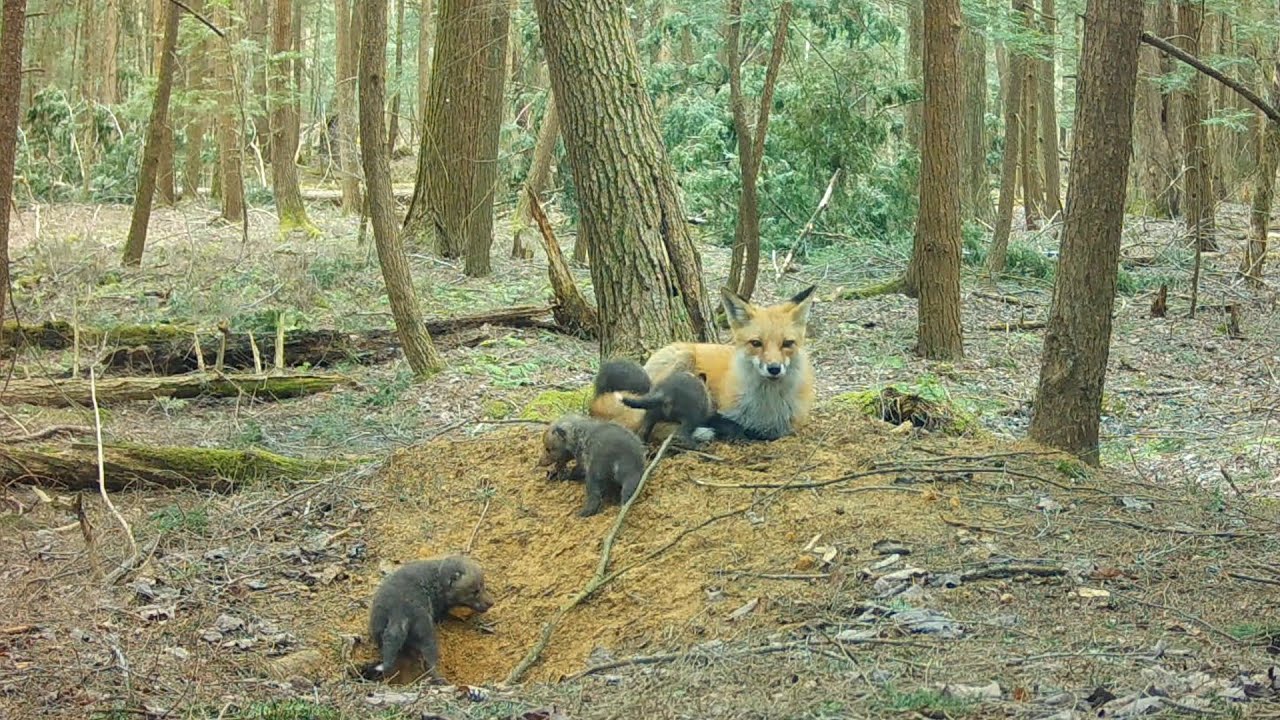
A red fox vixen settles on the bare sand of her den mound and calls, and dark gray shapes begin to come up out of the ground. It is April 2nd in a hemlock wood near Lake Ontario, and her kits are stepping outside for the first time.
She has earned the rest. Trail cameras have tracked her hunting from this den, leaving and returning within half an hour with prey for herself and the newborn litter. Today she heads to the lakeshore and returns with a muskrat. Only then does she sit by the entrance and call them up.
The kits look nothing like her yet. Their coats are dark gray against the orange sand, and each tail ends in a small white tip. That tip is a field mark. Red foxes carry a long, bushy, white-tipped tail, and the black booties and white tail tip together separate a red fox from a gray fox, even in grayish individuals. These kits are already wearing the giveaway.
First emergence runs on a schedule. Red fox kits are born blind, open their eyes at 9 to 14 days and leave the den at 4 to 5 weeks. Weaning comes by 8 to 10 weeks. Here two kits stay pressed against her flank while a third stands on the open sand.
At least four kits share the frame. Red fox litters average 4 or 5 pups, and a red fox eats 0.5 to 1 kg of food a day. As these kits grow, they will need a lot more to eat. Among red foxes, both parents bring food and guard the den; the male feeds the vixen but stays out of the maternity den.
At one point she gives a long stretch. Mostly she lies with head up and ears high, looking around the trees while the kits sort out what outside means. Young foxes disperse in fall, males usually first and farther, some nearly 400 km. For now the farthest any of these kits travels is the edge of the sand.