My Crittercam
My Crittercam › Gray wolf

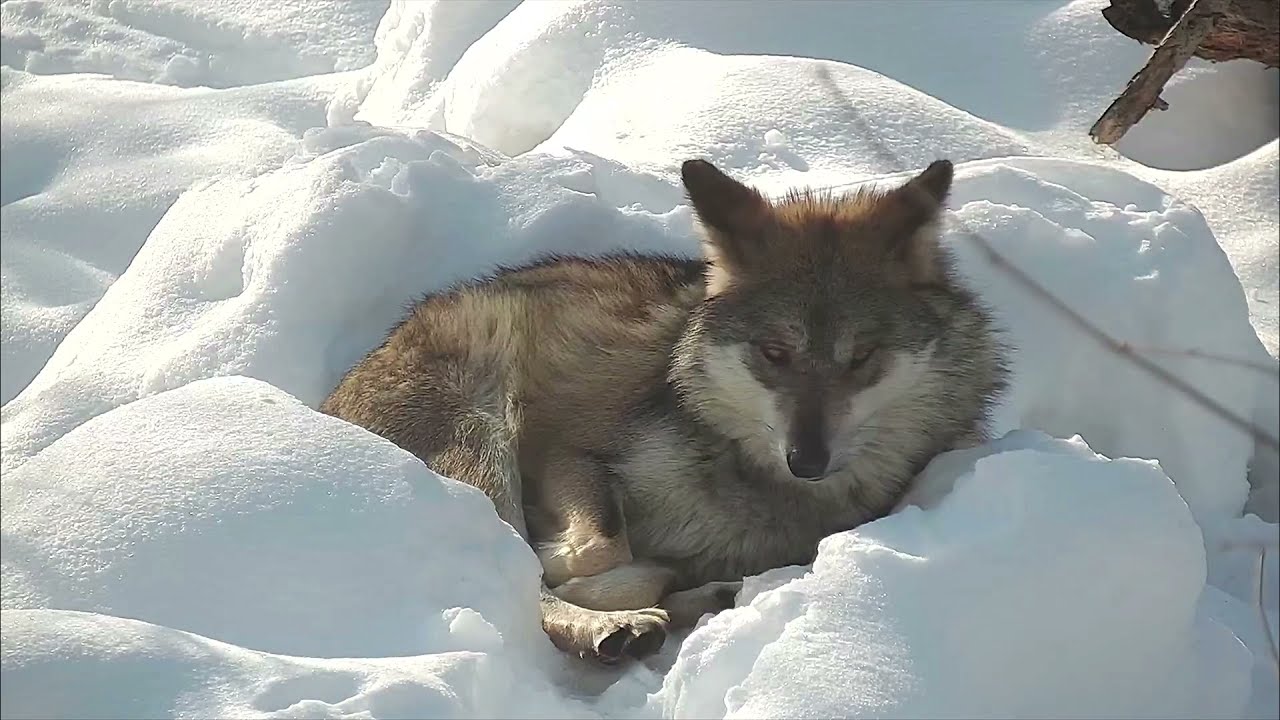
Mexican gray wolf curled up in a snow nest

A grizzled gray and tan wolf lies curled in deep sunlit snow with her head up, eyes half closed, ears raised and one front paw showing at the lower left.

Footage: Wolf Conservation Center · 1:04 · uploaded December 27, 2021
Written by My Crittercam · published November 6, 2026

The Story

A Mexican gray wolf named Jean lies curled into a hollow of drifted snow, chin low, the white heaped around her like the rim of a bowl. It is broad daylight in winter, and she has settled in.

Jean lives at the Wolf Conservation Center, where she stands for the center's part in the effort to save her kind from extinction. The Mexican gray wolf also goes by lobo. Whatever the label, she is a gray wolf, Canis lupus, and her species carries its own gear for snow.

Every fall a dense undercoat grows in beneath the outer guard hairs. Wolves shed it by July and start regrowing it in mid-August, ready for the cold. Their big feet work like snowshoes, and hair between the toes keeps snow from freezing there. A drift that would chill a person through is, for Jean, a cozy place to bed down. Nest is the right word for it: the drift curves up around her body.

Her daytime stillness fits the species' habits. Gray wolves are mainly nocturnal, and their movements usually happen at night. In Minnesota, wild wolves spend most of fall and winter sleeping, resting or traveling, and surprisingly little of it feeding.

So she rests, nose low, the snow shaped to her body as if she had poured herself into it.

Then a crow calls. Jean's head comes up from the snow, and the nap is over, at least for now. Crows, it seems, make poor neighbors for anyone trying to sleep in. What she makes of the interruption, the clip does not say.
Field Guide

Jean, a Mexican gray wolf at the Wolf Conservation Center, lies curled in a snow hollow on a winter day until a crow's call lifts her head. Full field guide for the Gray wolf

Common nameGray wolf
Scientific nameCanis lupus
FamilyCanidae (Dog family)
SizeMales 5 to 6.5 ft long nose to tail tip, females 4.5 to 6 ft; 26 to 32 in at the shoulderU.S. Fish & Wildlife Service (hosted by Montana Fish, Wildlife & Parks)
WeightMales 70 to 115 lb, females 60 to 100 lb; Alaska males occasionally 145 lbU.S. Fish & Wildlife Service (hosted by Montana Fish, Wildlife & Parks)
DietMainly medium and large hoofed mammals. Midwest: mainly white-tailed deer, also moose, beaver and snowshoe hare; Rocky Mountains: elk, deer, moose, bison and beaverU.S. Fish & Wildlife Service (hosted by Montana Fish, Wildlife & Parks) · U.S. Fish & Wildlife Service
Active whenMainly nocturnal; movements are usually at night and cover long distancesNatureServe Explorer · Animal Diversity Web, University of Michigan
LifespanUp to 13 years in the wild, 15 in captivity; Yellowstone average 4-5 yearsU.S. Fish & Wildlife Service (hosted by Montana Fish, Wildlife & Parks) · National Park Service, Yellowstone National Park
Conservation statusNatureServe global rank G5. US Endangered Species Act: threatened in Minnesota, endangered in most other lower-48 states; Northern Rocky Mountain population delistedNatureServe Explorer
Cam notes · Time of dayday
Cam notes · Seasonwinter (snow)
Cam notes · PlaceWolf Conservation Center

Habitat

Behavior

Questions

How can a wolf sleep on snow without freezing?

Each fall a dense undercoat grows in under the outer guard hairs, and wolves shed it by July and regrow it from mid-August. Their big feet work like snowshoes, and hair between the toes keeps snow from freezing there.International Wolf Center · International Wolf Center · Animal Diversity Web, University of Michigan

Do wolves sleep during the day?

Gray wolves are mainly nocturnal, and their movements usually happen at night. In Minnesota, wolves spend most of fall and winter sleeping, resting or traveling, with little time spent feeding.NatureServe Explorer · Animal Diversity Web, University of Michigan

Are gray wolves endangered?

Globally the gray wolf holds a conservation rank of G5. Under the US Endangered Species Act it is threatened in Minnesota and endangered in most other lower-48 states, while the Northern Rocky Mountain population has been delisted.NatureServe Explorer

Latest clips