My Crittercam
My Crittercam › Snowy Owl

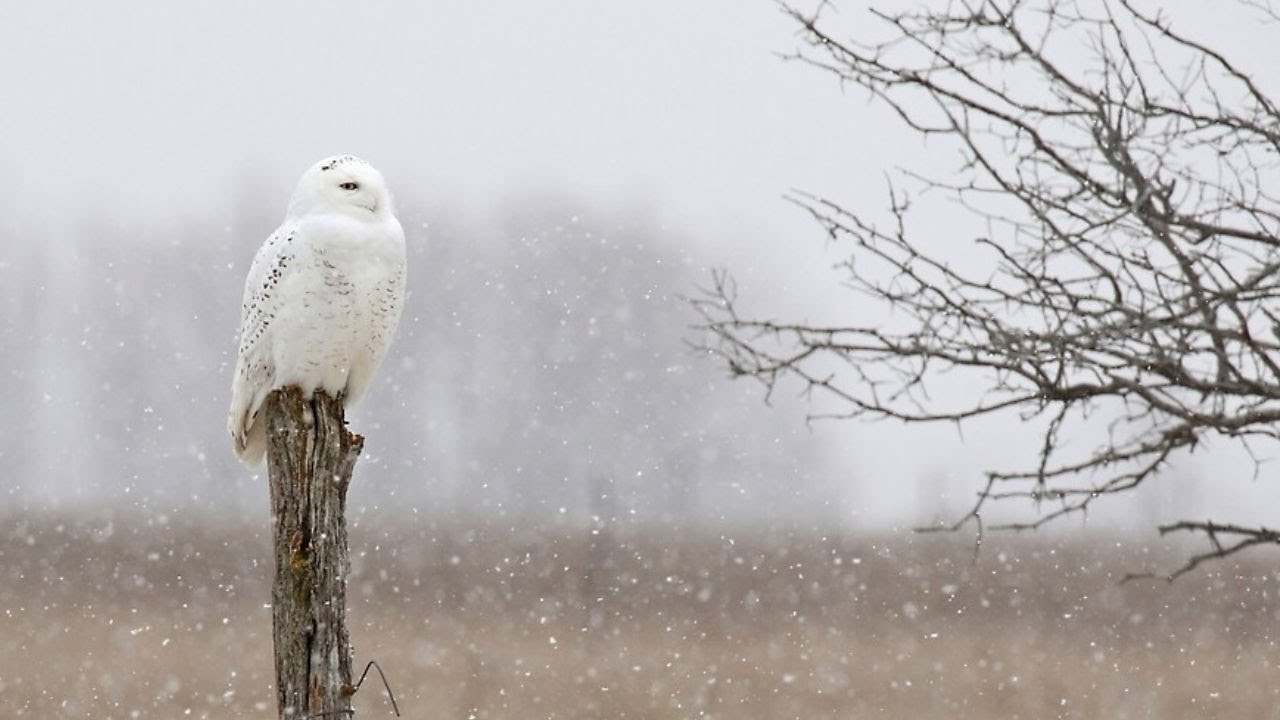
Male snowy owl holds his post in falling snow

A white snowy owl with dark flecks on its wings, flank and crown, eyes half closed, perches on top of a weathered wooden post, head turned to one side, as snow falls over a misty brown field.

Footage: Thee Owl Queen - Owlology · 13:34 · uploaded December 29, 2018
Written by My Crittercam · published November 6, 2026

The Story

A male snowy owl sits on a weathered wooden post above a Canadian field, white against a white sky. Below him, the ground is alive with voles.

This was an eruption year for voles in this spot. They show in the field, at the filmer's feet, as tracks pressed into the mud, and running across the road. He was the nearest of the owls to that road, so the whole day could be filmed without a step into the field. For a bird whose menu runs to lemmings, voles, mice, rabbits and hares, the table is laid edge to edge.

Snowy owls usually hunt from a perch, then chase prey in swift flight and take it in the talons. They find it by sight or by sound, and can pinpoint a rodent moving under snow by hearing. A post above a crowded field is the textbook setup, and for the first hours he sits on it and takes the field in.

Nothing in the account of the day has him making a catch. In winter Project SNOWstorm says snowy owls are active primarily at night and fairly inactive by day. Its Scott Weidensaul says they are more active, and earlier in the afternoon, on gloomy, cloudy days. This day ran through nearly every kind of weather.

He is close to white, with a scatter of dark flecks on the wings. Males have the least dark marking, and the Owl Research Institute says it takes males several years to turn totally white. A female he regularly roosts with makes a short appearance. Close to 25 snowy owls were counted on the same ground, a crowd for a species that is generally solitary and territorial, and whose females set up winter territories they defend until spring.

The day ends in heavy snow. White plumage hides a snowy owl in snow-covered country, and its legs and feet are wrapped in feathers, layered more densely than in owls of warmer climates. Snow blurs the field behind him, and he stays on the post.
Field Guide

A near-white male snowy owl watches from his post above a Canadian field overrun with voles, with a brief visit from the female he roosts with and heavy snow at the end of the day. Full field guide for the Snowy Owl

Common nameSnowy Owl
Scientific nameBubo scandiacus
FamilyStrigidae (Typical owls)
Size24 in (61 cm) long (Audubon); 63 to 73 cm per ADW. Females outsize males.National Audubon Society · Animal Diversity Web, University of Michigan · Owl Research Institute
Wingspan4 ft 7 in (1.4 m) per Audubon; ADW gives an average of 170 cm.National Audubon Society · Animal Diversity Web, University of Michigan
WeightMales 700-2500 g (1.5-5.5 lbs); females 790-2950 g (2-6.5 lbs).Owl Research Institute
DietLemmings, voles, mice, rabbits and hares, plus birds as big as geese; also fish and carrion.National Audubon Society · Minnesota Department of Natural Resources
Active whenHunts at any hour in Arctic summer daylight; in winter Project SNOWstorm says it is active primarily at night, and field observers see it fairly inactive by day.Owl Research Institute · Project SNOWstorm · Project SNOWstorm
RangeBreeds on Arctic tundra in Alaska and northern Canada; winters in Canada and the northern US, with irruptions farther south.Animal Diversity Web, University of Michigan · Minnesota Department of Natural Resources
LifespanOldest known wild bird at least 9 years 5 months; at least 28 years in captivity.Animal Diversity Web, University of Michigan
Conservation statusIUCN Red List: Vulnerable; NatureServe global rank G4; COSEWIC (Canada): Threatened, May 2025.NatureServe Explorer
Cam notes · Time of dayday, from the first hours to the end of the day
Cam notes · Seasonwinter, with snow
Cam notes · Placea field in Canada, filmed from the road

Habitat

Behavior

Questions

Do snowy owls hunt during the day?

They will hunt at any time in the constant daylight of the Arctic summer, usually from a perch before a swift chase. In winter, Project SNOWstorm says they are active primarily at night, and observers find them fairly inactive by day.National Audubon Society · Project SNOWstorm · Project SNOWstorm

Where do snowy owls live?

They breed on Arctic tundra in Alaska and northern Canada and winter in Canada and the northern US, with irruptions farther south. In winter they favor open country such as prairies, farmland, coastal marshes and beaches.Animal Diversity Web, University of Michigan · Minnesota Department of Natural Resources · National Audubon Society

Why are there so many snowy owls some winters?

Irruptions follow big Arctic breeding years fueled by lemmings, and the owls coming south are mostly healthy young birds. Approximately every four years, many snowy owls irrupt into the northern US in winter.Audubon Magazine (National Audubon Society) · Project SNOWstorm · Animal Diversity Web, University of Michigan

Latest clips