My Crittercam
My Crittercam › White-tailed deer

Lone white-tailed fawn waits in the dry leaves

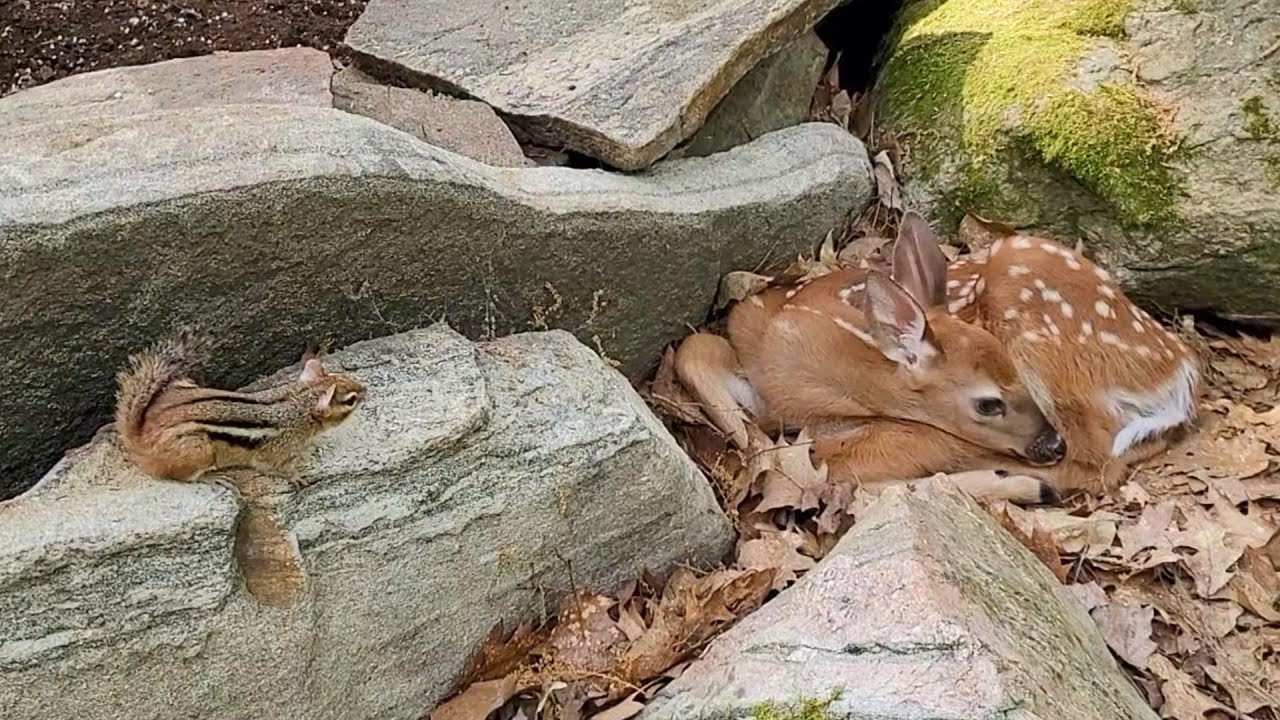
A spotted white-tailed deer fawn lies curled on dry brown leaves between gray stones and a moss-covered rock, ears up and one dark eye open.

Footage: ChooChoo's Story · 8:49 · uploaded June 26, 2021
Written by My Crittercam · published November 6, 2026

The Story

A chipmunk stops on a slab of gray rock, tail curled high, and stares. One stone over, a white-tailed deer fawn lies folded into the dead leaves with its ears up and one dark eye open, and it does not move.

No doe is in sight. The fawn is alone among the stones at the filmer's home, tucked in beside a mossy rock with its nose down by one black hoof. A small animal this still, this much by itself, looks like a problem. Anyone finding it would wonder whether it is hurt.

It is keeping an appointment. A white-tailed doe leaves her fawns hidden and visits only three or four times a day, for about 15 minutes each, a routine that diverts predators' attention. Between visits a fawn stays down for up to four hours, until she returns. A fawn can lie flat with its neck outstretched. This one holds a tight curl. Its white spots put a ceiling on its age, since fawns lose them at three to four months.

The chipmunk is not the only visitor. A person comes close too, with water on offer, and the fawn still stays put. Then it goes. It breaks from the leaves and runs, and the legs that stayed folded all this time turn out to work fine. Fawns can walk at birth, so the stillness was never about the legs.

The missing mother closes the story. A doe calls a hidden fawn with a soft mewing sound, and the basic social unit of the species is exactly this, a doe and her fawns. The fawn ends up at her side, the two of them walking off together. About a month later, by the filmer's account, the pair come back to the same place. The chipmunk's opinion goes unrecorded.
Field Guide

A spotted white-tailed fawn left alone among the stones at a home holds still under a chipmunk's stare before it runs, and later walks off beside its mother. Full field guide for the White-tailed deer

Common nameWhite-tailed deer
Scientific nameOdocoileus virginianus
FamilyCervidae (Deer)
SizeHead and body 150 to 200 cm, tail 10 to 28 cm; 80 to 100 cm at the shoulder.Animal Diversity Web, University of Michigan
Weight57 to 137 kg (125.55 to 301.76 lb). Missouri: females 110-145 lb, males 155-195 lb.Animal Diversity Web, University of Michigan · Missouri Department of Conservation
DietHerbivore: leaves, twigs, fruits and nuts of trees and shrubs, herbaceous plants, grasses, crops, and occasionally fungi, mosses and lichens.Missouri Department of Conservation
Active whenCrepuscular: typically most active around dawn and dusk; activity may increase throughout the day during the breeding season.Maine Department of Inland Fisheries and Wildlife
LifespanMost live about 2 to 3 years; maximum in the wild 20 years, but few live past 10.Animal Diversity Web, University of Michigan
RangeMost of southern Canada and the United States (except most of California, Nevada and Utah), south through Central America to Bolivia.Animal Diversity Web, University of Michigan · Connecticut Department of Energy & Environmental Protection
Conservation statusIUCN Red List: Least Concern (via NatureServe Explorer); NatureServe global rank G5.NatureServe Explorer
Cam notes · Time of dayday
Cam notes · Placethe filmer's home

Habitat

Behavior

Questions

Was this fawn abandoned by its mother?

Often the doe is nearby: she visits her fawns only three or four times a day, for about 15 minutes each, to divert predators' attention. Removing a healthy fawn from the wild is illegal and lowers its chance of survival.Connecticut Department of Energy & Environmental Protection

Why does a fawn lie so still instead of running away?

The doe leaves her fawns hidden in dense vegetation, where they lie flat with necks outstretched for up to four hours until she returns. Fawns can walk at birth, so lying still does not mean a fawn cannot move.Animal Diversity Web, University of Michigan · Oklahoma Department of Wildlife Conservation

How does a mother deer get back to her hidden fawn?

Does call hidden fawns with a soft mewing sound. A fawn may wait up to four hours for her return.Washington Department of Fish and Wildlife · Oklahoma Department of Wildlife Conservation

Latest clips