My Crittercam
My Crittercam › Moose

Lone moose noses along a November trail

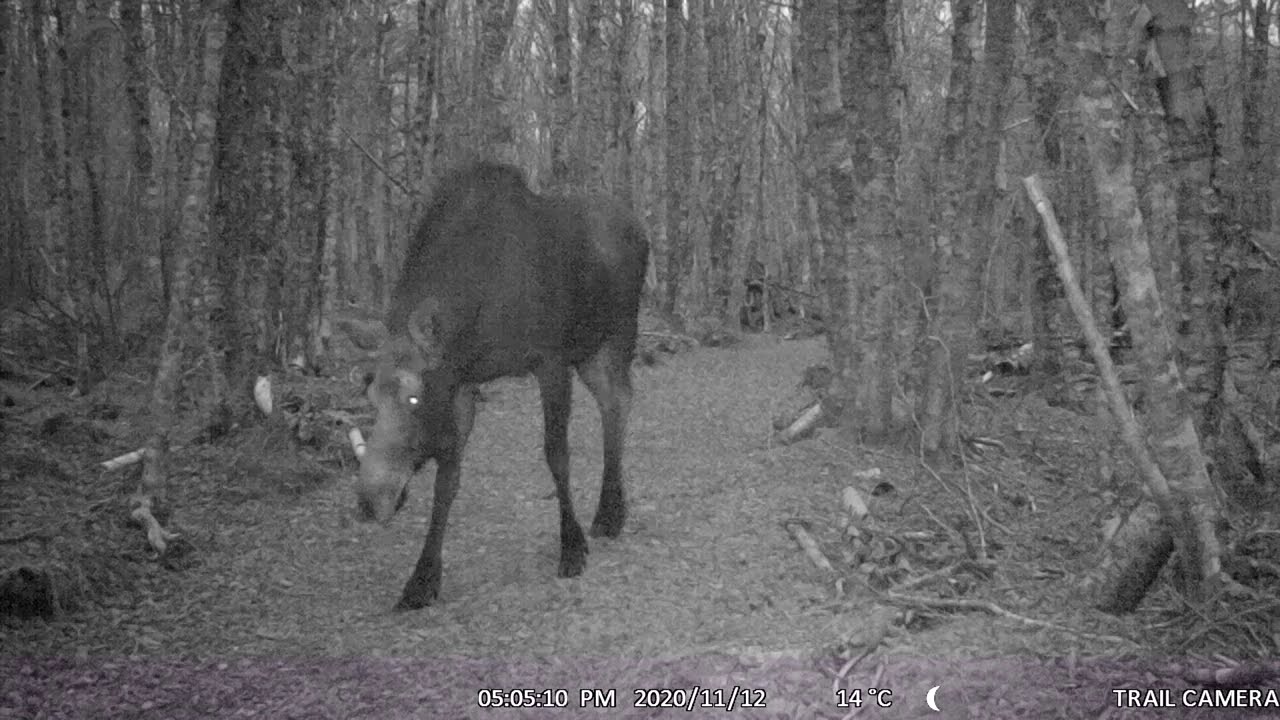
A dark, antlerless moose lowers its long muzzle toward a leaf-covered forest trail in black-and-white infrared, bare trunks behind it and a time stamp along the bottom edge.

Footage: Dale Calder · 2:59 · uploaded November 18, 2020
Written by My Crittercam · published November 6, 2026

The Story

A moose stands mid-stride on a trail carpeted in fallen leaves, bare November woods around it, and puts its long nose to the ground. The trail camera has already gone to infrared at five past five in the afternoon.

Everything about the animal runs long. The legs rise tall above the litter, the drooping muzzle hangs near the ground, and the back peaks above the front shoulders. This is the largest member of the deer family: five to seven feet at the shoulder on average, and anywhere from 800 pounds for a small cow to 1,600 for a large bull.

The head is bare. Bulls drop their antlers after the rut, in late fall or early winter, and Minnesota DNR says usually in December and January, so an antlerless moose in mid-November leans toward a cow without proving it. A cow's brown face against a bull's black one would help, but infrared shows no color.

The hour fits. Moose are crepuscular, most active at dawn and dusk. Walking alone fits too: moose are the least social of the deer, fairly solitary outside the mating season, and the rut is weeks past.

The lowered head could be sniffing the trail or picking at the leaves; the frame does not say which. In fall, moose browse willow, birch and aspen twigs, and an adult needs about 20 kilograms of food a day. That is a great many twigs.

Each of the three moose clips plays twice, once at normal speed and once at half speed, and the slow pass is where those legs earn a second look. On a bare autumn trail they seem almost excessive. In deep snow they are the right tool, letting a moose paw down to its food. This one keeps its head low the whole frame.
Field Guide

On a leaf-covered woodland trail at five on a November afternoon, a lone moose with no antlers stands mid-stride under infrared and puts its nose to the ground. Full field guide for the Moose

Common nameMoose
Scientific nameAlces alces
FamilyCervidae (Deer family)
SizeAdults stand on average 5 to 7 feet at the shoulder; total length about 9 feet (Maine).National Park Service · Maine Department of Inland Fisheries and Wildlife · Animal Diversity Web, University of Michigan
Weight800 lb (small adult female) to 1,600 lb (large adult male).Alaska Department of Fish and Game · Animal Diversity Web, University of Michigan
DietBrowser: leaves and shoots in summer, twigs of willow, birch and aspen in fall and winter, plus aquatic plants. Up to 70 lb of food a day.Animal Diversity Web, University of Michigan · Alaska Department of Fish and Game · National Park Service
Active whenCrepuscular: most active at dawn and dusk.Animal Diversity Web, University of Michigan · Maine Department of Inland Fisheries and Wildlife
RangeMuch of Alaska and Canada, the northern edge of the contiguous US, and south along the Rocky Mountains to Utah and Colorado.Animal Diversity Web, University of Michigan
LifespanRarely more than 16 years in the wild; one cow lived to 22.Alaska Department of Fish and Game · Animal Diversity Web, University of Michigan
Conservation statusIUCN Red List: Least Concern. NatureServe: G5; N5 in US and Canada.Animal Diversity Web, University of Michigan · NatureServe Explorer
Cam notes · Cameratrail camera
Cam notes · Time of dayabout 5 PM by the camera stamp, infrared (night mode)
Cam notes · Seasonlate fall, November by the camera stamp; bare trees and leaf litter

Habitat

Behavior

Questions

Do moose usually travel alone?

Moose are the least social member of the deer family and are fairly solitary except during the mating season. They are not territorial.Animal Diversity Web, University of Michigan

Are moose dangerous to people?

Moose usually flee, yet more people in Alaska are injured by moose than by bears each year. They can turn aggressive when harassed, when hungry and tired in deep winter snow, or as cows guarding calves.Alaska Department of Fish and Game

Why do moose have such long legs?

In winter, long legs let moose paw through deep snow to reach food such as willow, birch and aspen twigs. They also tramp out paths in the snow called yards.National Park Service · Alaska Department of Fish and Game

Latest clips