My Crittercam
My Crittercam › Gray wolf

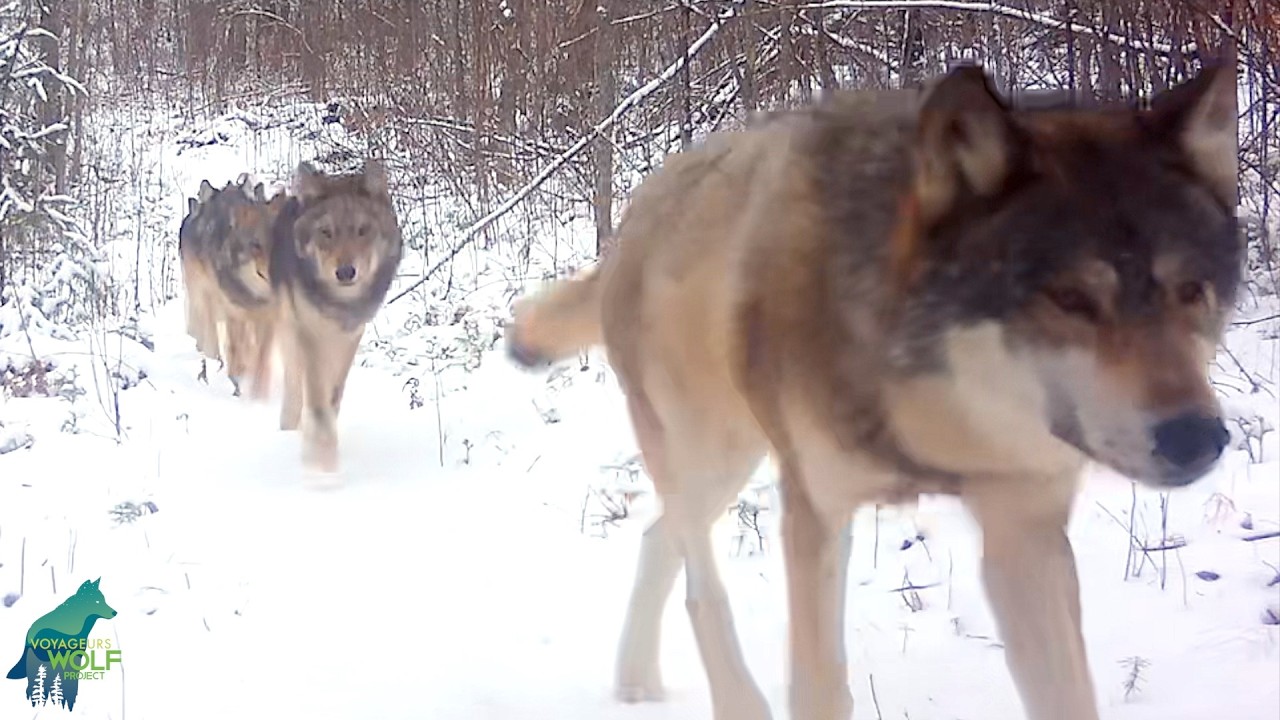
Gray wolf noses a trail camera in Minnesota snow

Close-up of a gray wolf from head to forelegs, dark grizzled face with upright ears and a black nose, turned slightly right against snow and bare saplings.

Footage: Voyageurs Wolf Project · 0:27 · uploaded June 1, 2026
Written by My Crittercam · published November 6, 2026

The Story

A gray wolf's face swings into the lens, near enough to block out the forest, short rounded ears up and a broad black-nosed muzzle going for the camera. Behind it, on a snowy trail in northern Minnesota, more wolves are coming.

This is the Blackstone Pack, the largest pack in the Greater Voyageurs Ecosystem in the winter of 2025-26, and the wolves do not simply walk by. They give the camera a few nibbles on their way past, a research camera inspected by the very animals it was put up to study.

Large has a yardstick here. Midwest packs average four to eight wolves in winter, with records of up to 16. A pack is a family: a breeding male and female, their pups, perhaps last year's young, and sometimes older wolves. In the Voyageurs area, pups have grown to the size of small adults by freeze-up and can travel with their parents, so a winter line may carry the year's litter among the adults.

The lead animal settles any coyote question in one frame. Its ears are short and rounded, not long and pointed, and its muzzle is large and blocky rather than petite. The coat is buff-tan grizzled with gray and black. Big feet work like snowshoes in snow like this, and hair between the toes keeps it from freezing there.

Wolves are shy but very curious by nature, though no source here explains a taste for camera housings. The footage shows the sequence plainly: a nose at the lens, a nibble, then the trail again.

Sleeping, resting and traveling fill most of a Minnesota wolf's fall and winter; feeding takes little of its time. A wolf trots at about 5 mph and may cover as far as 30 miles a day hunting. Around Voyageurs, frozen shorelines turn into wolf pathways once the ice sets. Midwest wolves live mainly on white-tailed deer. This pack found a camera instead and, judging by the tooth work, rated it a poor substitute.
Field Guide

On a snowy trail in northern Minnesota, the Blackstone Pack, the largest pack in the Greater Voyageurs Ecosystem in the winter of 2025-26, files past a trail camera and stops to nibble it. Full field guide for the Gray wolf

Common nameGray wolf
Scientific nameCanis lupus
FamilyCanidae (Dog family)
SizeMales 5 to 6.5 ft long nose to tail tip, females 4.5 to 6 ft; 26 to 32 in at the shoulderU.S. Fish & Wildlife Service (hosted by Montana Fish, Wildlife & Parks)
WeightMales 70 to 115 lb, females 60 to 100 lb; Alaska males occasionally 145 lbU.S. Fish & Wildlife Service (hosted by Montana Fish, Wildlife & Parks)
DietMainly medium and large hoofed mammals. Midwest: mainly white-tailed deer, also moose, beaver and snowshoe hare; Rocky Mountains: elk, deer, moose, bison and beaverU.S. Fish & Wildlife Service (hosted by Montana Fish, Wildlife & Parks) · U.S. Fish & Wildlife Service
Active whenMainly nocturnal; movements are usually at night and cover long distancesNatureServe Explorer · Animal Diversity Web, University of Michigan
RangeLower 48: Minnesota, Wisconsin, Michigan, Montana, Idaho, Wyoming and northern Washington's Cascades; tens of thousands in Canada and AlaskaU.S. Fish & Wildlife Service (hosted by Montana Fish, Wildlife & Parks) · NatureServe Explorer
LifespanUp to 13 years in the wild, 15 in captivity; Yellowstone average 4-5 yearsU.S. Fish & Wildlife Service (hosted by Montana Fish, Wildlife & Parks) · National Park Service, Yellowstone National Park
Conservation statusNatureServe global rank G5. US Endangered Species Act: threatened in Minnesota, endangered in most other lower-48 states; Northern Rocky Mountain population delistedNatureServe Explorer
Cam notes · Cameraresearch trail camera
Cam notes · Time of dayday
Cam notes · Seasonwinter, snow on the ground
Cam notes · PlaceGreater Voyageurs Ecosystem, northern Minnesota

Habitat

Behavior

Questions

How many wolves are in a Minnesota wolf pack?

Midwest packs average four to eight wolves in winter, with records of up to 16. A pack is a family group: a breeding male and female, their pups, perhaps last year's young and sometimes older wolves.U.S. Fish & Wildlife Service (hosted by Montana Fish, Wildlife & Parks)

Do Minnesota wolves mostly eat deer?

In the Midwest, wolves eat mainly white-tailed deer, but also moose, beaver and snowshoe hare. In northern Minnesota summers they mostly hunt small prey such as beavers and deer fawns.U.S. Fish & Wildlife Service (hosted by Montana Fish, Wildlife & Parks) · Voyageurs Wolf Project, University of Minnesota

Are gray wolves still a protected species in Minnesota?

On the latest federal listing, the gray wolf is threatened in Minnesota under the US Endangered Species Act, endangered in most other lower-48 states, and delisted in the Northern Rocky Mountain population. Its global conservation rank is G5.NatureServe Explorer

Latest clips