My Crittercam
My Crittercam › Eastern gray squirrel

Gray squirrel fakes a burial to fool a thief

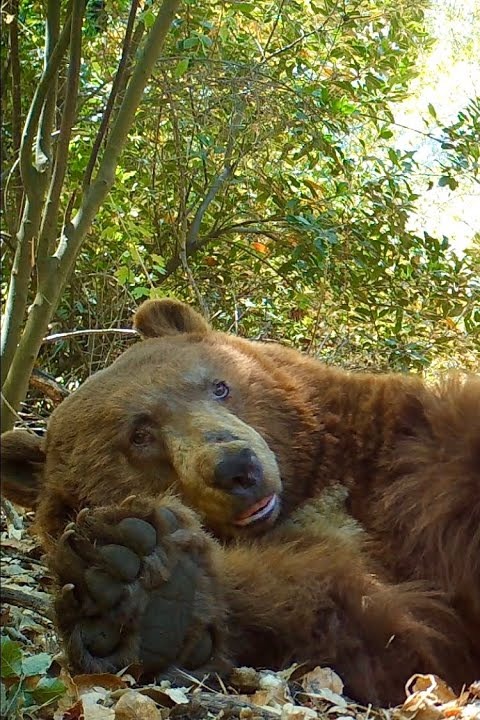
An eastern gray squirrel stands upright in front of a dark tree trunk, front paws folded against its white chest and a reddish acorn held in its mouth.

Footage: BBC Earth · 4:13 · uploaded September 10, 2019
Written by My Crittercam · published November 6, 2026

The Story

An eastern gray squirrel on the woodland floor lashes its tail at a stranger offering free acorns. The stranger is a robotic squirrel with a hidden camera, and it is about to film a crime.

The fluffed, lashing tail is no idle gesture. Gray squirrels talk with postures as well as calls, and tail flicking is part of that vocabulary. Once the newcomer proves a pushover, the squirrel takes the acorn and buries it at once.

That burial is the species' winter plan in miniature. Gray squirrels scatter-hoard, tucking nuts into many separate caches instead of one larder, then find them again by memory and smell. In a 1991 enclosure study, eight hand-raised gray squirrels recovered twice as many of their own nuts as another squirrel's and planned routes through their caches. In a 1997 experiment they could remember up to 24 cache locations for up to two months.

A scattered larder has one weakness. Anyone can dig. A second squirrel has watched where the acorn went in, and as soon as it is covered she moves in and digs it up. Theft is fine until the owner notices, and then the claws come out in a scrambling chase.

The next round goes to the victim. With the thief possibly still watching, he makes a grand show of burying his nut in an empty patch of ground. She waits for the performance to end, sneaks in and finds nothing. The acorn never left his mouth, and now he can eat it or bury it somewhere she is not looking.

Out in the woods, an acorn that stays lost is not wasted, since many unrecovered nuts eventually germinate and gray squirrels essentially plant nut trees. The thief, meanwhile, has not retired. The robot offers one more nut, this one with a camera inside, and she takes it.
Field Guide

A gray squirrel that lost one buried acorn to a thief stages a fake burial for her and keeps the real nut in his mouth. Full field guide for the Eastern gray squirrel

Common nameEastern gray squirrel
Scientific nameSciurus carolinensis
FamilySciuridae (squirrels)
DietOmnivore: mostly nuts (acorns, hickory, walnut, beech), seeds, buds, flowers, fruit and fungi; also corn, insects, bird eggs, nestlings and frogsAnimal Diversity Web, University of Michigan Museum of Zoology · Mass Audubon
SizeTotal length 380 to 525 mm, tail 150 to 250 mm; Missouri: 14 to 21 inches totalAnimal Diversity Web, University of Michigan Museum of Zoology · Missouri Department of Conservation
Weight338 to 750 g, average 540.33 g; Missouri: 3/4 to 1 1/2 poundsAnimal Diversity Web, University of Michigan Museum of Zoology · Missouri Department of Conservation
Active whenDaytime, year-round; spring to fall peaks about 2 hours after sunrise and 2-5 hours before sunset; winter single peak 2-4 hours before sunsetAnimal Diversity Web, University of Michigan Museum of Zoology · Mass Audubon
RangeEastern United States to just west of the Mississippi River and north to Canada; introduced in western states and parts of CanadaAnimal Diversity Web, University of Michigan Museum of Zoology
LifespanUp to 12.5 years in the wild; a captive female lived more than 20 yearsAnimal Diversity Web, University of Michigan Museum of Zoology
Conservation statusIUCN Red List: Least Concern; NatureServe global rank G5 (Secure)NatureServe Explorer · Animal Diversity Web, University of Michigan Museum of Zoology
Cam notes · Camerahidden spy cameras in a spy squirrel and in a nut
Cam notes · Time of dayday

Habitat

Behavior

Questions

Do squirrels really remember where they buried their nuts?

Yes, using both memory and smell. In a 1991 enclosure study, eight hand-raised gray squirrels recovered twice as many of their own nuts as another squirrel's. In a 1997 experiment they could remember up to 24 cache locations for up to two months.Animal Diversity Web, University of Michigan Museum of Zoology · Scientific American

Why are squirrels always chasing each other?

One reason is courtship: gray squirrels breed twice a year, December to February and May to June, slightly later farther north, and courtship features noisy chases through the treetops. They also turn noisy when alarmed or angry, chattering, rasping and barking.Chesapeake Bay Program · Animal Diversity Web, University of Michigan Museum of Zoology · Mass Audubon

Why does a squirrel flick its tail?

Tail flicking is one of the postures gray squirrels use to communicate with each other. The tail also serves for balance and warmth.Animal Diversity Web, University of Michigan Museum of Zoology · Chesapeake Bay Program

Latest clips