The Story
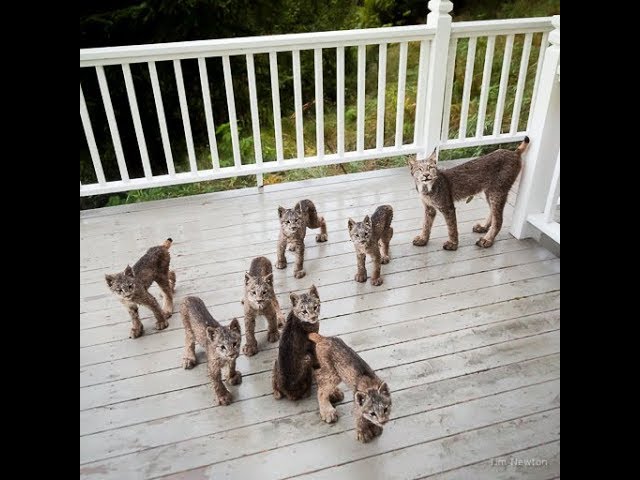
On a snowy deck in Alaska, seven Canada lynx kittens frolic and roughhouse with one another, and their mother is right in the scrum with them. Eight wild cats share one stretch of planking, and none of them holds still.
This is a return visit. The family first turned up in September, when the mother and all seven kittens lined up in front of the door to the deck long enough for the homeowner to take their photograph. That photograph, green forest behind a white railing, heads this page. Now there is snow, and nobody is posing.
Seven is a lot of kittens. In Alaska most lynx litters have two to four, and kitten survival rides on snowshoe hares, which make up 35 to 99 percent of a lynx's prey by biomass. When hares are scarce, kitten deaths rise and pregnancy rates fall, and prey scarcity can kill nearly all the young. This mother had seven at her side in September and seven again in the snow.
In Alaska, lynx mate in March and early April, and the kittens are born about 63 days later. They stay with their mother until the next winter's mating season. Adults are solitary and typically avoid each other outside the breeding season, so a crowd of lynx on one deck means a family that has not split up yet.
A family that stays together can hunt together. Females and young sometimes go after hares as a group, spreading out in a line, so a hare flushed by one cat is often caught by another.
The feet are the giveaway. Lynx paws are exceptionally large and furry, the toes spreading wide in soft snow, and they work as snowshoes in deep powder, likely an edge over other terrestrial hare predators. On kittens with long hind legs, the effect is a little comic, like teenagers in borrowed boots.
One more oddity: the September portrait was taken in daylight, by a species that is most active between dusk and dawn and usually hides during the day.