My Crittercam
My Crittercam › Moose

Bull moose traps an Alaska man in his shed

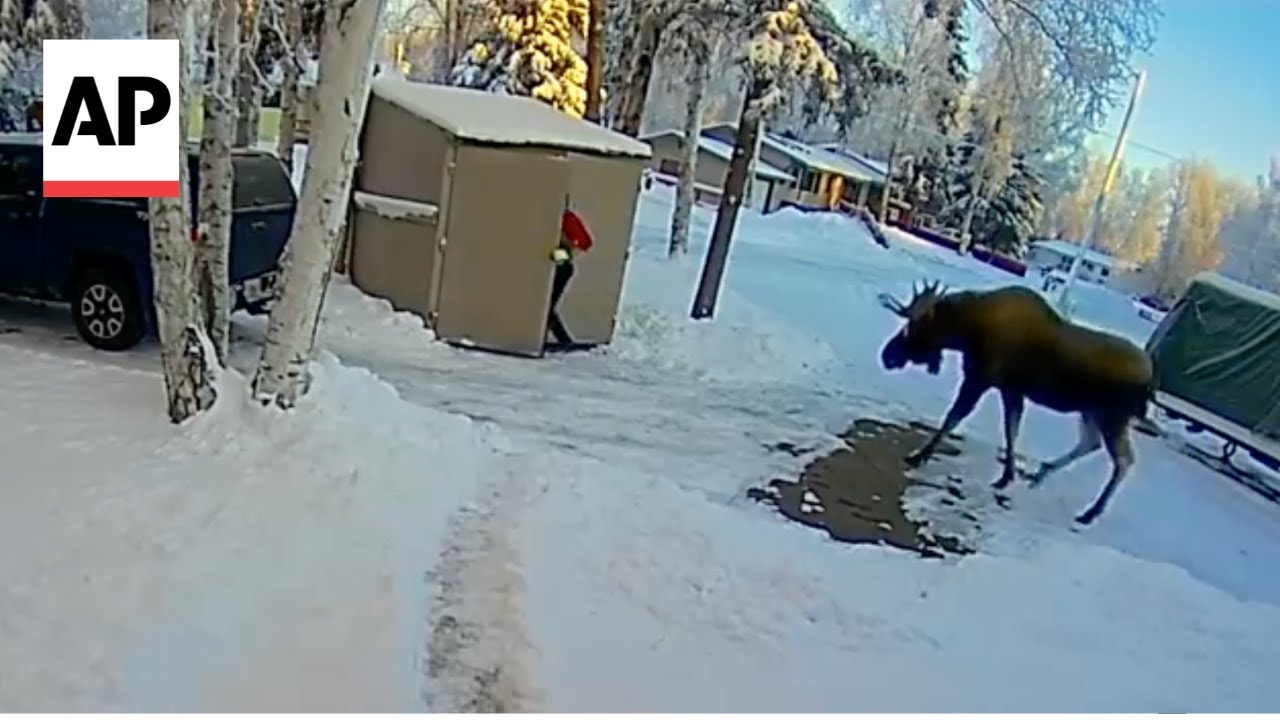
A dark bull moose with antler on his head walks left across a snow-covered yard past a bare dark patch in the snow, with a dark post, snowy houses and frosted trees behind him.

Footage: Associated Press · 1:01 · uploaded January 17, 2020
Written by My Crittercam · published November 6, 2026

The Story

A bull moose comes walking across a snowy Alaska yard on a bright winter day, headed for the one person outside. That person is carrying a sack of garbage, and the shed door is within reach.

A home security camera has the whole exchange. The man sees the bull coming, backs through the shed door and pulls it shut. No sprint, no skid on the ice. For a short while he is trapped in there, the moose outside, a closed door between them.

It is the right call. Alaska's Department of Fish and Game says more people in that state are injured by moose than by bears each year. Its list of warning signs includes a slow approach, along with raised hair on the hump, ears laid back and lip licking. If a moose charges, the advice is to run and get behind something solid like a tree, or retreat inside a building or car. A garbage shed qualifies.

The camera gives a fair look at what he was ducking. The moose is the largest member of the deer family; mature moose have a front shoulder hump and a flap of skin called a bell below the throat. A bull has a black face, and adults run from about 800 pounds for a small cow to 1,600 for a large bull. This one still carries antler in the snow season; Minnesota DNR puts the usual shed in December and January.

Winter brings its own risk. Fish and Game says a moose can turn aggressive when hungry and tired, especially in winter, when it must walk through deep snow. The winter menu is large quantities of willow, birch and aspen twigs, and long legs let a moose paw down through deep snow to reach food.

The standoff is brief. Moose are the least social of the deer, fairly solitary outside the mating season and not territorial. The bull moves off, and the trap ends there.
Field Guide

A bull moose walks up on an Alaska man taking garbage to his shed, and the man backs inside and shuts the door until the bull moves on. Full field guide for the Moose

Common nameMoose
Scientific nameAlces alces
FamilyCervidae (Deer family)
SizeAdults stand on average 5 to 7 feet at the shoulder; total length about 9 feet (Maine).National Park Service · Maine Department of Inland Fisheries and Wildlife · Animal Diversity Web, University of Michigan
Weight800 lb (small adult female) to 1,600 lb (large adult male).Alaska Department of Fish and Game · Animal Diversity Web, University of Michigan
DietBrowser: leaves and shoots in summer, twigs of willow, birch and aspen in fall and winter, plus aquatic plants. Up to 70 lb of food a day.Animal Diversity Web, University of Michigan · Alaska Department of Fish and Game · National Park Service
RangeMuch of Alaska and Canada, the northern edge of the contiguous US, and south along the Rocky Mountains to Utah and Colorado.Animal Diversity Web, University of Michigan
Active whenCrepuscular: most active at dawn and dusk.Animal Diversity Web, University of Michigan · Maine Department of Inland Fisheries and Wildlife
LifespanRarely more than 16 years in the wild; one cow lived to 22.Alaska Department of Fish and Game · Animal Diversity Web, University of Michigan
Conservation statusIUCN Red List: Least Concern. NatureServe: G5; N5 in US and Canada.Animal Diversity Web, University of Michigan · NatureServe Explorer
Cam notes · Camerahome security camera
Cam notes · Time of dayday
Cam notes · Seasonwinter, snow on the ground
Cam notes · PlaceAlaska

Habitat

Behavior

Questions

Are moose really more dangerous than bears?

Alaska Department of Fish and Game says more people in Alaska are injured by moose than by bears each year. Bulls in the rut, cows with young calves, and moose hungry and tired from walking through deep winter snow can all turn aggressive.Alaska Department of Fish and Game

How do you know a moose is about to charge?

Raised hairs on the hump, ears laid back, lip licking or a slow approach are warning signs. If charged, run and get behind something solid like a tree, or retreat inside a building or car.Alaska Department of Fish and Game

How big is a bull moose?

Adults range from 800 pounds for a small cow to 1,600 pounds for a large bull and on average stand 5 to 7 feet at the shoulder. Total length is about 9 feet.Alaska Department of Fish and Game · National Park Service · Maine Department of Inland Fisheries and Wildlife

Latest clips