My Crittercam
My Crittercam › Moose

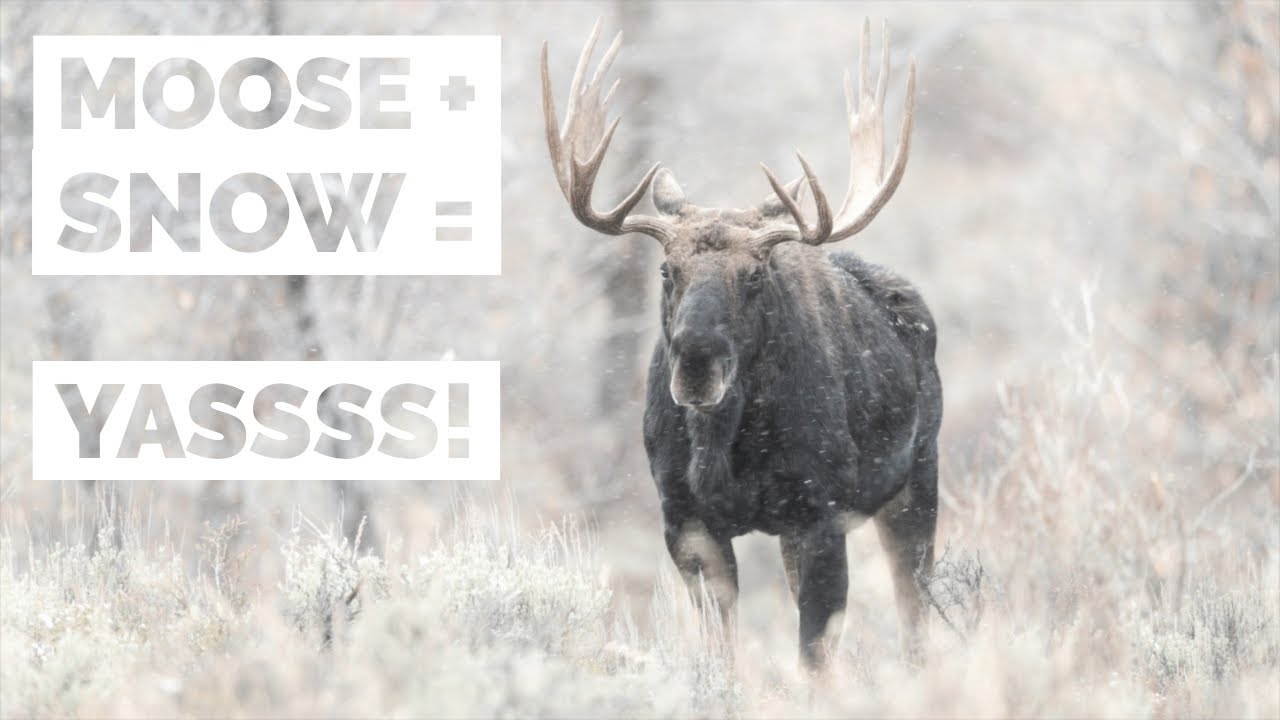
Bull moose stands in an October snowstorm

A dark bull moose with a wide rack of antlers stands facing the camera in falling snow among pale, frosted brush and blurred winter trees, with two cut-off white text panels at the left edge.

Footage: Steve Mattheis · 14:31 · uploaded November 6, 2019
Written by My Crittercam · published November 6, 2026

The Story

Snow is driving across Jackson Hole in October, and a bull moose with his full rack still on feeds right through it, snow settling on his back as he works the frosted brush.

He is one of two bulls feeding about 100 yards off the road on a stormy afternoon, near enough that cars have stopped and a handful of photographers have set up. A cow and a calf are somewhere in the same patch. The bulls mostly eat. Then they lie down in the snow, and nobody on the roadside knows whether they will stand again before sunset.

The field marks read clearly even through the storm. The face is near black, and a black face marks a bull; a cow's face is brown. Under his throat hangs the bell, the flap of skin that is larger and rounder on a bull than on a cow, whose bell looks more like a tuft of hair. Behind the head rises the shoulder hump of the largest member of the deer family.

A moose is dressed for this weather. Under the dark coat lies underfur, topped by long guard hairs. The hairs run 15 to 25 cm long and are hollow, and together the layers insulate the animal from cold.

The storm comes in October, and Minnesota DNR puts the rut from mid-September to mid-October, when bulls spar with their antlers and grunt to challenge rivals. Moose are the least social of the deer, fairly solitary outside the mating season. Here two big bulls share one patch, and the afternoon passes without a clash.

Fall and winter food is large quantities of willow, birch and aspen twigs, and an adult needs about 20 kg of food a day. The rack stays a while yet. Antlers are usually shed in December and January.

Meanwhile the photographer brews a cup of orange spice tea and asks only that the moose stay down long enough for him to drink it.
Field Guide

In an October snowstorm in Jackson Hole, two bull moose feed about 100 yards off the road, then bed down as the snow eases. Full field guide for the Moose

Common nameMoose
Scientific nameAlces alces
FamilyCervidae (Deer family)
SizeAdults stand on average 5 to 7 feet at the shoulder; total length about 9 feet (Maine).National Park Service · Maine Department of Inland Fisheries and Wildlife · Animal Diversity Web, University of Michigan
Weight800 lb (small adult female) to 1,600 lb (large adult male).Alaska Department of Fish and Game · Animal Diversity Web, University of Michigan
DietBrowser: leaves and shoots in summer, twigs of willow, birch and aspen in fall and winter, plus aquatic plants. Up to 70 lb of food a day.Animal Diversity Web, University of Michigan · Alaska Department of Fish and Game · National Park Service
Active whenCrepuscular: most active at dawn and dusk.Animal Diversity Web, University of Michigan · Maine Department of Inland Fisheries and Wildlife
RangeMuch of Alaska and Canada, the northern edge of the contiguous US, and south along the Rocky Mountains to Utah and Colorado.Animal Diversity Web, University of Michigan
LifespanRarely more than 16 years in the wild; one cow lived to 22.Alaska Department of Fish and Game · Animal Diversity Web, University of Michigan
Conservation statusIUCN Red List: Least Concern. NatureServe: G5; N5 in US and Canada.Animal Diversity Web, University of Michigan · NatureServe Explorer
Cam notes · Camerahandheld and tripod-mounted telephoto cameras from the roadside
Cam notes · Time of dayafternoon
Cam notes · SeasonOctober, during a snowstorm
Cam notes · PlaceJackson Hole, Wyoming

Habitat

Behavior

Questions

How do moose stay warm lying down in the snow?

Moose have underfur topped by long guard hairs, 15 to 25 cm long. Those guard hairs are hollow and insulate the animal from cold.Animal Diversity Web, University of Michigan

What do moose eat once the snow comes?

In fall and winter they eat large quantities of willow, birch and aspen twigs, with balsam fir adding value over the long winter though it is lower in nutrition. Their long legs let them paw through deep snow to reach food.Alaska Department of Fish and Game · Maine Department of Inland Fisheries and Wildlife · National Park Service

Is it safe to get close to a bull moose in October?

During the rut, bulls can be extremely aggressive and dangerous. More people in Alaska are injured by moose than by bears each year.National Park Service · Alaska Department of Fish and Game

Latest clips