The Story
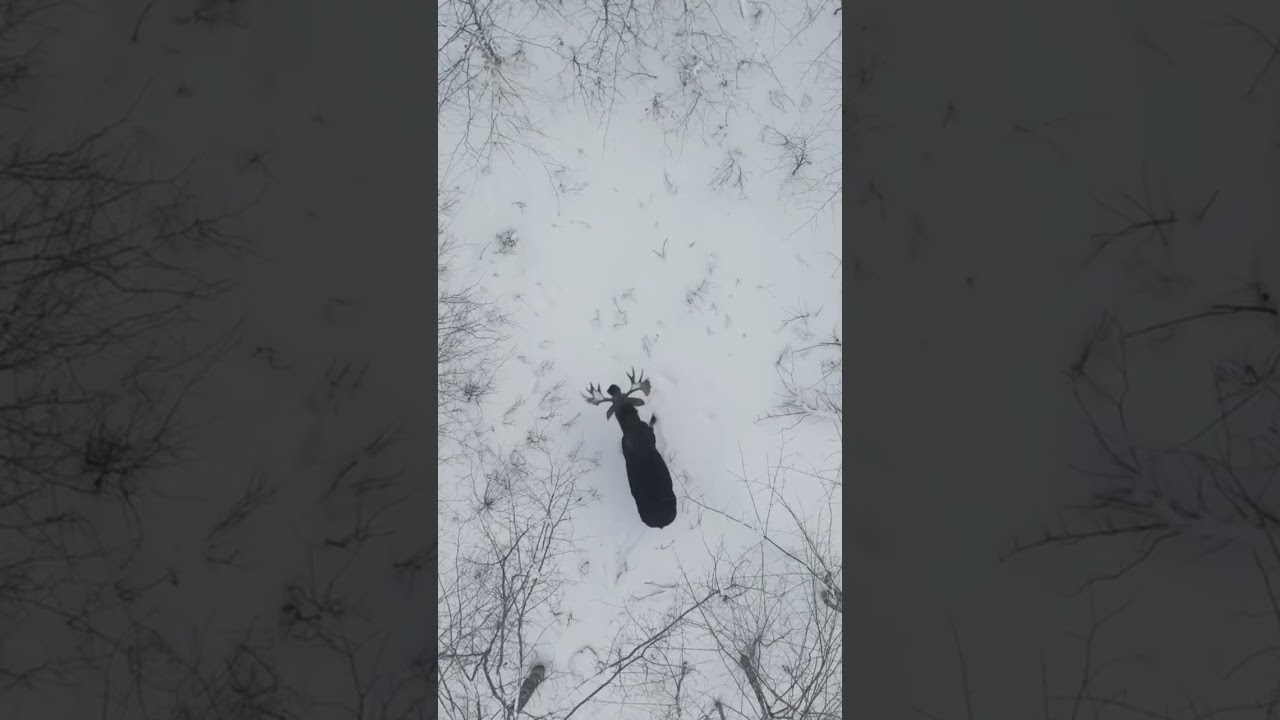
A bull moose stands alone in the snow, seen from straight above, antlers still riding on his head. A few seconds later both of them are lying in the snow and he is gone.
The camera looks down through bare branches onto a small opening among thin, leafless trees. The bull is a dark block against the white. Alone is normal for him; moose are the least social of the deer. Then he shakes. Not a toss of the head but the whole body, and the antlers come away.
This is the calendar at work. Bulls drop their antlers in late fall or early winter, after the rut, to conserve energy for the cold months, and they are usually shed in December and January. Bulls spar with them through the rut, which Minnesota DNR puts at mid-September to mid-October. After that the rack is a cost, and a big bull's palmate pair can reach five feet across and, by the National Park Service's figure, weigh up to 77 pounds.
The exit is the part that makes the clip. The instant the antlers hit the snow, the bull is off at a run. He has the legs for a quick exit; moose can run 35 miles an hour. The footage gives no reason for the hurry.
He will be bare-headed only until spring. New antlers begin growing in April, covered in velvet, and antler can grow as much as 8 inches in nine days. In September the velvet sheds as testosterone surges, and the bull walks into the next rut fully armed again.
Until then he has a winter to get through. Long legs let a moose paw down through deep snow to reach food, and the fall and winter menu is twigs of willow, birch and aspen, eaten in large quantities. The pair in the snow behind him is last season's growth, finished with.