My Crittercam
My Crittercam › Gray wolf

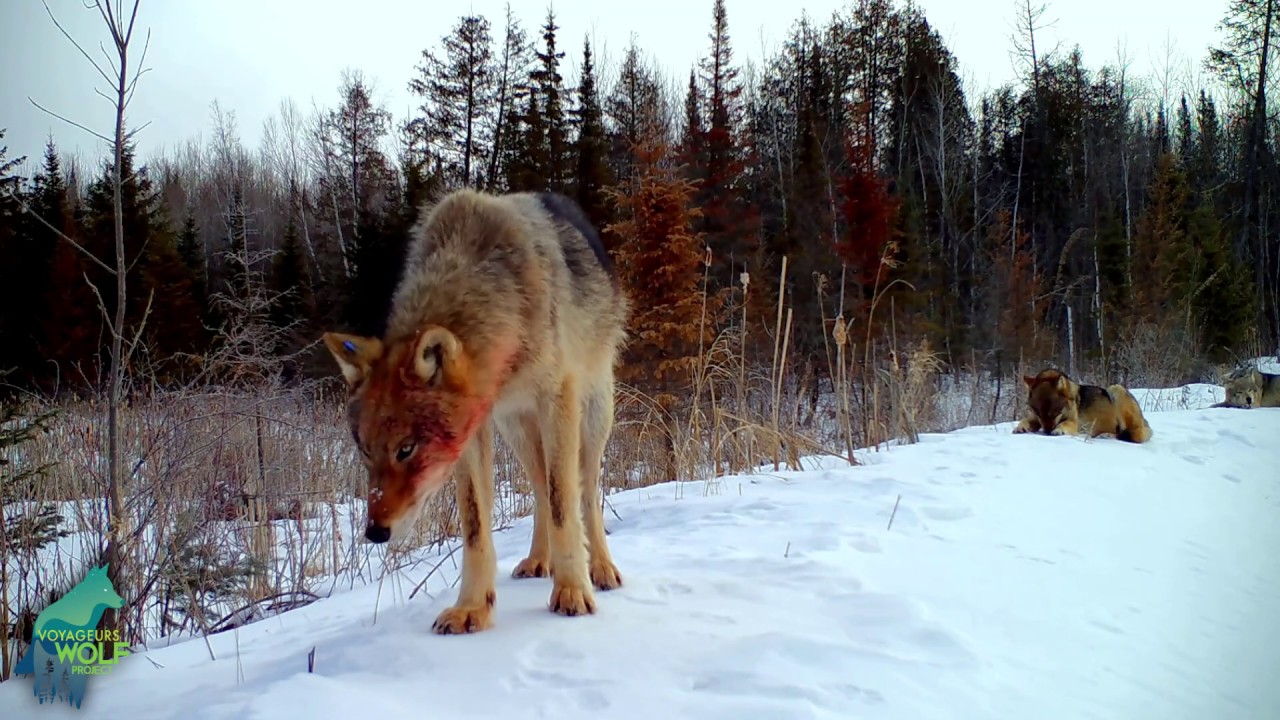
Blood-faced gray wolf sniffs snow after a kill

A tawny gray wolf with a blood-stained muzzle, cheeks and throat and a small blue tag in one ear stands on snow with its head lowered, dry grass and conifers behind it.

Footage: Voyageurs Wolf Project · 2:13 · uploaded November 14, 2019
Written by My Crittercam · published November 6, 2026

The Story

Blood stains a gray wolf from muzzle to throat as it drops its head and noses the snow in front of a remote camera in northern Minnesota. A small blue tag sits in one ear.

The red is deer. The Bowman Bay Pack had just killed an adult deer that March, and some of the wolves at this camera carry bellies so round the researchers liken them to a swallowed basketball. That is the routine: wolves stuff themselves, lounge while the food digests, then go back to the kill for more. A wolf can eat as much as 20 pounds of meat in one meal, and wolves may go a week or more without eating. In the Midwest, white-tailed deer are the staple.

For the Voyageurs Wolf Project, the ear tags matter more than the blood. This footage confirmed for the first time that two pack members were still alive. Pup 2217, wearing small ear tags, had been tagged in spring 2018 and not seen since. Wolf V067 was collared that same spring, but the collar failed immediately, and its fate stayed a blank until these frames. Confirming who is still alive with remote cameras is one of several reasons the project ear-tags wolves.

Behind the bloodied wolf, the breeding pair rests. V034, the breeding male, is the lighter-colored, collared wolf lying in the background; the wolf in front of him is the breeding female. That spring she rescued her seven pups from a flooding den. Wolf dens can be dug as much as 10 feet into well-drained soil.

Packs are family groups: a breeding male and female, their pups, perhaps last year's young, and sometimes older wolves. In the Midwest they average four to eight wolves in winter. Which wolf wears the blue tag at the lens goes unrecorded, and the frame alone cannot settle it.

The deer fed the pack. The camera took attendance.
Field Guide

A Bowman Bay Pack gray wolf, its face red from a fresh deer kill, noses the snow at a remote camera in northern Minnesota while the pack's breeding pair rests behind. Full field guide for the Gray wolf

Common nameGray wolf
Scientific nameCanis lupus
FamilyCanidae (Dog family)
DietMainly medium and large hoofed mammals. Midwest: mainly white-tailed deer, also moose, beaver and snowshoe hare; Rocky Mountains: elk, deer, moose, bison and beaverU.S. Fish & Wildlife Service (hosted by Montana Fish, Wildlife & Parks) · U.S. Fish & Wildlife Service
WeightMales 70 to 115 lb, females 60 to 100 lb; Alaska males occasionally 145 lbU.S. Fish & Wildlife Service (hosted by Montana Fish, Wildlife & Parks)
SizeMales 5 to 6.5 ft long nose to tail tip, females 4.5 to 6 ft; 26 to 32 in at the shoulderU.S. Fish & Wildlife Service (hosted by Montana Fish, Wildlife & Parks)
Active whenMainly nocturnal; movements are usually at night and cover long distancesNatureServe Explorer · Animal Diversity Web, University of Michigan
RangeLower 48: Minnesota, Wisconsin, Michigan, Montana, Idaho, Wyoming and northern Washington's Cascades; tens of thousands in Canada and AlaskaU.S. Fish & Wildlife Service (hosted by Montana Fish, Wildlife & Parks) · NatureServe Explorer
LifespanUp to 13 years in the wild, 15 in captivity; Yellowstone average 4-5 yearsU.S. Fish & Wildlife Service (hosted by Montana Fish, Wildlife & Parks) · National Park Service, Yellowstone National Park
Conservation statusNatureServe global rank G5. US Endangered Species Act: threatened in Minnesota, endangered in most other lower-48 states; Northern Rocky Mountain population delistedNatureServe Explorer
Cam notes · Cameraremote camera
Cam notes · Time of dayday
Cam notes · SeasonMarch
Cam notes · Placenorthern Minnesota

Habitat

Behavior

Questions

What do wolves in northern Minnesota kill?

Wolves feed mainly on medium and large hoofed mammals, and in the Midwest that means white-tailed deer. In northern Minnesota summers they mostly hunt small prey such as beavers and deer fawns.U.S. Fish & Wildlife Service (hosted by Montana Fish, Wildlife & Parks) · Voyageurs Wolf Project, University of Minnesota

How much can a wolf eat at once?

A wolf can eat as much as 20 pounds of meat in one meal, and wolves may go a week or more without eating. In fall and winter in Minnesota, wolves spend most of their time sleeping, resting or traveling, and little time feeding.U.S. Fish & Wildlife Service (hosted by Montana Fish, Wildlife & Parks) · NatureServe Explorer

Are wolves dangerous to people?

Aggressive behavior by wild wolves toward people is extremely rare; in Alaska and Canada there were 16 cases of non-rabid wolves biting people since 1970. Risk rises when wolves are habituated, for example by being fed.U.S. Fish & Wildlife Service (hosted by Montana Fish, Wildlife & Parks) · Minnesota Department of Natural Resources

Latest clips