My Crittercam
My Crittercam › Gray wolf

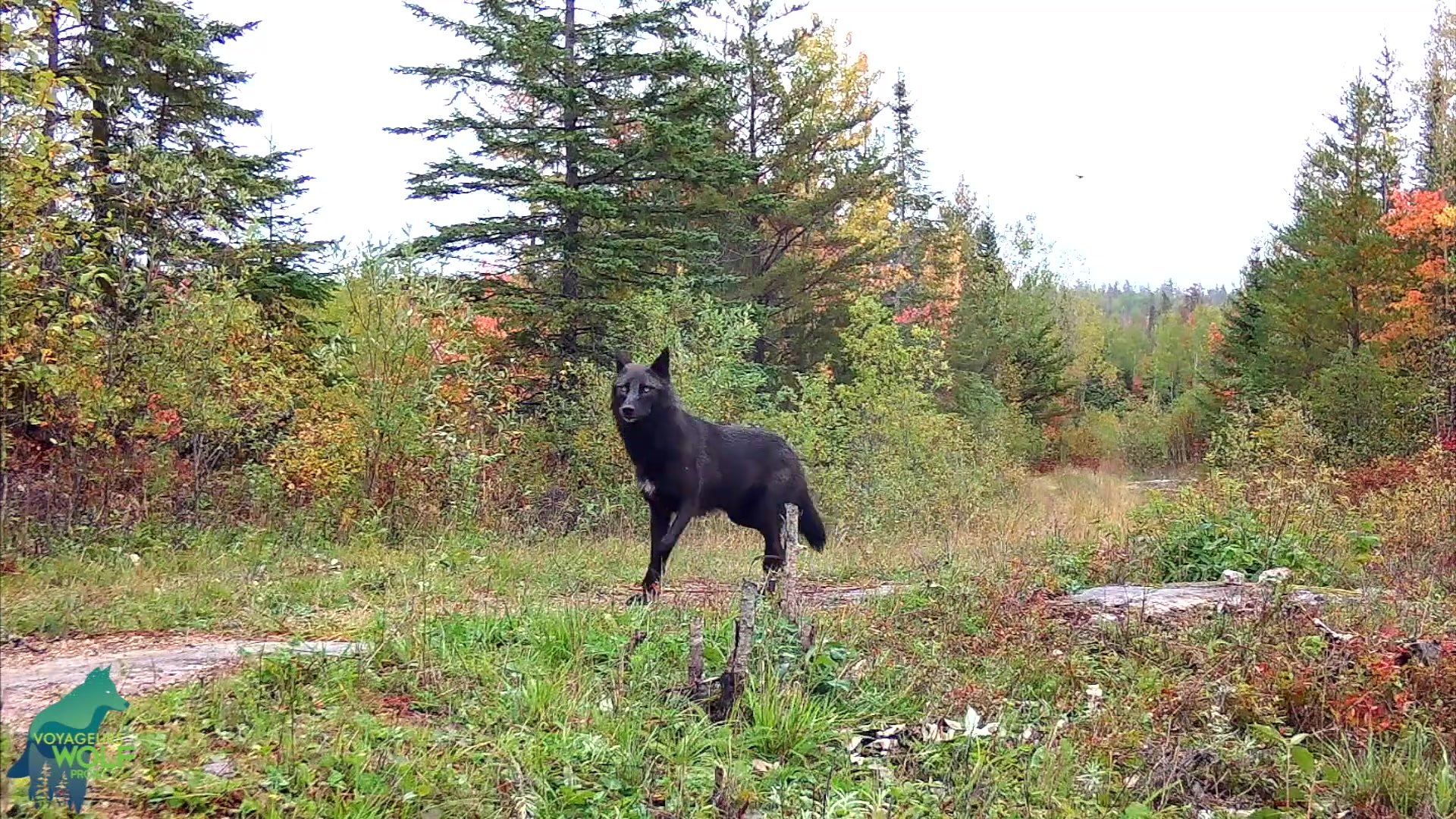
Black wolf pauses amid Minnesota fall colors

A black wolf with a small white chest patch stands side-on in green grass with its head turned to the camera, a spruce and red, orange and yellow fall brush behind it.

Footage: Voyageurs Wolf Project · 0:17 · uploaded September 27, 2021
Written by My Crittercam · published November 6, 2026

The Story

A gray wolf in a black coat stops in the open below red and yellow brush in northern Minnesota and holds still, ears pricked toward the trail camera, then turns and walks off along a grassy track. One small white blaze marks its chest, and the tail hangs straight down, the way a wolf carries it: straight out or down, never curled.

For the Voyageurs Wolf Project, whose camera this is, the moment is a first: their first daytime video of a black wolf. Black wolves are rare in their area. They have followed 10 to 11 packs a year for three years without finding a single black pack member, and the black wolves they have photographed in winter were all lone animals passing through. Elsewhere the color is no oddity. In Yellowstone, gray and black wolves turn up in roughly equal numbers.

Gray wolves usually travel at night, and their movements can cover long distances. No other wolf appears with this one. The camera sits in the territory of the Windsong Pack, whose three members are all the usual gray, so the researchers judge this wolf almost certainly a loner too.
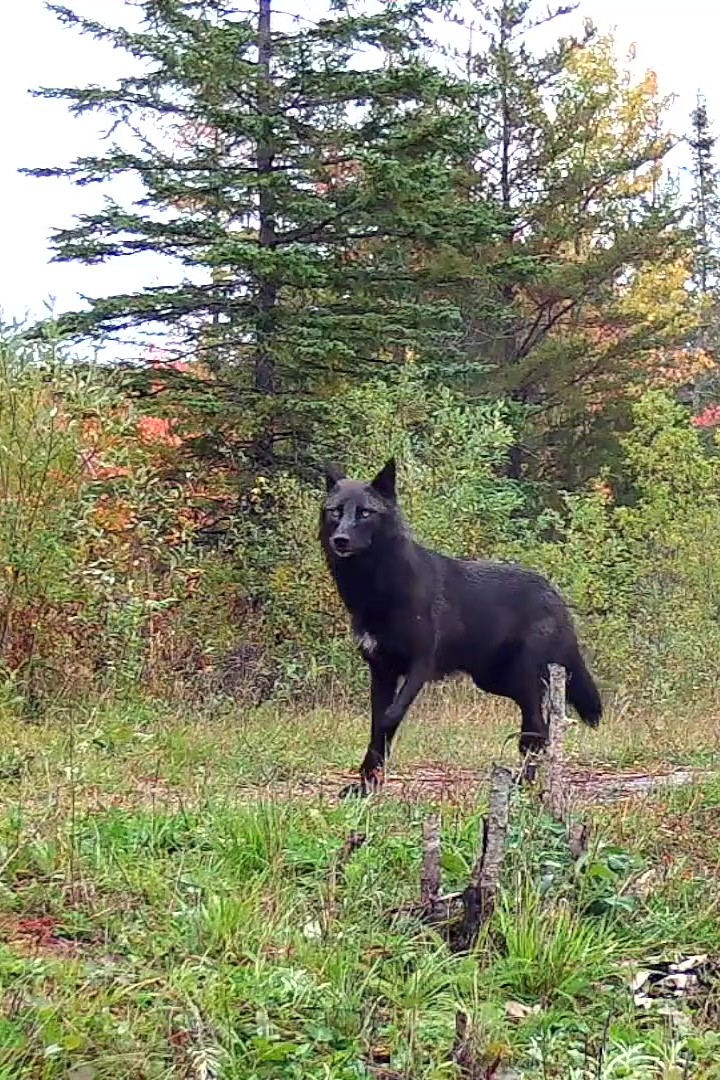
A black wolf with a small white chest patch stands side-on in green grass, head turned to the camera, tail down, spruce and red and yellow fall brush behind. A headline runs in white letters across the lower third.Save
Rare black wolf eyes the camera in daylight

Packs are family groups, a breeding male and female with their pups and perhaps last year's young, and they defend a territory by howling and by marking it with urine and scats, the signal that tells outside wolves an area is occupied. One Minnesota study measured territories of 195 to 555 square kilometers each, so a loner here is a stranger on claimed ground. This one does not linger. It turns its nose from the camera and walks off to the left along the track, tail hanging low behind it.
Field Guide

In the Windsong Pack's territory in northern Minnesota, a black wolf with a white chest blaze, almost certainly a lone wolf, stops in daylight among the fall colors. Full field guide for the Gray wolf

Common nameGray wolf
Scientific nameCanis lupus
FamilyCanidae (Dog family)
SizeMales 5 to 6.5 ft long nose to tail tip, females 4.5 to 6 ft; 26 to 32 in at the shoulderU.S. Fish & Wildlife Service (hosted by Montana Fish, Wildlife & Parks)
WeightMales 70 to 115 lb, females 60 to 100 lb; Alaska males occasionally 145 lbU.S. Fish & Wildlife Service (hosted by Montana Fish, Wildlife & Parks)
DietMainly medium and large hoofed mammals. Midwest: mainly white-tailed deer, also moose, beaver and snowshoe hare; Rocky Mountains: elk, deer, moose, bison and beaverU.S. Fish & Wildlife Service (hosted by Montana Fish, Wildlife & Parks) · U.S. Fish & Wildlife Service
Active whenMainly nocturnal; movements are usually at night and cover long distancesNatureServe Explorer · Animal Diversity Web, University of Michigan
RangeLower 48: Minnesota, Wisconsin, Michigan, Montana, Idaho, Wyoming and northern Washington's Cascades; tens of thousands in Canada and AlaskaU.S. Fish & Wildlife Service (hosted by Montana Fish, Wildlife & Parks) · NatureServe Explorer
LifespanUp to 13 years in the wild, 15 in captivity; Yellowstone average 4-5 yearsU.S. Fish & Wildlife Service (hosted by Montana Fish, Wildlife & Parks) · National Park Service, Yellowstone National Park
Conservation statusNatureServe global rank G5. US Endangered Species Act: threatened in Minnesota, endangered in most other lower-48 states; Northern Rocky Mountain population delistedNatureServe Explorer
Cam notes · Cameratrail camera
Cam notes · Time of dayday
Cam notes · Seasonfall colors
Cam notes · PlaceWindsong Pack territory, northern Minnesota

Habitat

Behavior

Questions

Who belongs to a wolf pack?

Wolf packs are family groups: a breeding male and female, their pups, perhaps last year's young and sometimes older wolves. Packs defend their territories by howling and scent-marking with urine.U.S. Fish & Wildlife Service (hosted by Montana Fish, Wildlife & Parks) · National Park Service, Yellowstone National Park

Is a black wolf a different species from a gray wolf?

No, black is one of the gray wolf's coat colors; the coat is often buff-tan grizzled with gray and black. In Yellowstone, gray and black wolves occur about 50:50, and white is rare.U.S. Fish & Wildlife Service (hosted by Montana Fish, Wildlife & Parks) · National Park Service, Yellowstone National Park

How can you tell a wolf from a coyote?

A wolf is roughly twice a coyote's size, with short rounded ears, a large blocky muzzle and a tail held straight out or down, never seen curled. Its track is about 4.5 inches long, against about 2.5 inches for a coyote.U.S. Fish & Wildlife Service (hosted by Montana Fish, Wildlife & Parks) · International Wolf Center

Latest clips