My Crittercam
My Crittercam › Black-capped Chickadee

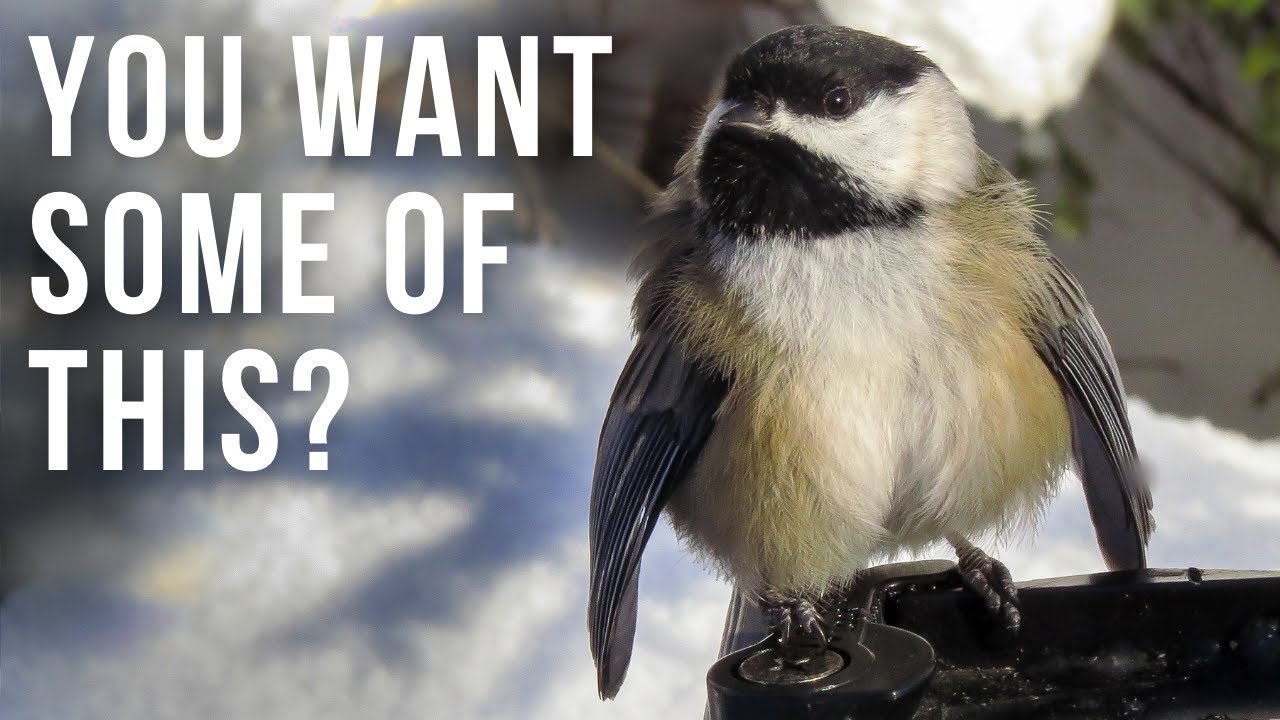
Black-capped chickadee puffs up, wings held out

A black-capped chickadee with puffed-out buff and white breast feathers perches on a black edge, the wing on the left of the frame held down and away from its body, against blurred, sunlit snow.

Footage: Lesley the Bird Nerd · 5:35 · uploaded October 19, 2020
Written by My Crittercam · published November 6, 2026

The Story

A black-capped chickadee stands on a black rim in winter sun and suddenly looks bigger than it is, breast and back feathers raised, wings held out from its sides. Another chickadee is close, and this is the reply.

The whole show lasts a second or two. At full speed it is a flicker, so the footage runs slowed down and lets each lifted feather register. Researchers call it the body ruffling display, and the filmer is firm on one point. This is not a cold bird fluffing up for warmth. The posture is different, and so is the trigger.

The field marks are easy in this light. Black cap, black bib, white cheeks, gray wings and a buff wash along the sides, all on a short plump body with a tiny pointed beak. Males and females look identical, so nothing in the plumage tells you who is bluffing whom.

What the display seems to settle is rank. Chickadee flocks run on dominance hierarchies, and males outrank females. Pairs typically form in fall and spend the winter inside the flock, the highest-ranking male and female usually paired together. Birds lower down pay for it. They tend to forage in the outermost parts of trees, where they are most exposed to predators.

The filmer has seen it many times between adults from neighboring territories, especially in fall, when both want the same food, usually seed held out by hand. Seeds matter to this bird. It tests each sunflower seed for plumpness and discards empty ones before opening them, and in fall a single chickadee can store up to 1,000 seeds a day in bark crevices and small cavities.

To the filmer it looks like a way of keeping order at a crowded food source without spending energy on an actual fight. That logic suits a bird of 9 to 14 grams that eats more than 35 percent of its weight every day. A real scuffle burns fuel. A second or two of raised feathers, on that reading, settles the question without one.
Field Guide

A black-capped chickadee on a snowy backyard perch raises its breast feathers and holds its wings out in a slowed-down body ruffling display given when another chickadee is close. Full field guide for the Black-capped Chickadee

Common nameBlack-capped Chickadee
Scientific namePoecile atricapillus
FamilyParidae (Chickadees and Titmice)
SizeLength 5–6 in (12–15 cm); about the size of a sparrow.National Audubon Society (Guide to North American Birds) · National Park Service, Mississippi National River & Recreation Area
Weight0.3–0.5 oz (9–14 g).National Audubon Society (Guide to North American Birds)
Wingspan6–8 in (15–20 cm).National Audubon Society (Guide to North American Birds)
DietMostly insects, seeds and berries; seeds and fruit may be no more than 10 percent of the summer diet and up to 50 percent in winter.National Audubon Society (Guide to North American Birds)
RangeAlaska through the southern half of Canada, south to the upper two-thirds of the United States; mostly a permanent resident.Animal Diversity Web, University of Michigan · National Audubon Society (Guide to North American Birds)
Active whenDiurnal: active by day from first light, sleeping at night in thick branches or tree cavities.Smithsonian's National Zoo and Conservation Biology Institute
LifespanEstimated average about 2.5 years; most live about two to three years. Oldest on record 12.5 years (ADW) or over 11.5 years (Smithsonian).Animal Diversity Web, University of Michigan · Smithsonian's National Zoo and Conservation Biology Institute
Conservation statusIUCN Red List: Least Concern; NatureServe global rank G5. Numbers apparently stable.NatureServe Explorer · National Audubon Society (Guide to North American Birds)
Cam notes · Cameraclose-range video, shown in slow motion
Cam notes · Time of dayday
Cam notes · Seasonwinter, snow in frame
Cam notes · Placebackyard or garden

Habitat

Behavior

Questions

How do you get chickadees to eat from your hand?

Black-capped chickadees are among the easiest birds to feed by hand. The trick is to stand very still and let the birds get used to you.National Park Service, Mississippi National River & Recreation Area

Is there a pecking order in a chickadee flock?

Yes, flocks have dominance hierarchies, males outrank females, and the highest-ranking male and female usually pair. Subordinate birds tend to forage in the outermost parts of trees, where they are most exposed to predators.Animal Diversity Web, University of Michigan · Smithsonian's National Zoo and Conservation Biology Institute

How do you tell a black-capped chickadee from a Carolina chickadee?

The two are almost identical and are best told apart by range. In the zone where they overlap, song may not help, because each species can learn the other's song.National Audubon Society (Guide to North American Birds)

Latest clips