The Story
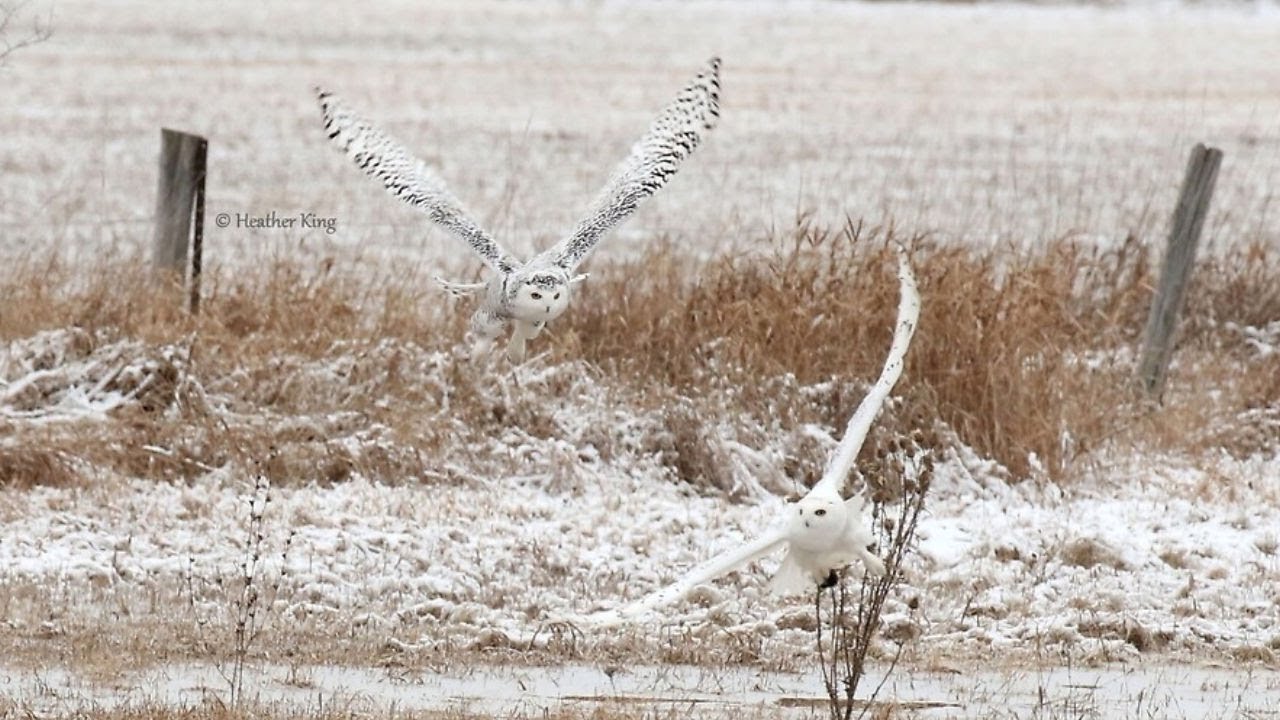
A heavily barred snowy owl comes straight at the lens, wings thrown high, feathered feet dangling over frosted grass. Lower down and off to one side, a whiter owl flaps low over the snow.
The filmer called her Queen B, and she earned it. On several occasions the female was seen charging other snowy owls on her ground, trying to drive them out. One day she left her high perch and went after four in a row, three males and a female, all of them simply roosting on poles or sitting in the field. By the filmer's account this was routine.
There is a reason a female would bother. Snowy owls are generally solitary and territorial, and in winter females set up territories and hold them until spring. A female's winter territory may run from 150 to 450 hectares, a lot of open country to keep clear.
The plumage fits the cast. Adult females retain some darker markings, males have the least, and old males are almost pure white. The barred bird in the air and the cleaner bird near the ground look like a female and a male, though markings alone cannot prove which owl is which.
The sharpest episode comes in a run of stills. A male sits on a post in her field. She charges and knocks him off it. Clamped in his right foot is a vole, and he does not let go. What the camera missed, the filmer saw: the two climbed high, the male dropped the vole, and Queen B swept underneath and caught it in midair. He lost the post and his lunch in one go.
Snowy owls usually hunt from a perch, then chase in swift flight and take prey in their talons. Voles are standard fare, alongside lemmings, mice, rabbits and hares. Queen B brought that same perch-and-chase method to dealing with her neighbors, and at least once the prey came with it.