My Crittercam
My Crittercam › Bald eagle

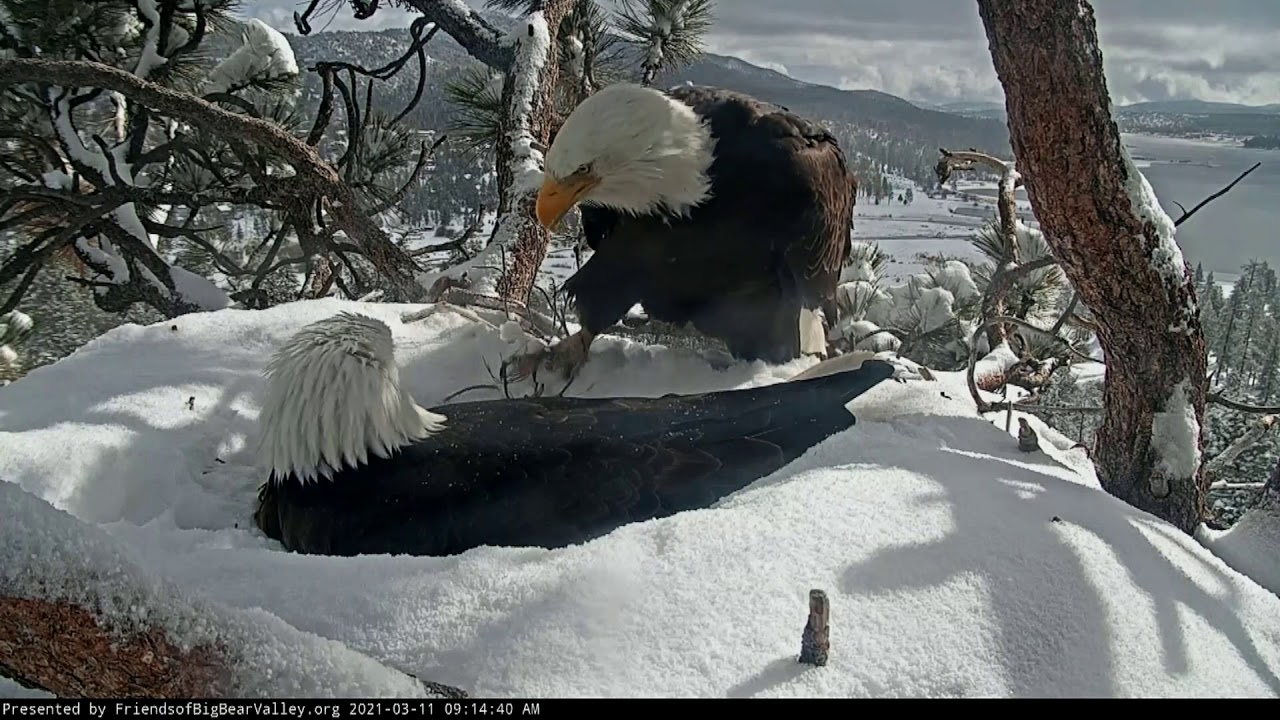
Bald eagles swap shifts on a snowy nest

An adult bald eagle with a white head and yellow bill stands in deep snow on a nest, talons planted, leaning toward its mate, whose dark back and wing lie low across the snow in the foreground, with snowy pine branches and mountains behind.

Footage: PennLive.com · 1:12 · uploaded March 12, 2021
Written by My Crittercam · published November 6, 2026

The Story

Snow lies deep on a nest about 145 feet up a pine at Big Bear Lake, California, and a bald eagle sits sunk in it to the shoulders. A second adult drops onto the rim and puts a stick on the sitter's tail feathers.

It is a Thursday morning, and under the sitting bird are two eggs. Moments later the sitter lifts off and leaves, and the newcomer settles onto the eggs in its place. What the stick means, if it means anything, is the eagles' own business.

Both birds wear the white head of adults. In full plumage a bald eagle is snowy white on the head, neck and tail over a dark brown body, and it is the only eagle carrying both a white head and a white tail. That look takes about five years to come in, and pairs first breed at around four or five.

Telling this pair apart takes more than a glance. Female bald eagles are generally larger than males, but with one bird buried in snow and the other hunched over it, the comparison is not a fair one.

Both parents incubate, trading shifts like this one, and the work runs 34 to 36 days. Two eggs is the usual clutch, and these two were expected to hatch in mid-March. The eggs have plenty of takers: ravens, crows, magpies, gulls, black bears, raccoons and bobcats all take eagle eggs or young, while the adults are rarely preyed on.

The nest is a long project. Both parents build it and add to it every year, and most run 4 to 5 feet wide, while one reused for years can reach 10 feet across and thousands of pounds. Bald eagles pick tall trees near water, and pine is among the trees they use. For this pair, today, the job is simpler. Sit down, stay down, and outlast the snow.
Field Guide

At Big Bear Lake, California, one bald eagle lays a stick on its snow-buried mate's tail, and moments later the pair trade places on two eggs. Full field guide for the Bald eagle

Common nameBald eagle
Scientific nameHaliaeetus leucocephalus
FamilyAccipitridae (hawks, eagles and kites)
Size79 to 94 cm long; females generally somewhat larger than males.Animal Diversity Web, University of Michigan · NatureServe · Smithsonian's National Zoo & Conservation Biology Institute
Wingspan178 to 229 cm; up to 8.5 feet (2.6 meters).Animal Diversity Web, University of Michigan · Smithsonian's National Zoo & Conservation Biology Institute
Weight6.5 to 14 pounds (3 to 6.5 kilograms); average 4.3 kg.Smithsonian's National Zoo & Conservation Biology Institute · Animal Diversity Web, University of Michigan
DietMainly fish such as salmon, herring, catfish and carp; also waterfowl, small mammals, turtles, snakes and carrion.National Audubon Society · U.S. Fish & Wildlife Service
RangeThroughout North America near large water, concentrated in Florida, Alaska, the Pacific Northwest and near some Midwest rivers and lakes; Alaska estimated at 70,000 (2020).Animal Diversity Web, University of Michigan · Alaska Department of Fish and Game
Active whenDiurnal (active by day); most populations, especially northern ones, migrate to milder climates each year.Animal Diversity Web, University of Michigan
LifespanTypically 15-20 years in the wild (oldest known wild bird 28); up to about 30 years in the wild per USFWS; one captive bird reportedly lived 47 years.Animal Diversity Web, University of Michigan · U.S. Fish & Wildlife Service
Conservation statusIUCN Red List: Least Concern; NatureServe Global Rank G5 (secure, reviewed 2016-04-08). Removed from the US endangered species list in 2007.NatureServe · Animal Diversity Web, University of Michigan · U.S. Fish & Wildlife Service
Cam notes · Camerawebcam near the nest
Cam notes · Time of daymorning
Cam notes · Seasonwinter, deep snow on the nest
Cam notes · PlaceBig Bear Lake, California; nest about 145 feet up in a pine

Habitat

Behavior

Questions

Do both bald eagle parents sit on the eggs?

Yes. Both parents build the nest, incubate the eggs and care for the young, and incubation lasts 34 to 36 days.Minnesota Department of Natural Resources · National Audubon Society · NatureServe

Which bald eagle is bigger, the male or the female?

Females are generally larger than males. Adults run 79 to 94 cm long with a wingspan of 178 to 229 cm.Animal Diversity Web, University of Michigan · Smithsonian's National Zoo & Conservation Biology Institute

How high up do bald eagles build their nests?

They nest in tall trees near water, up to 180 feet or more above the ground, and use cliffs or the ground where there are no trees. The nests are generally 4 to 5 feet wide and can reach 10 feet across.National Audubon Society · Animal Diversity Web, University of Michigan · U.S. Fish & Wildlife Service

Latest clips