My Crittercam
My Crittercam › Bald eagle

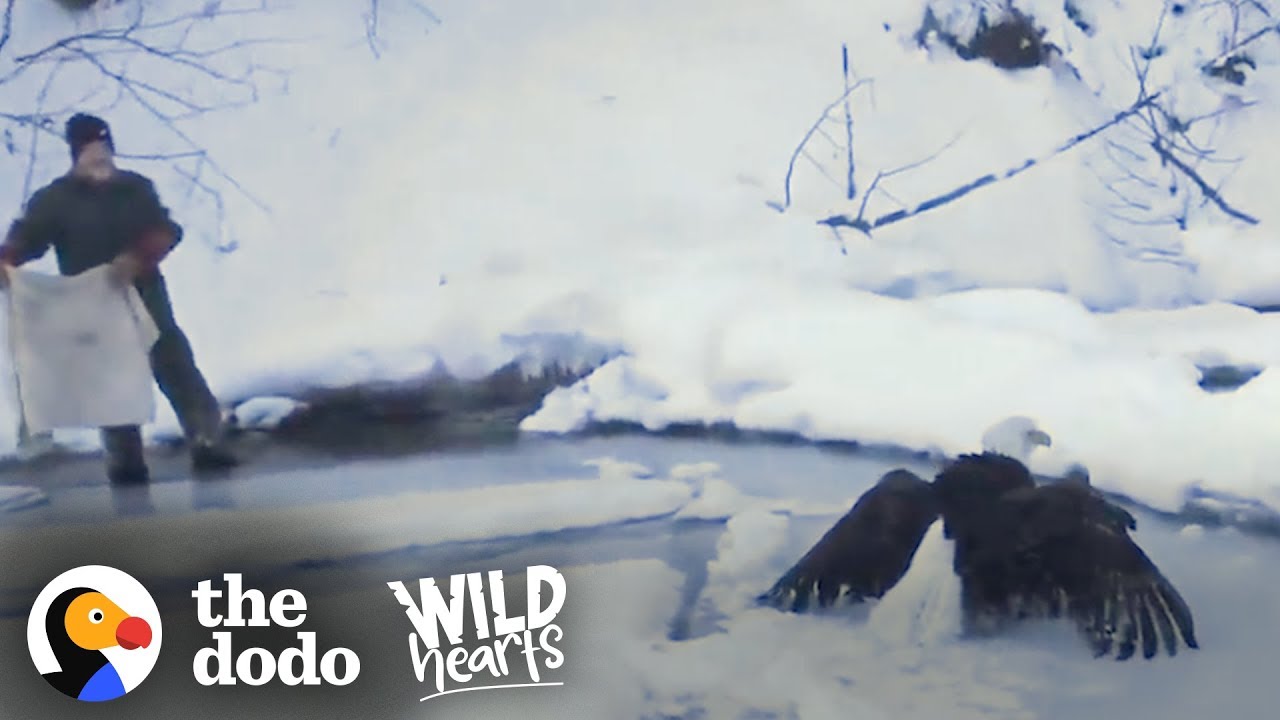
Bald eagle frozen to the ice by its tail

An adult bald eagle with a white head sits low on snowy ice with both dark wings spread, a snowbank and bare branches behind it.

Footage: The Dodo · 3:25 · uploaded June 9, 2019
Written by My Crittercam · published November 6, 2026

The Story

A bald eagle lies spread on the snow and ice of a frozen lake, wings flung wide, white head up, going nowhere. A ball of ice has frozen onto its tail and fixed it to the spot.

The bird is an adult, and the field marks settle that at a glance: snowy white head and tail on a dark brown body, a big yellow bill. No other eagle wears white at both ends. Today the white end at the back is the trouble, a fan of tail feathers sealed into a lump of ice.

Winter ice is familiar footing for this species. When lakes lock up, bald eagles go where water stays open, below dams and power plants, and they perch on the ice shelves along rivers. Fish are the staple of the diet, so the margin between ice and water is a working spot. It can also be a trap.

This one is found in time. Rescuers take the eagle in hand, a real armful for a bird that weighs 3 to 6.5 kg, and the thaw begins. Warm water goes over the frozen tail until the ice lets go.

Through all of it the eagle stays calm. No snapping, no thrashing. Laid down with its legs held apart and its tail in warm water, it has the look of a raptor enduring a bath it never agreed to, and it puts up with every minute.

Then the release, in the snow, in front of a crowd that has turned out to see it go. The eagle beats up and away on wings that can span 178 to 229 cm, passes a power line, and clears it. A bird that was cemented to a lake is airborne again.
Field Guide

An adult bald eagle frozen to a lake by a ball of ice on its tail is thawed loose with warm water and released before a crowd. Full field guide for the Bald eagle

Common nameBald eagle
Scientific nameHaliaeetus leucocephalus
FamilyAccipitridae (hawks, eagles and kites)
Size79 to 94 cm long; females generally somewhat larger than males.Animal Diversity Web, University of Michigan · NatureServe · Smithsonian's National Zoo & Conservation Biology Institute
Wingspan178 to 229 cm; up to 8.5 feet (2.6 meters).Animal Diversity Web, University of Michigan · Smithsonian's National Zoo & Conservation Biology Institute
Weight6.5 to 14 pounds (3 to 6.5 kilograms); average 4.3 kg.Smithsonian's National Zoo & Conservation Biology Institute · Animal Diversity Web, University of Michigan
DietMainly fish such as salmon, herring, catfish and carp; also waterfowl, small mammals, turtles, snakes and carrion.National Audubon Society · U.S. Fish & Wildlife Service
RangeThroughout North America near large water, concentrated in Florida, Alaska, the Pacific Northwest and near some Midwest rivers and lakes; Alaska estimated at 70,000 (2020).Animal Diversity Web, University of Michigan · Alaska Department of Fish and Game
Active whenDiurnal (active by day); most populations, especially northern ones, migrate to milder climates each year.Animal Diversity Web, University of Michigan
LifespanTypically 15-20 years in the wild (oldest known wild bird 28); up to about 30 years in the wild per USFWS; one captive bird reportedly lived 47 years.Animal Diversity Web, University of Michigan · U.S. Fish & Wildlife Service
Conservation statusIUCN Red List: Least Concern; NatureServe Global Rank G5 (secure, reviewed 2016-04-08). Removed from the US endangered species list in 2007.NatureServe · Animal Diversity Web, University of Michigan · U.S. Fish & Wildlife Service
Cam notes · Cameraa photographer's camera, filming the rescue
Cam notes · Time of dayday
Cam notes · Seasonwinter (snow)
Cam notes · Placea frozen lake

Habitat

Behavior

Questions

How big is a bald eagle?

Adults are 79 to 94 cm long with a wingspan of 178 to 229 cm and weigh 6.5 to 14 pounds. Females are generally larger than males.Animal Diversity Web, University of Michigan · Smithsonian's National Zoo & Conservation Biology Institute · NatureServe

Why are bald eagles out on frozen lakes in winter?

They gather where open water and easy food meet: locks, dams and power plants keep rivers open, and eagles fish below dams or perch on river ice shelves. Northern interior breeders also migrate south between August and January.Iowa Department of Natural Resources · Alaska Department of Fish and Game · U.S. Fish & Wildlife Service · South Carolina Department of Natural Resources · U.S. National Park Service · National Audubon Society

Do bald eagles keep the same mate?

Some pairs stay together for many years, and a bird that loses its mate will pair again. Both parents build the nest, incubate the eggs and care for the young.U.S. National Park Service · National Audubon Society · Minnesota Department of Natural Resources

Latest clips