Grizzly bear field guide
Field Guide
| Common name | Grizzly bear |
|---|---|
| Scientific name | Ursus arctos horribilis |
| Family | Ursidae (Bears) |
| Size | Adults stand about 3.5 feet at the shoulder; about 8 feet tall standing on hind legs (ADW: 90-150 cm at shoulder).National Park Service (Yellowstone National Park) · Animal Diversity Web, University of Michigan |
| Weight | Lower 48: adult males average 400-600 lb (200-300 kg), females 250-350 lb (110-160 kg). On the southern Alaska coast males average 389 kg; some weighed as much as 780 kg.U.S. Fish & Wildlife Service · Animal Diversity Web, University of Michigan |
| Lifespan | Generally around 25 years; some wild bears have lived over 35 years. Oldest Alaska brown bear: a 39-year-old female.U.S. Fish & Wildlife Service · Alaska Department of Fish and Game |
| Diet | Opportunistic omnivore: carcasses, elk calves, trout or salmon, roots, pine nuts, berries, grasses, insects, rodents.National Park Service (Yellowstone National Park) · U.S. Fish & Wildlife Service · Alaska Department of Fish and Game |
| Active when | May be active at any time of day but generally forage in the morning and evening; in Yellowstone, look at dawn and dusk. Dens in winter.Animal Diversity Web, University of Michigan · National Park Service (Yellowstone National Park) |
| Range | Throughout Alaska except some southeast, Aleutian and Bering Sea islands; western Canada; in the lower 48, Greater Yellowstone, north-central Montana, Cabinet-Yaak and Selkirks.Alaska Department of Fish and Game · U.S. Fish & Wildlife Service |
| Conservation status | IUCN Red List: Least Concern (Ursus arctos); NatureServe Global Rank G4. US ESA: Threatened in the 48 contiguous states since 1975.NatureServe Explorer · Animal Diversity Web, University of Michigan · U.S. Fish & Wildlife Service · National Park Service (Yellowstone National Park) |
Field Marks
- A large muscle mass above the shoulders forms a hump, more prominent than a black bear's.National Park Service (Yellowstone National Park) · Alaska Department of Fish and Game
- Face profile is concave (dished), not straight or convex as in a black bear.National Park Service (Yellowstone National Park) · U.S. Fish & Wildlife Service
- Front claws are longer and less curved than a black bear's, suited to digging rather than climbing.National Park Service (Yellowstone National Park) · U.S. Fish & Wildlife Service
- Ears are less prominent than a black bear's.Alaska Department of Fish and Game
- Usually 1.5 to 2 times larger than a black bear of the same sex and age in the same region.National Park Service (Yellowstone National Park)
- Color runs blond to black, often with pale-tipped guard hairs; color alone is not a reliable way to tell grizzly from black bear.National Park Service (Yellowstone National Park) · Alaska Department of Fish and Game
Habitat
- In North America brown bears seem to prefer open areas such as tundra, alpine meadows and coastlines, with dense cover to shelter by day.Animal Diversity Web, University of Michigan
- Grizzlies use forest but make more use of large non-forested meadows and valleys than black bears do.National Park Service (Yellowstone National Park)
- In the lower 48, the six recovery ecosystems lie in mountainous ecoregions offering food, denning and cover.U.S. Fish & Wildlife Service
- Bed sites are often under vegetative cover, giving shade in the hottest hours and a place to sleep at night.U.S. Fish & Wildlife Service
- In Alaska, spring bears are usually on low south-facing slopes and in riparian forests and wetlands; summer and fall bring them to berry patches and, in some areas, salmon rivers.Alaska Department of Fish and Game
- Greater Yellowstone grizzlies occupy 27,066 square miles; about 150-200 have home ranges partly or wholly in the park.National Park Service (Yellowstone National Park)
Behavior
- Adults are normally solitary except when breeding or with young, but are not territorial; home ranges frequently overlap.U.S. Fish & Wildlife Service
- Yellowstone lifetime home range: males 800-2,000 square miles, females 300-550 square miles.National Park Service (Yellowstone National Park)
- Though generally solitary, they often gather in large groups at concentrated food such as salmon streams, sedge flats and whale carcasses, so they have a complex language and social structure.Alaska Department of Fish and Game
- Adult males dominate the best habitats and foods, generally followed by mature females with cubs, then other single adults.National Park Service (Yellowstone National Park)
- Greater Yellowstone grizzlies eat at least 266 species of plants, invertebrates, mammals, fish and fungi.National Park Service (Yellowstone National Park)
- In spring, Yellowstone grizzlies feed mainly on winter-killed elk and bison and on elk calves; they also dig up pocket gopher caches.National Park Service (Yellowstone National Park)
- Bears take wolf-killed carcasses; wolves usually fail to chase a bear away, though female grizzlies with cubs are seldom successful in taking a wolf kill.National Park Service (Yellowstone National Park)
- Mating runs May through July, peaking in mid-June; embryos do not implant until late fall.U.S. Fish & Wildlife Service
- Cubs are born in the den in late January or early February; average litter is about 2 cubs (1-4 in Alaska).U.S. Fish & Wildlife Service · Alaska Department of Fish and Game
- Families typically stay together 2 or 3 years; less than half of Alaska cubs survive.Alaska Department of Fish and Game
- A female may take 10 or more years to replace herself, one of the slowest reproductive rates of land mammals.U.S. Fish & Wildlife Service
- They communicate mainly by smell and sound, sometimes moan while foraging, and scratch and rub trees to mark boundaries and reproductive status.Animal Diversity Web, University of Michigan
- Sense of smell exceeds a dog's; eyesight and hearing are comparable to humans.Alaska Department of Fish and Game
- Can run in short bursts up to 40 mph and are excellent swimmers; they can climb trees, but curved claws and weight make it difficult.National Park Service (Yellowstone National Park) · Alaska Department of Fish and Game
Winter
- Lower-48 grizzlies den four to six months, typically entering October to December; males enter later than females, and on average exit earlier.U.S. Fish & Wildlife Service
- In autumn hyperphagia they may gain more than three pounds a day before denning.National Park Service (Yellowstone National Park) · U.S. Fish & Wildlife Service
- Greater Yellowstone dens are typically dug on 30-60 degree slopes, often north-facing, where wind-drifted snow insulates them; digging typically takes 3-7 days.National Park Service (Yellowstone National Park)
- In the den they do not eat, drink, urinate or defecate; body temperature stays within 12°F of normal and metabolism drops 50-60%.National Park Service (Yellowstone National Park) · U.S. Fish & Wildlife Service
- Breathing slows to one breath every 45 seconds and heart rate to 8-19 beats per minute; bears may lose 15-30% of body weight.National Park Service (Yellowstone National Park)
- In northern Alaska bears may spend up to 8 months in dens; on Kodiak some males stay active all winter.Alaska Department of Fish and Game
Questions
How big is a grizzly bear?
Lower-48 males average 400-600 pounds and females 250-350 pounds. Adults stand about 3.5 feet at the shoulder.U.S. Fish & Wildlife Service · National Park Service (Yellowstone National Park)
How can I tell a grizzly from a black bear?
Look for the shoulder hump, a dished face profile and long, less curved front claws. Fur color is not reliable, because both species range from blond to black.National Park Service (Yellowstone National Park) · U.S. Fish & Wildlife Service
Are grizzly bears dangerous to people?
Attacks are rare but have caused serious injuries and deaths, and grizzlies are more aggressive than black bears, especially defending cubs. Yellowstone requires people to stay at least 100 yards away.National Park Service · National Park Service (Yellowstone National Park)
What should I do if a grizzly attacks?
NPS advice is to keep your pack on, lie flat on your stomach with hands behind your neck, and play dead. If the attack persists, or the bear attacks in a tent, fight back.National Park Service
What do grizzly bears eat?
They are omnivores that eat carcasses, elk calves, fish, roots, pine nuts, berries, grasses, moths and ants. In Alaska, salmon, sedges and ground squirrels are common foods.National Park Service (Yellowstone National Park) · Alaska Department of Fish and Game
Do grizzly bears hibernate?
Yes, they den for four to six months in the lower 48 and do not eat or drink in the den. Their body temperature drops only slightly, so they can wake and react to danger.U.S. Fish & Wildlife Service · National Park Service (Yellowstone National Park)
When are cubs born?
Cubs are born in the den in late January or early February and nurse for 3 to 4 months, in the den and after emerging; yearlings still nurse occasionally. Two-year-olds generally leave their mother shortly after den emergence.U.S. Fish & Wildlife Service
Are grizzlies endangered?
Grizzlies in the 48 contiguous states have been listed as Threatened under the Endangered Species Act since 1975. Worldwide, the brown bear is Least Concern on the IUCN Red List.National Park Service (Yellowstone National Park) · U.S. Fish & Wildlife Service · NatureServe Explorer
How many grizzlies live in Yellowstone?
The Greater Yellowstone population grew from 136 in 1975 to an estimated 1,030 in 2024. About 150-200 have home ranges wholly or partly in the park.National Park Service (Yellowstone National Park)
Are grizzly and brown bears the same?
Yes, both are Ursus arctos; the grizzly is a subspecies. In coastal Alaska, salmon-fed bears are called brown bears and grow larger than interior grizzlies.National Park Service (Yellowstone National Park) · Alaska Department of Fish and Game
Clips
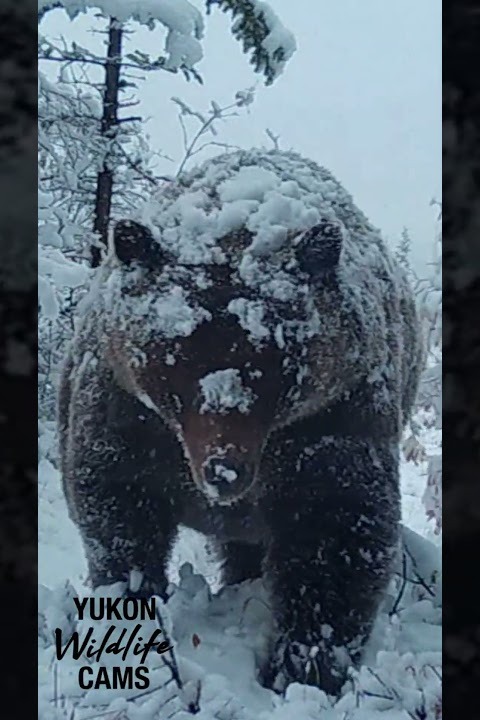 Snow-caked grizzly walks right up to the lens
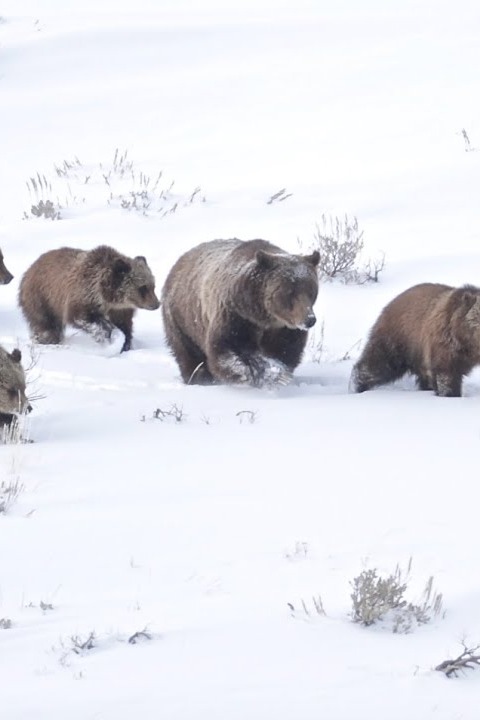 Grizzly 399 walks four cubs toward the den
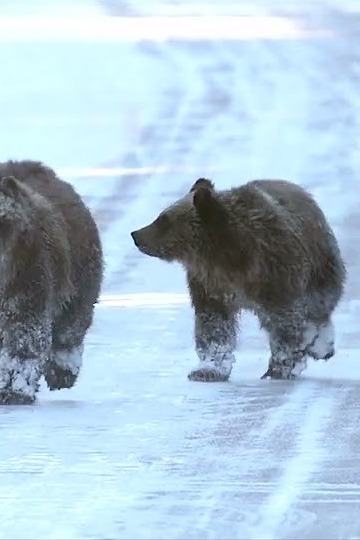 Grizzly 399 and four cubs take a snowy road
A snow-caked grizzly walks head-on at a Yukon camera after an early-season snowfall, white heaped on its brow, back and muzzle.
Grizzly bear 399 plows through a snowfield in the Grand Teton and Yellowstone country with all four of her cubs, headed north to the winter den.
Grizzly 399 leads her four cubs down a snow-packed road in Grand Teton on December 31, 2020, straight toward a truck's bumper camera.
Sources
- Bear Ecology, National Park Service (Yellowstone National Park)
- Grizzly Bear (Ursus arctos horribilis), U.S. Fish & Wildlife Service
- Brown/Grizzly Bear Species Profile, Alaska Department of Fish and Game
- Ursus arctos (brown bear), Animal Diversity Web, University of Michigan
- Ursus arctos, Brown Bear, NatureServe Explorer
- Staying Safe Around Bears, National Park Service