Bobcat field guide
Field Guide
| Common name | Bobcat |
|---|---|
| Scientific name | Lynx rufus |
| Family | Felidae (cats) |
| Size | 65 to 105 cm long, tail adding 11 to 19 cm; 45 to 58 cm high at the shoulderAnimal Diversity Web, University of Michigan |
| Weight | 4 to 15 kg (8.81 to 33.04 lb); adult males in Washington weigh 20 to 30 poundsAnimal Diversity Web, University of Michigan · Washington Department of Fish & Wildlife |
| Lifespan | Most bobcats live between five and 15 years in the wild; median about 18 years in human careSmithsonian's National Zoo and Conservation Biology Institute |
| Diet | Strictly meat eaters; mostly rabbits and hares, also rodents, small deer, birds, snakes and lizardsAnimal Diversity Web, University of Michigan · Smithsonian's National Zoo and Conservation Biology Institute |
| Active when | May be active at all hours, but studies consistently find them crepuscular (most active at dawn and dusk)Smithsonian's National Zoo and Conservation Biology Institute |
| Range | Throughout North America from southern Canada to southern MexicoAnimal Diversity Web, University of Michigan |
| Conservation status | IUCN Red List: Least Concern; NatureServe global rank G5; CITES Appendix IIAnimal Diversity Web, University of Michigan · NatureServe Explorer |
Field Marks
- Buff to brown fur, sometimes with a reddish tinge, marked with spots or stripes of brown and black; lighter undersides.Smithsonian's National Zoo and Conservation Biology Institute
- Short ("bobbed") tail; the tip of the tail and the backs of the ears are black.Missouri Department of Conservation · Animal Diversity Web, University of Michigan
- Backs of the ears are marked with white spots; the underside of the bobbed tail is white.Smithsonian's National Zoo and Conservation Biology Institute
- Short ear tufts and ruffs of hair on the side of the head, giving the appearance of sideburns.Animal Diversity Web, University of Michigan
- Bobcat vs lynx: other lynx have plain, brown-gray coats, longer ear tufts, longer legs and fur-covered footpads; the bobcat's footpads are bare and its coat black-spotted.Smithsonian's National Zoo and Conservation Biology Institute
- Tracks: round, four toes, no claws evident, generally twice the size of a domestic cat's print; young bobcat tracks are easily confused with housecats'.Washington Department of Fish & Wildlife · Missouri Department of Conservation
Habitat
- Lives in a variety of habitats, including forests, semi-deserts, mountains, and brushland.Animal Diversity Web, University of Michigan
- Ranges from boreal coniferous and mixed forests in the north to bottomland hardwood forests and coastal swamps in the southeast and desert and scrublands in the southwest.Smithsonian's National Zoo and Conservation Biology Institute
- Sleeps in hidden dens, often in hollow trees, thickets, or rocky crevices.Animal Diversity Web, University of Michigan
- Rock cliffs, outcroppings and ledges are important for shelter, raising young and resting; brush or log piles and hollow trees or logs are used in wooded areas.Washington Department of Fish & Wildlife
- Found in open fields, meadows and agricultural areas when enough brushy or timbered escape cover is nearby.Washington Department of Fish & Wildlife
- In the southeastern United States, bobcats are becoming increasingly habituated to urban and suburban settings, though they are unlikely to be seen.Animal Diversity Web, University of Michigan
Behavior
- Solitary; males and females interact almost exclusively during the mating season.Animal Diversity Web, University of Michigan
- Stalks prey, then pounces and (if successful) kills with a bite to the vertebrae of the neck.Animal Diversity Web, University of Michigan
- Often travels 2 to 7 miles (3 to 11 kilometers) in an evening while hunting and patrolling its territory.Smithsonian's National Zoo and Conservation Biology Institute
- Places its back feet in the same spots where its front feet stepped, to reduce noise when hunting.Smithsonian's National Zoo and Conservation Biology Institute
- Excellent climber; can run up to 30 miles per hour (48 kilometers per hour).Smithsonian's National Zoo and Conservation Biology Institute
- Travels in predictable patterns along logging roads, railways and trails made by other animals, between resting areas, food sources and hunting areas.Washington Department of Fish & Wildlife
- In areas occupied by humans, typically limits activity to night hours; in dim light bobcats see up to six times better than humans.Washington Department of Fish & Wildlife
- Covers the remains of a large carcass and frequently returns to feed, reaching out only 15 inches to rake up debris.Washington Department of Fish & Wildlife
- Marks territory with urine, feces in latrine sites, anal gland secretions, ground scrapes, and claw marks normally 2 to 3 feet up trees.Smithsonian's National Zoo and Conservation Biology Institute · Washington Department of Fish & Wildlife
- Rarely mews like a domestic cat but will chortle and make birdlike chirps; mating-season calls resemble a screaming alley cat.Smithsonian's National Zoo and Conservation Biology Institute
- Mating season is primarily in winter, though mating can take place from November through August.Smithsonian's National Zoo and Conservation Biology Institute
- Male home range overlaps several females' and may overlap another male's; female home ranges do not overlap one another.Animal Diversity Web, University of Michigan
- Western Washington home ranges are 2.5 to six square miles for adult males, about half that for adult females.Washington Department of Fish & Wildlife
Winter
- Bobcats occur less frequently in areas of deep winter snow.Washington Department of Fish & Wildlife
- Unlike lynx, bobcats have relatively small feet, and snow greatly reduces their mobility and ability to catch prey.Washington Department of Fish & Wildlife
- Lynx footpads are densely furred and their legs longer for deep snow, where the bobcat, with bare footpads, is at a disadvantage.Smithsonian's National Zoo and Conservation Biology Institute
- Evidence of a bobcat includes tracks in snow or mud; droppings are generally covered with loose soil, snow or leaves.Washington Department of Fish & Wildlife
Questions
How big is a bobcat?
Bobcats weigh between 9 and 33 pounds (4 and 15 kilograms) and stand 1.5-2 feet tall at the shoulder. Larger animals are found in the north and smaller ones in the south.Smithsonian's National Zoo and Conservation Biology Institute
Is it a bobcat or a lynx?
Other lynx have plain brown-gray coats, longer ear tufts, longer legs and furred footpads. The bobcat has a black-spotted brown coat, bare footpads and lives in warmer, lower latitudes.Smithsonian's National Zoo and Conservation Biology Institute
What does a bobcat eat?
Bobcats mostly eat rabbits and hares. They may also eat squirrels, mice, small deer, snakes, lizards and domestic animals such as cats and poultry.Smithsonian's National Zoo and Conservation Biology Institute
Are bobcats dangerous to people?
On rare occasions humans are attacked by bobcats. Because of their elusive nature and caution around humans, they are seldom seen.Animal Diversity Web, University of Michigan · Washington Department of Fish & Wildlife
Will a bobcat take my pets or chickens?
Bobcats are not often responsible for killing domestic animals, but occasionally take poultry, lambs, small goats, pigs and house cats, and have attacked cocker-spaniel-size dogs. Washington's wildlife agency advises keeping dogs and cats indoors, especially from dusk to dawn, and enclosing poultry in a secure pen and house.Washington Department of Fish & Wildlife
Where does a bobcat sleep?
Bobcats sleep in hidden dens, often in hollow trees, thickets, or rocky crevices. Rock ledges, brush piles and hollow logs are also used.Animal Diversity Web, University of Michigan · Washington Department of Fish & Wildlife
What time of day are bobcats active?
Bobcats may be active at any hour, but studies have consistently found them crepuscular (most active at dawn and dusk). In areas occupied by humans they typically limit activity to night hours; in undisturbed areas they can be active at dawn or dusk if prey is active then. They travel in predictable patterns along logging roads, railways and trails made by other animals.Smithsonian's National Zoo and Conservation Biology Institute · Washington Department of Fish & Wildlife
What sounds does a bobcat make?
Bobcats rarely vocalize but often yowl and hiss during the mating season. Those wails have been likened to a child crying or a woman's scream.Washington Department of Fish & Wildlife
When are bobcat kittens born?
Kittens are typically born in the spring after a gestation of about 60-70 days (average 62). The Smithsonian gives usually two to four kittens per litter; Animal Diversity Web gives a litter of about 3, and the Missouri Department of Conservation usually 2 or 3. Kittens travel with their mother for three to five months before separating from her for the winter mating season.Smithsonian's National Zoo and Conservation Biology Institute · Animal Diversity Web, University of Michigan · Missouri Department of Conservation
Why is it called a bobcat?
Bobcats got their name because of their short tails. The tail adds only 11 to 19 cm to the body length.Animal Diversity Web, University of Michigan
Clips
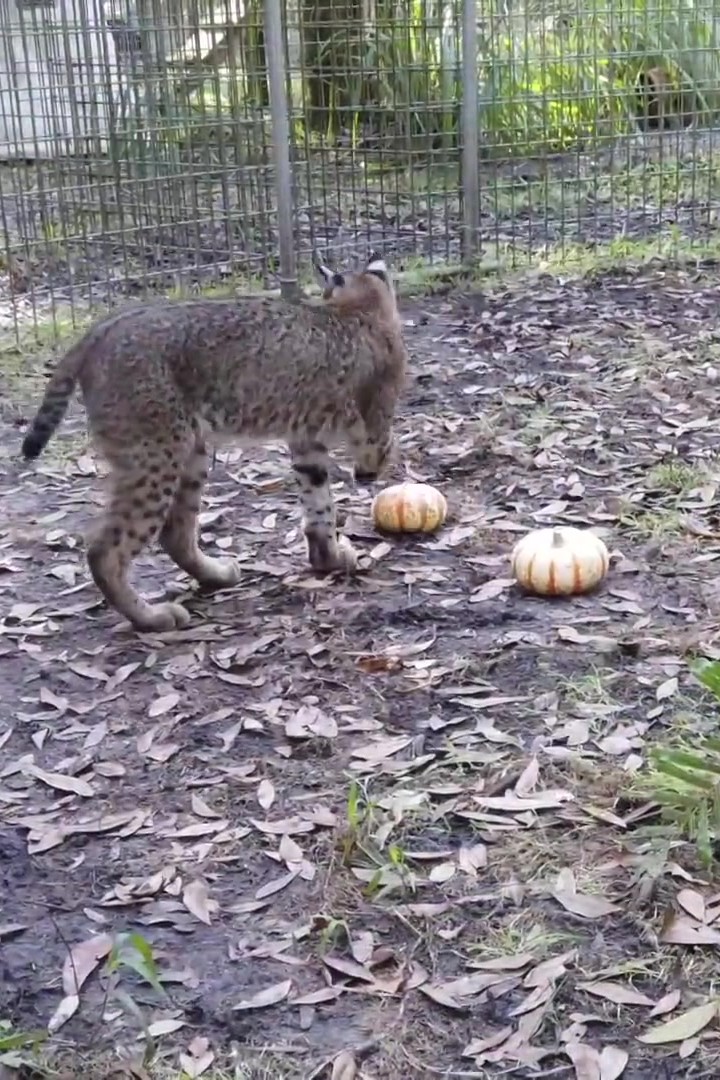
Flint, a bobcat with deformed bones and a collapsed pelvic canal, sprawls belly-up with a paper bag at the Tampa sanctuary that now keeps him for good.
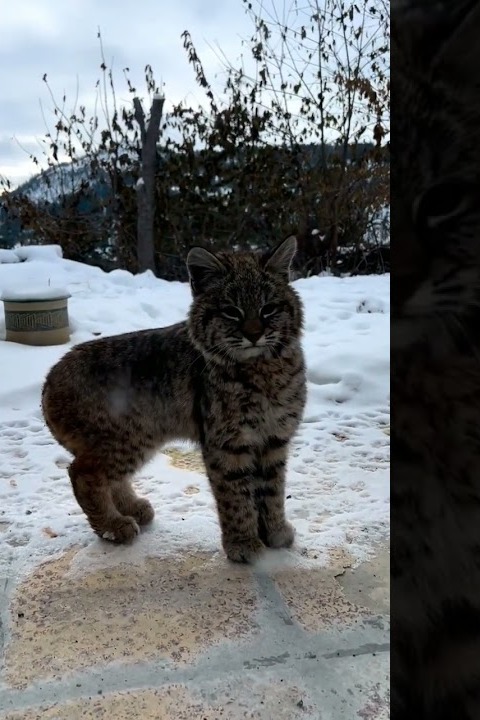
A young, fluffy bobcat crosses a snowy yard in daylight and stops to stare at the people behind a house window.
Sources
- Lynx rufus (bobcat), Animal Diversity Web, University of Michigan
- Bobcat | Field Guide, Missouri Department of Conservation
- Bobcat, Smithsonian's National Zoo and Conservation Biology Institute
- Bobcat (Lynx rufus), Washington Department of Fish & Wildlife
- Lynx rufus, NatureServe Explorer