Cougar field guide
Field Guide
| Common name | Cougar |
|---|---|
| Scientific name | Puma concolor |
| Family | Felidae (cats) |
| Size | Males 7-8 ft long nose to tail tip, up to 30 in at the shoulder; females 5-7 ft; tail about one-third of total lengthCalifornia Department of Fish and Wildlife · Animal Diversity Web, University of Michigan |
| Weight | Washington adult males average about 140 lb, rarely 180 lb; females rarely exceed 110 lbWashington Department of Fish and Wildlife |
| Lifespan | About 10-13 years (NPS); up to 18 to 20 years in the wild (ADW)National Park Service · Animal Diversity Web, University of Michigan |
| Diet | Carnivore; deer are the preferred and most common prey, plus elk, moose, mountain goats and wild sheep; other prey, especially for younger cougars, includes raccoons, coyotes and rabbitsWashington Department of Fish and Wildlife · Animal Diversity Web, University of Michigan |
| Active when | Most active dusk to dawn, but may hunt at any time of dayWashington Department of Fish and Wildlife |
| Range | Canada south to South America, now mainly in mountainous, relatively unpopulated areas; eastern North American populations exterminated except Florida panthers; wanderers confirmed in MissouriNatureServe Explorer · Animal Diversity Web, University of Michigan · Missouri Department of Conservation |
| Conservation status | IUCN Red List: Least Concern; NatureServe global rank G5; Florida panther (P. c. coryi) listed Endangered by USFWS under the US Endangered Species ActAnimal Diversity Web, University of Michigan · NatureServe Explorer |
Field Marks
- Unspotted tan-brown coat with a whitish throat, belly and inner legs; backs of the ears and tail tip are black.National Park Service
- Long, heavy, cylindrical tail; the last two to three inches are black.Missouri Department of Conservation
- Bobcats are much smaller, with short bobbed tails and spotted, streaked coats; cougars are uniform in color.California Department of Fish and Wildlife · Missouri Department of Conservation
- Sides of the muzzle are black; chin and throat are white; nose is pinkish with a black border.Missouri Department of Conservation · Animal Diversity Web, University of Michigan
- Kittens are spotted until 4-5 months old; barring may remain up to 14 months of age.Washington Department of Fish and Wildlife
- Claw marks are rarely visible in tracks because claws are kept retracted most of the time; in snow the tail may leave drag marks between prints.Washington Department of Fish and Wildlife
Habitat
- Uses steep canyons, rock outcroppings, boulders, dense brush and forests to stay hidden while hunting.Washington Department of Fish and Wildlife
- Habitats range from montane coniferous forest to grassland, dry brush country and swamps, wherever there is cover and prey.Animal Diversity Web, University of Michigan
- Shelters in rocky crevices, hollow trees or logs, holes in banks, or tall grass and underbrush; it has no special home.Missouri Department of Conservation
- In rough terrain daybeds are usually in a cave or a nook on a cliff face; in less mountainous areas, in forest, thickets, or under large roots or fallen trees. They are frequently near kill sites.Washington Department of Fish and Wildlife
- Cougars do not use dens like bears; a mother may stay put up to six weeks while kittens are immobile.Washington Department of Fish and Wildlife
- Around 40% of California is considered suitable mountain lion habitat.California Department of Fish and Wildlife
- In the Santa Monica Mountains, more than 250,000 GPS locations show mountain lions prefer natural areas and attempt to avoid contact with humans; typical home ranges there are about 150 sq mi (adult males) and 50 sq mi (adult females).National Park Service
Behavior
- Solitary and elusive; a group seen together is not a pack, but often a mother with her offspring.California Department of Fish and Wildlife
- Adult male home ranges in Washington cover 50 to 150 square miles and often overlap three or four females.Washington Department of Fish and Wildlife
- Males have territories up to 500 square miles that can overlap several females, and defend them from other males; female territories reach up to 300 square miles.California Department of Fish and Wildlife
- Marks territory with claw marks on trees, stumps and occasionally fence posts, 4 to 8 feet up for an adult, and with mounds scented with urine.Washington Department of Fish and Wildlife · National Park Service
- Ambush hunter: stalks under cover to 30 feet or less, then leaps onto the prey's back with a neck bite.National Park Service
- A large Cascade male kills a deer or elk every 9 to 12 days, eating up to 20 pounds at a time.Washington Department of Fish and Wildlife
- Usually drags kills to a secluded spot under cover, often covers the remains with snow, grass, leaves, sticks or soil, then returns to feed.Washington Department of Fish and Wildlife · California Department of Fish and Wildlife
- May guard a cached kill against scavengers and feed on it over six to eight days.Washington Department of Fish and Wildlife
- Can travel as much as 15 miles in a single night between places its prey frequents.Washington Department of Fish and Wildlife
- Hisses, purrs, mews, growls, yowls, chirps and cries; it cannot roar.Washington Department of Fish and Wildlife · California Department of Fish and Wildlife
- Eerie night wails heard in mating season have been likened to a woman's scream or a child crying.Washington Department of Fish and Wildlife
- Young call their mother with loud, chirping whistles.Animal Diversity Web, University of Michigan
- Mating occurs year-round but in northern areas concentrates December to March; gestation is 82 to 96 days.Animal Diversity Web, University of Michigan
- Litters are 2-4 kittens; kittens stay with their mother for 18-24 months.California Department of Fish and Wildlife
- Can leap as high as 18 feet vertically and cover 40 feet horizontally in one bound.National Park Service
- In the Santa Monica Mountains, 87% of more than 700 analyzed kills were mule deer; mountain lions typically eat about one deer per week.National Park Service
Winter
- A kill may be covered with snow, or with dirt, grass, leaves or sticks, to hide it from scavengers.Washington Department of Fish and Wildlife · California Department of Fish and Wildlife
- In some areas cougars have summer and winter home ranges and migrate between them.Animal Diversity Web, University of Michigan
- In Rocky Mountain National Park, territories shift with the seasonal migration of elk and deer herds.National Park Service
- Tracks are soft and may be virtually invisible on crusted snow; the heavy tail, carried in a wide U at a walk, may leave drag marks between prints in snow.Washington Department of Fish and Wildlife
Questions
How big is a cougar?
Adult males measure 7-8 feet from nose to tail tip and stand up to 30 inches at the shoulder. Washington males average about 140 pounds, and females rarely exceed 110 pounds.Washington Department of Fish and Wildlife · California Department of Fish and Wildlife
Are cougars dangerous to people?
Attacks are rare: Washington records two fatal attacks in the last 100 years and California six since 1890. Most attacks have been by young lions forced to hunt on their own and not yet living in established areas.Washington Department of Fish and Wildlife · California Department of Fish and Wildlife · National Park Service
What should I do if I meet a cougar?
Stop, pick up small children, do not run, face it and appear larger while backing away. If it attacks, fight back and try to stay on your feet.Washington Department of Fish and Wildlife
Is that a woman screaming at night?
It may be a cougar: their mating-season wails have been likened to a woman's scream. Cougars also hiss, growl, chirp and purr, but cannot roar.Washington Department of Fish and Wildlife · California Department of Fish and Wildlife
What does a cougar eat?
Deer are the preferred and most common prey, plus elk, moose, mountain goats and wild sheep. Other prey, especially for younger cougars, includes raccoons, coyotes, rabbits and occasionally pets and livestock.Washington Department of Fish and Wildlife
Why does a cougar bury its kill?
It often covers the carcass with snow, grass, leaves, sticks or soil; covering hides it from scavengers. It may stay near the kill and feed on it over six to eight days, so never linger near a covered carcass.Washington Department of Fish and Wildlife · California Department of Fish and Wildlife
Where does a cougar sleep?
It uses daybeds rather than dens, in caves, cliff nooks, thickets or under fallen trees. Daybeds are often near kill sites.Washington Department of Fish and Wildlife
Do cougars live in groups?
No, they are solitary except for mothers with kittens and brief pairings during mating. Kittens stay with their mother for 18-24 months.California Department of Fish and Wildlife · Animal Diversity Web, University of Michigan
Why are cougars caught on trail cameras far from known populations?
Young males typically leave their birth areas and often wander hundreds of miles seeking territory. Missouri has confirmed an average of 8 a year since the mid-2000s, using photos, videos, tracks, hair and scat as evidence.Missouri Department of Conservation
Is it a cougar or a bobcat on my camera?
A cougar has a long tail about one-third of its length and a uniform coat. A bobcat is much smaller with a short bobbed tail and a spotted coat.California Department of Fish and Wildlife · Animal Diversity Web, University of Michigan · Missouri Department of Conservation
Clips
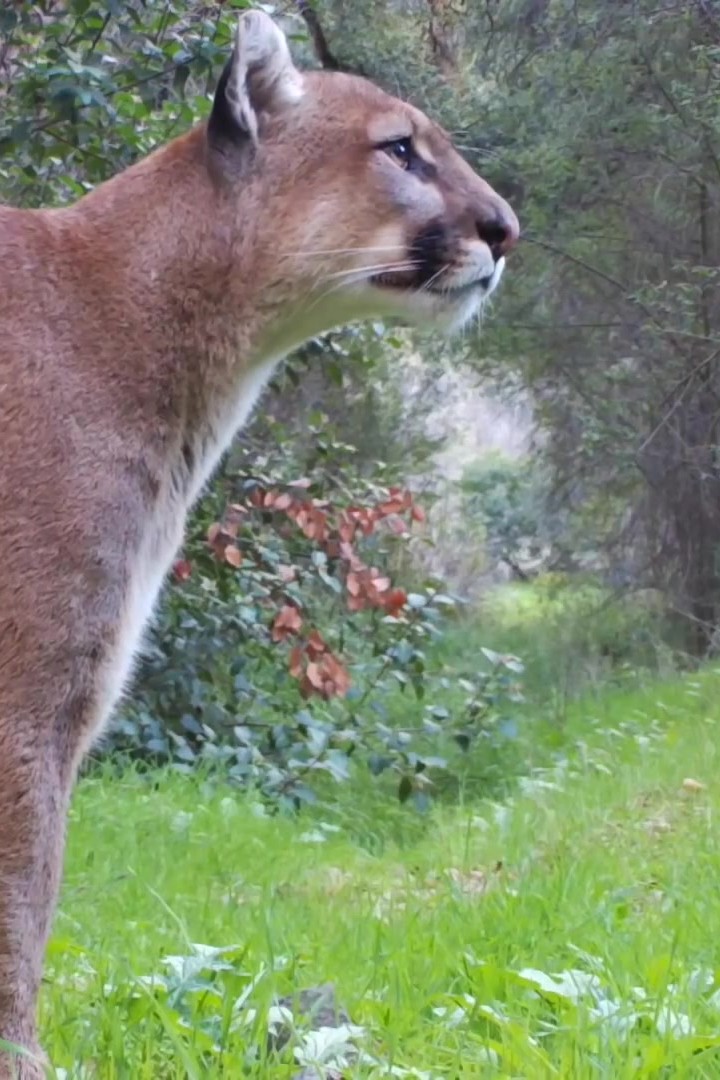 Five hours behind another male, a puma screams
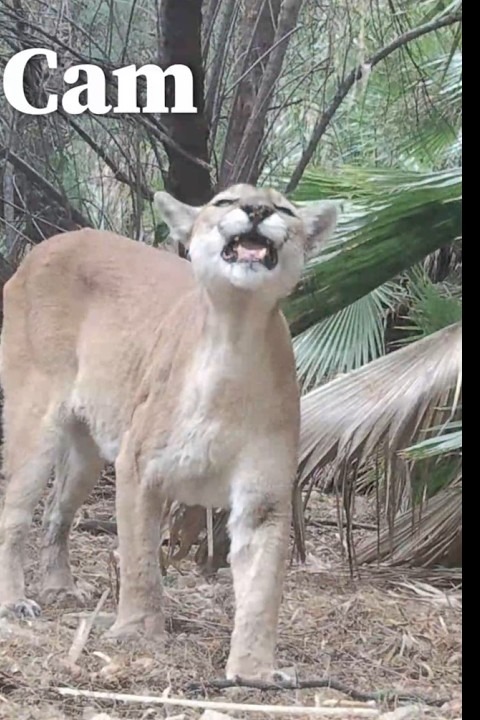 Mountain lion curls its lip at a scent mark
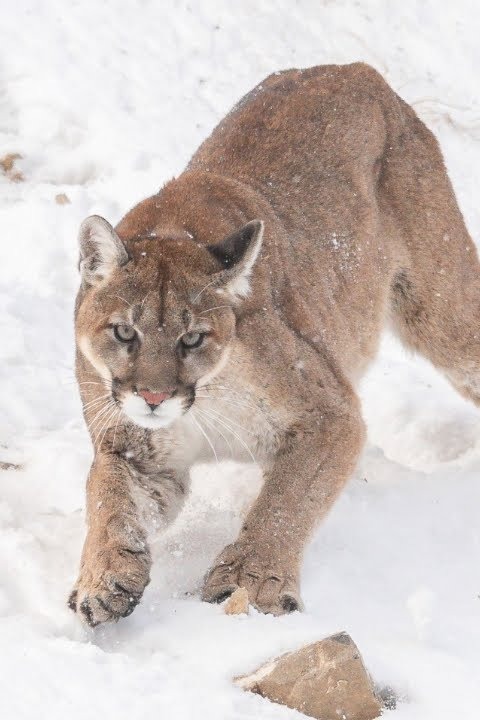 Cougar charges downhill to guard its kill
A male cougar screams in a green canyon in the Angeles National Forest, twenty minutes before another male returns to the same spot.
A mountain lion near Tucson, Arizona, tips its head back in the flehmen response at a spot where another lion had urinated.
In the town of Jackson, Wyoming, a cougar charges down a snowy slope three times in one afternoon to chase birds off a kill it had not yet buried.
Sources
- Cougar (Puma concolor), Washington Department of Fish and Wildlife
- Mountain Lion, California Department of Fish and Wildlife
- Puma concolor (cougar), Animal Diversity Web, University of Michigan
- Mountain Lion - Rocky Mountain National Park, National Park Service
- Mountain Lions - Santa Monica Mountains National Recreation Area, National Park Service
- Mountain Lion - Field Guide, Missouri Department of Conservation
- Puma concolor - Cougar, NatureServe Explorer